
Aircraft Powerplant Technician Associate's Degree at AIM-Atlanta
The Aircraft Powerplant Technology/Technician Associate's degree, usually 2 years In-person at Aviation Institute of Maintenance-Atlanta, leads to FAA A&P certification and steady aviation careers.

By Jeffrey Hartford
Every time a jetliner climbs out of Hartsfield-Jackson Atlanta International Airport, a powerplant technician has signed off on the engines that make that climb possible. If you have ever watched a turbofan spool up and wondered who keeps those machines running safely, the answer is a small, highly trained workforce of aviation maintenance professionals. One of the most direct routes into that workforce is the Aircraft Powerplant Technology/Technician Associate's degree, usually 2 years In-person at Aviation Institute of Maintenance-Atlanta, a program built around the airframe and powerplant (A&P) certification that the FAA requires before you can legally return an engine or aircraft to service.
This guide breaks down what that associate's degree actually contains, who it suits, how the Atlanta campus experience differs from online options, what it costs, and how graduates move into jobs with airlines, MROs (maintenance, repair, and overhaul providers), and corporate flight departments. If you are comparing two-year technical programs against four-year degrees, you will also find realistic earning and ROI context so you can judge whether this path fits your goals.
What an Aircraft Powerplant Technician Program Actually Teaches
The word "powerplant" is narrower than it sounds. In FAA terms, a powerplant rating covers reciprocating engines, turboprop and turboshaft engines, turbofan and turbojet engines, propellers, engine fuel and ignition systems, lubrication, cooling, exhaust, and the electrical systems tied to engine operation. An associate's program that carries the powerplant designation, especially one embedded in a broader aviation maintenance curriculum, typically prepares students for both the powerplant rating and the airframe rating so they can test for the combined A&P certificate.
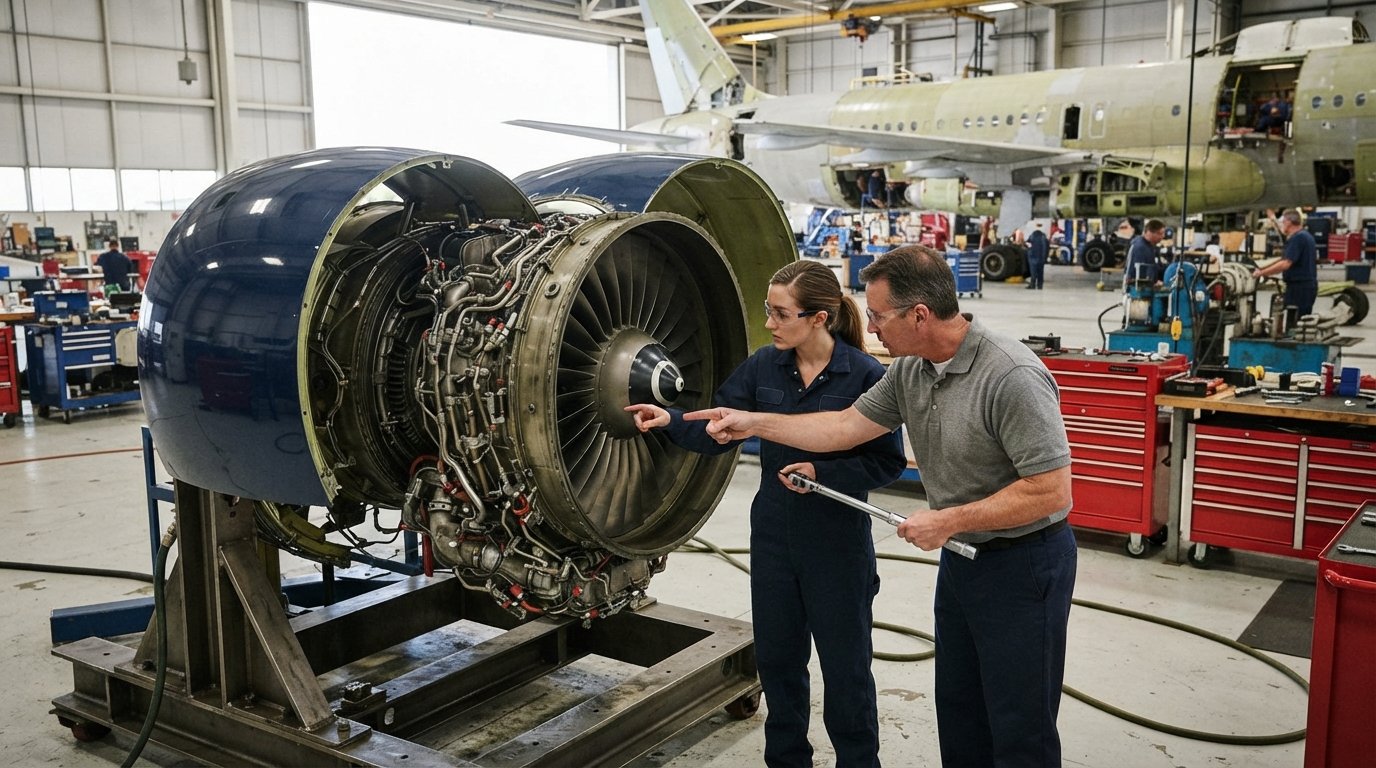
At a campus like Aviation Institute of Maintenance-Atlanta, coursework blends classroom theory with substantial hands-on lab time. Students disassemble and reassemble engines, inspect turbine blades, troubleshoot fuel metering systems, practice run-up procedures, and learn the documentation discipline that FAA regulations demand. You cannot earn a powerplant rating by watching videos alone, which is why the in-person format matters: the practical hours are the credential.
Typical topic areas in a two-year powerplant-focused associate's program include:
- Reciprocating and turbine engine theory, overhaul, and inspection procedures
- Engine fuel, ignition, lubrication, cooling, and exhaust systems
- Propeller theory, installation, and balancing
- Electrical and instrument systems related to powerplants
- FAA regulations, weight and balance, and maintenance recordkeeping
- Airframe structures, hydraulics, and systems (for students pursuing the full A&P)
Because the FAA requires a minimum number of instructional hours in specific subject areas before you can sit for the written, oral, and practical exams, the program's structure is less flexible than a typical liberal arts associate's degree. That rigidity is a feature, not a bug: it keeps you on a clock that maps directly to certification eligibility.
Why the In-Person Format at Aviation Institute of Maintenance-Atlanta Matters
Aviation maintenance is one of the few fields where online learning genuinely cannot substitute for the real thing. You need to torque bolts to spec, read a micrometer, interpret an engine manual, and feel the difference between a healthy bearing and a failing one. The Atlanta campus format exists because the FAA practical exam tests exactly those physical competencies, and employers interview for them.
Location is a practical advantage too. Atlanta is home to the world's busiest airport and a dense cluster of aviation employers, including major airline maintenance bases, regional carriers, cargo operators, and independent repair stations. Students at an Atlanta campus can often arrange part-time work or internships near the airport while enrolled, which builds both hours and references before graduation. That proximity is hard to replicate in a purely online program or in a city without a major aviation hub.
There is also a scheduling consideration. In-person programs typically run on structured daytime or evening cohorts, so you should plan your work and family commitments around a fixed class calendar. The trade-off is worth naming plainly: you give up flexibility, but you gain the lab hours, instructor access, and local employer connections that make the credential employable.
Admission Requirements and What to Expect Before You Enroll
Admission to an aviation maintenance associate's program is generally more accessible than admission to a four-year engineering school, but it is not automatic. Schools typically look for a high school diploma or equivalent, basic math and reading competency, and a clear understanding of the physical and regulatory demands of the field. Some programs require a campus visit or admissions interview before enrollment.
Before you commit, expect to complete the following steps:
- Confirm the program's FAA approval status and that graduates are eligible to test for the powerplant and airframe ratings.
- Review the total cost of attendance, including tools, uniforms, and testing fees, not just tuition.
- Ask about cohort start dates, completion rates, and job placement support for recent graduates.
- Visit the campus and inspect the labs, engine stands, and avionics equipment you will actually use.
- Speak with a financial aid advisor about grants, loans, and scholarship options before signing anything.
That last point deserves emphasis. Aviation maintenance programs cost more than many two-year degrees because of the equipment and lab hours involved, so understanding the full financial picture up front prevents unpleasant surprises later. Resources that explain how to compare college costs and financial aid options can help you model the total investment before you enroll.
Cost, Financial Aid, and Return on Investment
Tuition for an aviation maintenance associate's degree varies by institution and by state, and the Atlanta campus may have different pricing than other locations in the same network. Beyond tuition, budget for tools (often several hundred to over a thousand dollars), FAA written and practical exam fees, and possibly housing or transportation if you commute. Financial aid in the form of federal grants, loans, and institutional scholarships is commonly available for eligible students, and veterans may have access to GI Bill benefits.
The return on investment question is fair to ask. Powerplant technicians earn solid middle-class wages, and entry-level pay at regional carriers and repair stations has risen in recent years as the industry faces a well-publicized mechanic shortage. Experienced A&P technicians at major airlines and cargo carriers can earn substantially more, particularly with type-specific training and shift differentials. Compared with a four-year degree that requires two additional years of tuition and forgone wages, a two-year powerplant program can reach positive ROI faster, though ceiling earnings depend on how far you advance into inspection, supervision, or specialized engine work.
If you want broader salary context across two-year credentials, our breakdown of top paying associate degrees for 2026 shows where aviation maintenance sits relative to other technical fields. For a fuller picture of how tuition, aid, and total cost of attendance interact, CollegeAndTuition publishes planning resources aimed at U.S. students and families comparing higher education costs.
Career Outcomes: Where Powerplant Technicians Work
Graduates with a powerplant credential and A&P certificate move into a surprisingly wide range of employers. The most visible are the major airlines, which operate large maintenance bases and hire continuously as their workforce retires. But cargo carriers, regional airlines, corporate flight departments, helicopter operators, and independent MROs all compete for the same talent pool, which gives technicians leverage when negotiating shifts and pay.
Common job titles and settings include:
- Airline powerplant technician or engine shop specialist
- Line maintenance technician at an airport
- Heavy maintenance and overhaul technician at an MRO
- Corporate or private jet maintenance technician
- Aviation inspector or quality assurance technician (with experience)
Career progression usually runs from apprentice or entry technician to certificated A&P technician, then into lead, inspector, or supervisor roles. Some technicians pursue additional type ratings for specific engines or airframes, which can increase pay and open doors to engine manufacturer facilities. Others move into training, regulatory compliance, or maintenance management after several years on the floor.
How This Program Compares With Other Pathways
The most common alternative to an associate's degree is a certificate program at a Part 147 school, which can get you to the A&P exams faster but may offer less general education and fewer transfer options. A four-year aviation or engineering degree opens management and design roles but takes longer and costs more. The associate's degree sits in a useful middle: long enough to include general education and broad systems coursework, short enough to enter the workforce in about two years.
If you are weighing multiple two-year options, compare them on three axes: FAA approval and exam pass rates, hands-on lab hours, and local employer relationships. A program with strong Atlanta-area placement support can matter more than a marginally lower tuition figure elsewhere. Prospective students who want to explore related degree paths before committing can use school-matching tools to compare programs by location and field, keeping in mind that featured listings may be sponsored.
Is the Powerplant Technician Path Right for You?
This career rewards people who like diagnosing problems, working with their hands, and following procedures precisely. It is less suited to anyone who wants a desk-based, remote-friendly role or who dislikes shift work, since line maintenance often runs nights and weekends. The physical demands are real, and the regulatory responsibility is serious: your signature on a maintenance record carries legal weight.
For the right person, though, the combination of a two-year credential, a nationally recognized certificate, and steady demand makes the Aircraft Powerplant Technology/Technician Associate's degree, usually 2 years In-person at Aviation Institute of Maintenance-Atlanta a practical and well-defined investment. The field rewards precision, curiosity, and reliability, and it offers a clear ladder from entry technician to specialist and supervisor roles.
Before you enroll, visit the campus, talk to current students and instructors, confirm the program's FAA status, and model the full cost against realistic starting wages in your area. If the numbers and the work itself fit, a powerplant technician career can be one of the more dependable two-year pathways in technical education today.