
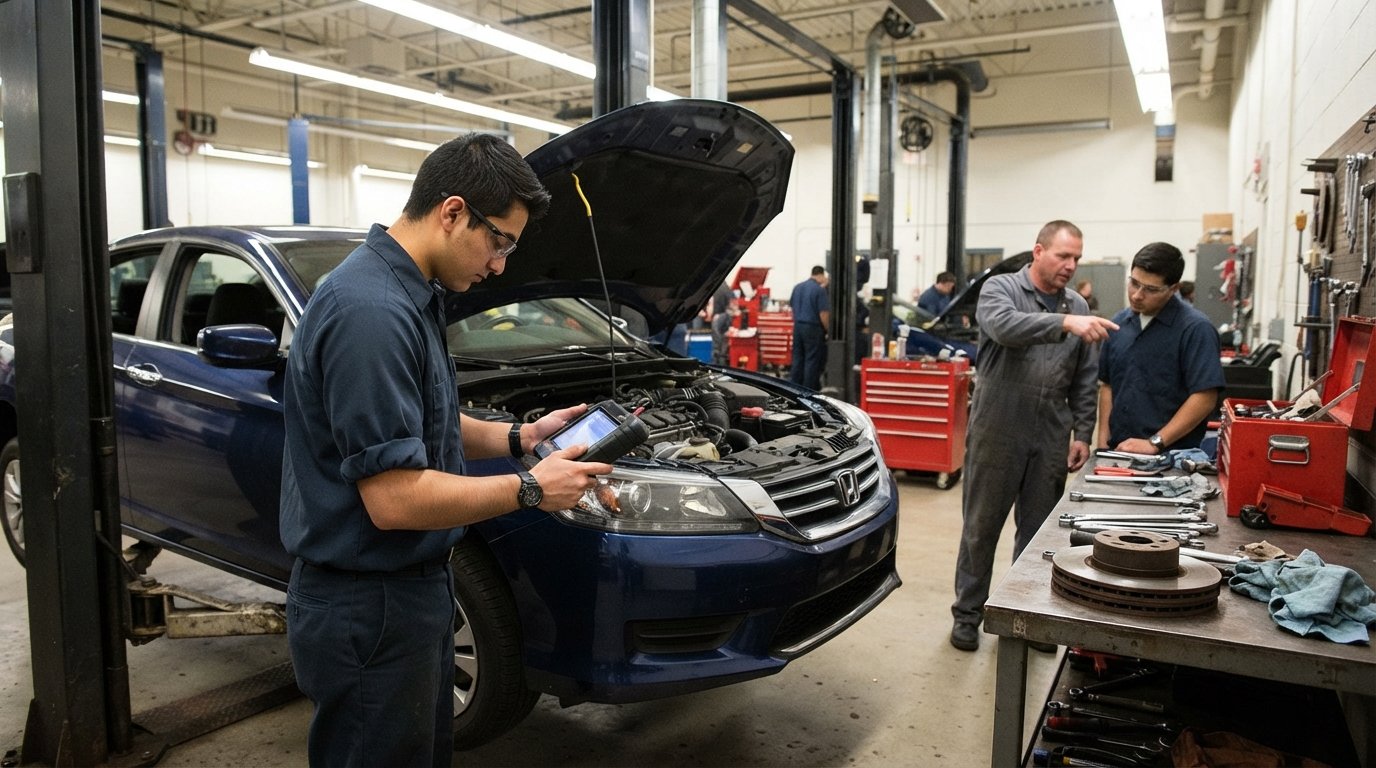
Auto Mechanics Certificate at East Mississippi CC
The automotive mechanics certificate at East Mississippi Community College takes 1 to 2 years, meets in person, and prepares you for entry-level technician jobs.

If you want to turn a fascination with engines into a paycheck without spending four years in a classroom, the Automobile/Automotive Mechanics Technology/Technician Certificate, 1 year to less than 2 years In-person at East Mississippi Community College offers one of the fastest, most hands-on routes into the trade. This program is built for people who learn by doing: you will spend your weeks diagnosing real vehicles, wrenching on brake systems, and tracing electrical faults under the guidance of instructors who have worked in the field. And because it is a certificate rather than a degree, you can finish in roughly 12 to 18 months and start earning sooner.
What makes this particular program worth a closer look is the combination of length, format, and location. East Mississippi Community College (EMCC) has a long history of workforce training, and its automotive program is designed around the tasks entry-level technicians actually perform on the job. You are not sitting through abstract lectures about thermodynamics; you are pulling codes from a scan tool, measuring brake rotors, and learning how to explain a repair to a customer. That practical focus is exactly what independent shops, dealership service departments, and fleet operations say they need when they hire.
This article walks through what the certificate covers, how long it takes, what it costs, what you can earn afterward, and how to decide whether this in-person path at EMCC fits your goals. Whether you are a recent high school graduate, a career changer tired of desk work, or a parent helping a young adult find a trade with real upward mobility, the details below will help you compare this option against other training routes.
What the Automotive Mechanics Technology Certificate Covers
The Automobile/Automotive Mechanics Technology/Technician Certificate, 1 year to less than 2 years In-person at East Mississippi Community College is structured as a stackable credential. That means the courses you take count toward the certificate first, and if you later decide to pursue an associate degree in automotive technology, much of that coursework can carry over. The curriculum is organized around the major systems of a modern vehicle, and each course blends classroom instruction with substantial lab time in a shop setting.
Core topics typically include engine repair and rebuilding, automatic and manual transmissions, brake systems, steering and suspension, electrical and electronic systems, heating and air conditioning, and engine performance. Because today's vehicles are computers on wheels, you will also spend meaningful time on diagnostics: reading wiring diagrams, using multimeters, interpreting scan tool data, and following logical troubleshooting steps instead of guessing. Instructors generally emphasize safety, tool care, and shop professionalism from day one, since those habits are what separate a technician who gets promoted from one who stalls out.
Here is a closer look at the kinds of skills you can expect to build during the program:
- Diagnostic reasoning: learning to move from symptom to root cause using scan tools, meters, and service information.
- Hands-on repair: performing brake jobs, suspension work, fluid services, and engine repairs on training vehicles.
- Electrical fundamentals: understanding circuits, batteries, starting and charging systems, and the networked modules that control modern cars.
- Shop professionalism: documenting work, communicating with customers, and following safety and environmental rules.
What you will not get from a short certificate is the full depth of an engineering degree, and that is fine. The goal here is employability at the entry level, not design work. Most graduates step into technician or apprentice roles and continue learning on the job, often earning manufacturer-specific certifications as they go. If you want a broader academic foundation, you can continue into an associate program after finishing the certificate.
How Long It Takes and What the In-Person Format Means
The program is explicitly designed to be completed in 1 year to less than 2 years, which puts it in the sweet spot between a quick vocational course and a full degree. In practice, students who attend full time and pass their courses can finish in about three or four semesters, depending on how the college sequences its automotive classes and whether you need any developmental coursework first. Part-time students and working adults often stretch the timeline, but the total number of credits remains the same.
The in-person requirement is not a formality. Automotive work is physical, tactile, and equipment-dependent, and you cannot learn to diagnose a parasitic battery draw by watching a video. At EMCC you will have access to lifts, diagnostic tools, training vehicles, and instructors who can watch you work and correct your technique in real time. That feedback loop is difficult to replicate online, and it is one reason employers tend to trust hands-on certificate programs more than purely theoretical ones.
Expect a schedule that mixes morning or afternoon blocks with lab sessions that may run longer than a standard class period. Many automotive programs also build in an internship or cooperative work experience, which gives you a foot in the door with a local shop before you graduate. If you are balancing a job, ask an advisor early about evening options and whether the program can be completed on a part-time basis. The admissions office can also tell you which semesters specific courses are offered, since not every class runs every term.
Admission Requirements and How to Enroll
Community college certificate programs are generally open-access, which means you do not need a competitive GPA or a portfolio to get in. The baseline requirements at most Mississippi community colleges include a high school diploma or equivalent, completion of the college's application, and submission of transcripts. Some programs also ask for placement test scores or a brief advising session before registration, mainly to make sure you are ready for the reading and math demands of the coursework.
Because this is a hands-on program with limited shop space, seats can fill up. It helps to apply early and to speak with an automotive faculty advisor before the term begins. That conversation is your chance to ask about tool requirements, dress code, and whether the program provides access to a tool room or expects you to buy your own starter set. Many students begin with a modest set of hand tools and add specialty tools as they progress, and some colleges offer tool purchase programs or scholarships to offset that cost.
Here is a practical sequence for getting from interested to enrolled:
- Complete the college application and submit your high school transcript or equivalency documentation.
- Take any required placement assessments and meet with an academic advisor to map your first-semester schedule.
- Apply for financial aid by completing the FAFSA, and ask about workforce grants and scholarships specific to career and technical programs.
- Attend orientation, confirm your tool and safety equipment list, and register for your first block of automotive courses.
One more tip: ask about credit for prior learning. If you have already worked in a shop or completed automotive courses in high school, you may be able to demonstrate competency and skip certain introductory classes. That can shorten your timeline and reduce costs, though it depends on the college's policies and the evidence you can provide.
Cost, Financial Aid, and Return on Investment
Compared with a four-year degree, a certificate program is a low-cost entry point into a skilled trade. Tuition at Mississippi community colleges is among the more affordable in the country, and automotive programs sometimes carry modest lab fees to cover consumables like brake fluid, shop supplies, and equipment maintenance. Your total cost will depend on whether you qualify for in-district tuition, how many semesters you take, and whether you need to purchase tools.
Financial aid is often available even for short programs. Federal Pell Grants can cover a significant portion of tuition for eligible students, and Mississippi offers workforce development grants that target high-demand fields. The college's financial aid office can walk you through the FAFSA, institutional scholarships, and any state programs you may qualify for. It is also worth browsing broader scholarship databases; for example, Scholarship.Education aggregates opportunities for students at all levels, including career and technical learners, and can help you find awards you might otherwise miss.
To think about return on investment, compare the total cost of the certificate against the starting wages for entry-level technicians in your area. In many markets, entry-level automotive technicians earn an hourly rate plus incentives, and flat-rate pay structures can reward efficient, well-trained workers. Graduates who add ASE certifications and manufacturer training often see their pay climb quickly. The certificate itself is not a guarantee of a particular salary, but it does shorten the time between enrollment and your first paycheck, which matters if you are financing the program yourself.
Career Outcomes and Earning Potential
Automotive technicians are in steady demand because vehicles keep getting more complex and the workforce is aging out. Dealerships, independent repair shops, tire and service chains, fleet maintenance operations, and specialty shops all hire entry-level technicians, and many of them are willing to train the right person further. The certificate gives you a credible signal that you have baseline skills, which makes you easier to hire than someone with no formal training.
Entry-level pay varies by region and employer type, but automotive technicians generally start somewhere in the range of a livable hourly wage and can advance quickly with certifications and experience. The real earning power comes later: master technicians, diagnostic specialists, and shop foremen can command significantly higher pay, and some technicians eventually open their own shops. If you are comparing this path with other short credentials, our guide to top high paying certificate careers puts automotive technology in context alongside fields like HVAC, welding, and healthcare support.
Beyond wages, consider the working conditions and career ladder. Automotive work is physical and can be demanding, but it also offers variety, problem-solving, and a clear path to specialization. Technicians who learn hybrid and electric vehicle systems, advanced driver assistance systems, or diesel equipment position themselves for the next wave of demand. The certificate is a starting point, not a ceiling, and many graduates return for manufacturer-specific training or an associate degree once they know which specialty they enjoy most.
Is This Program Right for You?
The Automobile/Automotive Mechanics Technology/Technician Certificate, 1 year to less than 2 years In-person at East Mississippi Community College fits people who want a practical, fast, and affordable route into a skilled trade. If you learn best with your hands, prefer a shop environment to a cubicle, and want to start earning without a long detour through general education requirements, this program is worth serious consideration. It is also a good fit for career changers who need to keep costs low and timelines short.
It is less ideal if you want a purely academic experience, if you cannot commit to regular in-person attendance, or if you are aiming for an engineering or management role that requires a bachelor's degree. In those cases, an associate or bachelor's program may be a better long-term fit, though you can still start with the certificate and build from there. The key is to be honest about your schedule, your budget, and the kind of work you actually want to do.
Before you decide, visit the campus if you can. Walk through the shop, meet an instructor, and ask current students what the workload is really like. Talk to a few local shops about what they look for when hiring, and ask the college about job placement rates and employer partnerships. Those conversations will tell you more than any brochure, and they will help you decide whether this certificate is the right first step toward a career you can build on.