
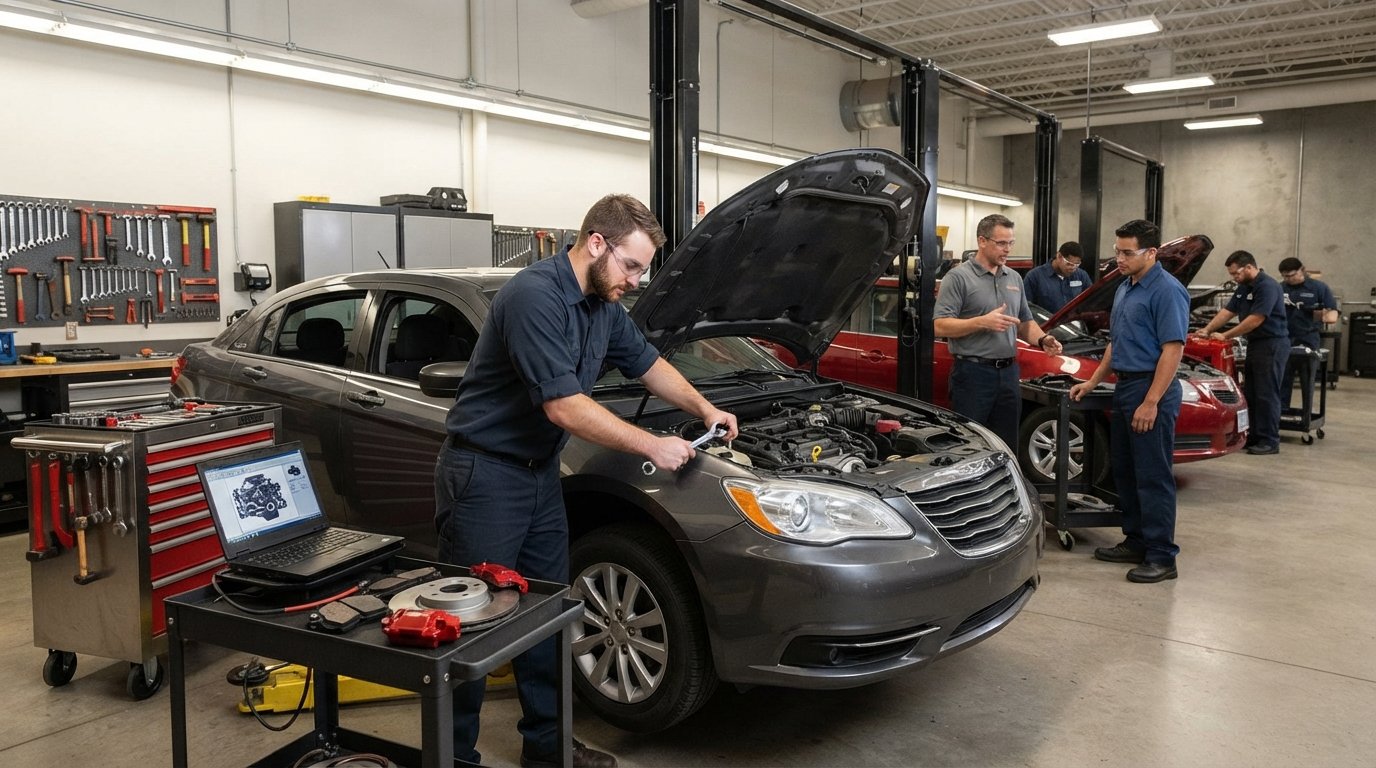
Auto Mechanics Certificate in Under 12 Weeks at Chisholm Trail
The Automotive Mechanics Technician Certificate at Chisholm Trail Technology Center takes under 12 weeks in person and gets you shop-ready for entry-level technician jobs.

By Jeffrey Hartford
You want to work on cars, but you do not want to spend two years in a classroom before you touch a wrench. That is exactly the gap the Automobile/Automotive Mechanics Technology/Technician Certificate, less than 12 weeks In-person at Chisholm Trail Technology Center is built to close. In roughly one quarter, you can move from changing your own oil to diagnosing electrical faults, servicing brakes, and understanding how a modern engine management system actually thinks. For career changers, recent high school graduates, and working adults who need a fast on-ramp into the trades, this short, hands-on program is one of the most direct routes from interest to employability.
This guide breaks down what the certificate covers, who it suits, how the in-person format works in your favor, what it costs in time and money, and how to turn the credential into a job or further study. It also explains how to compare a sub-12-week automotive certificate against longer associate degree pathways, so you can decide which investment matches your goals. If you are still mapping out your options, resources like our overview of short technician certificates that finish in 12 weeks can help you see how compressed trade programs compare across fields.
What the Automotive Mechanics Technician Certificate Covers
Automotive technology certificates are not one-size-fits-all. A quality program blends classroom theory with supervised shop time so that you understand why a system fails, not just how to swap a part. At Chisholm Trail Technology Center, the in-person requirement means your learning happens on actual vehicles and trainers, with an instructor nearby to correct technique before bad habits set in. The curriculum typically rotates through the major systems every entry-level technician is expected to know.
Expect the coursework to touch on engine fundamentals, electrical and electronic systems, brake systems, steering and suspension, and basic drivetrain service. Modern vehicles are computers on wheels, so diagnostic scanning and reading live data usually appear early in the program. You will also practice shop safety, tool use, and the documentation habits that employers care about, such as writing a clear repair order and explaining a repair to a customer without jargon.
Because the program runs in less than 12 weeks, the pace is intense but focused. You are not sitting through general education requirements or elective surveys. Every hour is aimed at a skill you can demonstrate. That compression is the point: it lets you enter the workforce or an apprenticeship quickly, then build specialization on the job or through later manufacturer training.
Core Skills You Should Expect to Practice
Exact course titles vary by institution, but most short automotive technician certificates organize learning around a common skill set. Before enrolling, ask for the syllabus and confirm that hands-on lab hours are included, not just lectures. The following competencies are the ones hiring managers most often screen for in entry-level applicants.
- Engine repair and performance basics, including cooling and lubrication systems
- Electrical diagnostics, battery and charging systems, and wiring repair
- Brake inspection, service, and hydraulic system bleeding
- Steering, suspension, and alignment fundamentals
- Preventive maintenance, fluid service, and multi-point inspections
Notice that the list emphasizes diagnosis and maintenance rather than engine rebuilding. Entry-level shop work is dominated by inspections, brakes, tires, fluid services, and electrical gremlins. A certificate that gives you real reps in those areas makes you billable faster, which is what service managers actually need. If a program promises advanced performance tuning in under 12 weeks, ask how much of that time is hands-on versus demonstration.
Why the In-Person Format Matters for Trade Training
Online learning works well for theory, but automotive repair is a physical craft. You learn torque by feel, spot a worn brake pad by sight, and hear a failing bearing before a scan tool confirms it. The in-person requirement at Chisholm Trail Technology Center is not a limitation; it is the feature that makes the certificate credible to employers. Shop time also builds the professional habits that no video can teach: keeping a bay clean, returning tools, communicating with a service writer, and working safely around lifts and high-voltage systems.
In-person training also gives you access to equipment you probably do not own. Alignment racks, diagnostic scan tools, brake lathes, and vehicle lifts are expensive, and a training shop lets you use them under supervision. That exposure matters when you interview, because you can speak concretely about equipment you have operated rather than equipment you have only read about.
Finally, the cohort model creates a network. Classmates become the people who refer you to a shop hiring an express lube tech or a tire and brake apprentice. Instructors often have industry contacts and can vouch for your work ethic. In a field where reputation travels fast, those relationships are worth as much as the certificate itself.
Who Should Enroll in a Sub-12-Week Automotive Certificate
A compressed certificate is a tool with a specific job. It is not the right fit for everyone, and being honest about your situation saves time and money. The strongest candidates share a few traits: they want to work with their hands, they are comfortable in a fast-paced environment, and they need to start earning sooner rather than later.
Career changers often choose this route because it respects their existing obligations. If you are leaving retail, logistics, or food service, a program that finishes in under three months lets you keep income flowing while you retrain, especially if classes are scheduled in blocks that fit around a job. Recent high school graduates benefit because the certificate provides a credential and a pathway into an associate degree later if they decide to specialize.
Working technicians who already perform basic maintenance may also use the certificate to formalize skills and qualify for higher-paying roles. Some employers reimburse tuition for employees who pursue relevant credentials, so ask your service manager before you pay out of pocket.
Signs This Program Fits Your Goals
Before committing, run through a short self-check. The questions below are the ones most likely to predict whether a short automotive program pays off for you.
- You want to enter the workforce or an apprenticeship within months, not years.
- You are willing to invest in your own basic tools as you progress.
- You can commit to full-day, in-person attendance for the length of the program.
- You are comfortable with physical work, standing for long periods, and lifting safely.
- You see the certificate as a first step, not a final destination.
If most of those statements describe you, the program is likely a strong fit. If you are unsure whether you enjoy repair work at all, spend a weekend doing your own brake job or shadow a technician before enrolling. A short program is efficient, but it is still an investment of tuition and weeks you cannot get back.
Time, Cost, and Return on Investment
The headline advantage of the Automobile/Automotive Mechanics Technology/Technician Certificate, less than 12 weeks In-person at Chisholm Trail Technology Center is time. Traditional associate degree programs in automotive technology typically take about two years, and while they offer broader general education and deeper specialization, they also delay your first paycheck by roughly 18 months. A certificate compresses the core employable skills into one quarter, which changes the math on opportunity cost.
Costs vary by institution and residency status, so request a current tuition and fee schedule directly from the technology center. Factor in more than tuition: basic hand tools, safety glasses, work boots, and possibly a uniform or shop shirt add to the total. Some programs include a starter tool kit, while others provide tools only during lab hours. Ask specifically which items you must buy and which are supplied.
Financial aid is often available for approved certificate programs, even short ones. The Scholarship.Education resource for finding scholarships and financial aid is a useful starting point for locating awards aimed at career and technical students, including adult learners and non-traditional students. Employers sometimes offer tuition assistance as well, particularly dealership groups and national service chains that struggle to fill entry-level bays.
To estimate return on investment, compare three numbers: total program cost, the entry-level wage in your local market, and the time to your first job offer. In many regions, entry-level technicians start above the wage floor for retail and food service, and pay rises quickly as you add certifications such as ASE tests or manufacturer-specific training. The certificate does not guarantee a salary, but it shortens the runway to a wage you can build on.
How to Choose an Automotive Technician Program
Not every short program is created equal. Accreditation, lab quality, instructor experience, and job placement support all affect whether the certificate translates into a job. Start by confirming that the program is approved for federal financial aid if you plan to use it, and ask about completion and placement rates for recent cohorts. Those numbers tell you more than any brochure.
Visit the shop if you can. Look at the vehicles, lifts, and diagnostic equipment, and ask how many students share each bay. A program with modern scan tools and enough lifts for hands-on practice will prepare you far better than one where students mostly watch demonstrations. Ask whether the instructors have recent industry experience and whether the center maintains relationships with local dealerships and independent shops.
Finally, ask about stackability. A strong certificate program should articulate into a longer diploma or associate degree, so you can return later and apply your credits rather than starting over. That flexibility matters because automotive careers increasingly reward specialization in areas like electric vehicles, advanced driver assistance systems, and diesel or heavy equipment service.
Comparing Short Certificates With Associate Degrees
The choice between a certificate and a degree is really a choice about timing and scope. A certificate gets you into the trade quickly and lets you earn while you learn. An associate degree gives you more theory, more general education, and often stronger preparation for advancement into shop management or manufacturer-specific master technician roles.
- Certificate: fastest entry, lowest upfront cost, strongest immediate employability for entry-level roles
- Associate degree: broader foundation, better long-term options for supervision and specialization
- Stackable path: start with the certificate, work, then return for the degree with employer support
- Apprenticeship: combine paid on-the-job training with related instruction, sometimes alongside a certificate
Many successful technicians do both, just in a different order than the traditional sequence. They earn a certificate, get hired, and then use tuition reimbursement to complete an associate degree part-time. That path keeps income flowing while building credentials, and it is especially common in dealerships that want technicians to complete manufacturer certification programs.
Career Paths After the Certificate
Graduates of short automotive programs typically start in roles that build volume and confidence: express maintenance technician, tire and brake technician, lube technician, or apprentice in a full-service shop. These roles are not glamorous, but they generate the repetitions that make diagnosis intuitive. Within a year or two, many technicians move into line technician positions where they handle a wider range of repairs and earn more per flat-rate hour.
From there, the paths branch. Some technicians pursue manufacturer certifications and become specialists in a brand's diagnostic procedures. Others move into diesel, fleet maintenance, collision repair, or electric vehicle service, each of which carries its own training ladder. Still others transition into service writing, parts management, or shop ownership, where customer communication and business skills matter as much as mechanical ability.
It is worth noting that automotive work is physically demanding and shop conditions vary. The Bureau of Labor Statistics projects steady demand for automotive service technicians and mechanics, with openings driven by retirements and the growing complexity of vehicles. That complexity is good news for trained workers: cars need more skilled diagnosis than ever, and employers increasingly prefer candidates with formal training over those who learned entirely on the job.
How to Enroll and Prepare
The enrollment process for a short in-person certificate is usually straightforward, but it rewards preparation. Start by contacting Chisholm Trail Technology Center directly to confirm the next start date, admission requirements, and whether there is a waiting list. Ask about assessment tests, immunization or safety requirements, and any prerequisites such as a valid driver's license, which many programs require because students move vehicles on campus.
Once admitted, prepare logistically. Confirm the daily schedule and plan transportation, since in-person attendance is mandatory and missing lab hours is hard to make up in a compressed program. Budget for tools and safety gear early so you are not scrambling during the first week. If you need financial aid, complete the FAFSA well before the start date and speak with the financial aid office about certificate eligibility.
Finally, treat the program like a job interview that lasts 12 weeks. Arrive early, dress for shop work, ask questions, and volunteer for the tasks nobody wants. Instructors notice, and their recommendations often lead directly to job offers. The certificate opens the door; your conduct in the shop determines how wide it swings.
The Automobile/Automotive Mechanics Technology/Technician Certificate, less than 12 weeks In-person at Chisholm Trail Technology Center is a practical, focused entry point into a skilled trade that rewards hands-on ability and continued learning. If your priority is getting trained, getting hired, and getting paid without a two-year detour, this kind of compressed, in-person program deserves a serious look. Confirm the details with the school, line up your funding, and treat the twelve weeks as the first step in a longer career you can build deliberately.