
Bates Technical College Machinist Associate's Degree Guide
Earn a Machine Tool Technology/Machinist Associate's degree, usually 2 years In-person at Bates Technical College, and step into hands-on CNC and manual machining careers.

If you have ever watched a CNC machine carve a complex metal part from a solid block and wondered how someone learned to program that level of precision, the answer often starts with a two-year degree. The Machine Tool Technology/Machinist Associate's degree, usually 2 years In-person at Bates Technical College, is one of the most direct routes from a high school diploma or a career change to a skilled, hands-on trade. Bates Technical College in Tacoma, Washington, has built a reputation for turning out machinists who can read blueprints, set up lathes and mills, write CNC code, and hold tolerances measured in thousandths of an inch. This guide walks through what the program actually covers, who thrives in it, what it costs, how to get admitted, and what the job market looks like when you finish.
What the Machinist Associate's Degree at Bates Technical College Covers
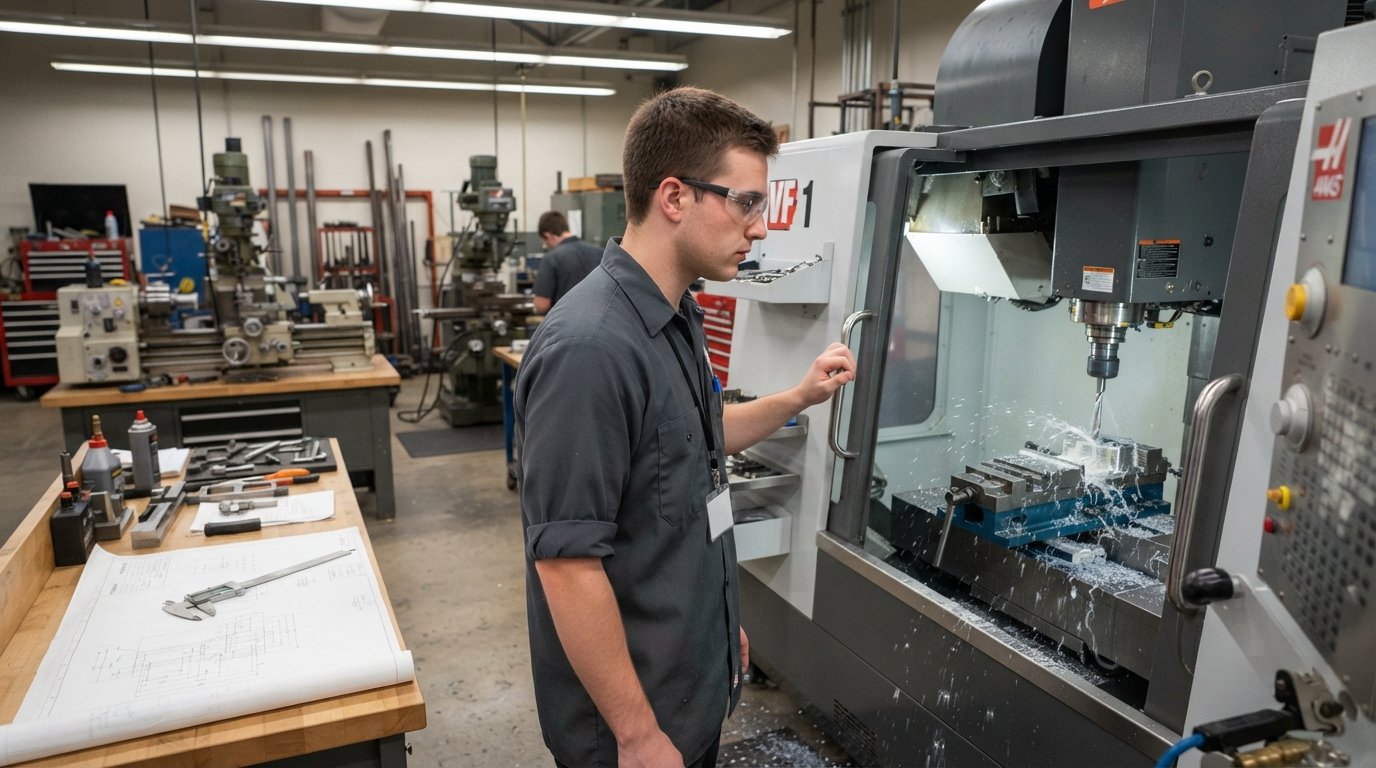
The Machine Tool Technology program at Bates is a hands-on, shop-floor education. You will not spend most of your time in a lecture hall. The curriculum is built around the machines themselves, from manual engine lathes and vertical mills to CNC turning centers and machining centers. Students learn the full arc of modern machining: interpreting engineering drawings, planning a sequence of operations, selecting tooling and speeds and feeds, measuring finished parts, and inspecting them against specifications. Along the way, you build the math and problem-solving skills that separate a machinist who can run a machine from one who can diagnose why a part is drifting out of tolerance.
Because the degree is an Associate of Applied Science or Associate of Technology credential rather than a transfer-oriented degree, the coursework leans practical. Expect substantial time in the machine shop each week, supported by classes in print reading, geometric dimensioning and tolerancing (GD&T), CNC programming, and shop safety. Many programs also introduce CAD/CAM software, metallurgy basics, and quality inspection tools such as micrometers, calipers, height gauges, and coordinate measuring machines. The goal is straightforward: graduate able to walk onto a shop floor and contribute without months of remedial training.
One detail that matters for prospective students is that this is an in-person program by design. Machining is a physical skill. You learn to feel chatter in a cut, hear when a tool is dull, and judge surface finish by eye and by touch. Bates structures the Machine Tool Technology/Machinist Associate's degree, usually 2 years In-person at Bates Technical College, around that reality, with lab access and instructor supervision that online simulations cannot fully replace. If you are comparing formats, keep in mind that some schools offer hybrid or online theory courses, but the hands-on core of machining is almost always delivered in a shop.
Roughly half or more of your schedule will be dedicated to shop-based learning, with the remainder in related instruction. A typical week might include a print reading or math class, a CNC programming session, and long blocks of supervised machine time. The program is usually completed in four to six quarters depending on your starting point and course load, which is why the commonly cited timeline is two years. Students who need developmental math or English courses may take a bit longer, and part-time students should plan for a longer runway.
Who Thrives in a Two-Year Machinist Program
The strongest machinist students tend to share a few traits: patience, mechanical curiosity, comfort with numbers, and a genuine satisfaction in making something precise with their hands. You do not need prior machining experience to succeed, but you do need to be comfortable standing for long stretches, working with sharp tooling and coolant, and following safety procedures without shortcuts. Attention to detail is not a cliche in this field; a single misread dimension can scrap an expensive part. If you enjoy troubleshooting, measuring, and iterating until a part is exactly right, the work will feel natural.
Career changers are a large part of the audience for this kind of degree. People coming from retail, food service, construction, or logistics often find that machining offers better pay, more technical challenge, and a clearer path to advancement. Veterans also gravitate to the trade because the skills map well to military maintenance and fabrication experience. High school graduates who want a credential that leads directly to employment, rather than a four-year degree with an uncertain major, are another core group. The common thread is a preference for learning by doing over learning by reading.
It also helps to be realistic about the physical and environmental aspects of the job. Shops can be loud, and machinists spend long hours on their feet. Coolant, metal chips, and oil are part of the daily environment. On the positive side, modern shops are increasingly clean, climate-controlled, and automated, and the work is far more mentally engaging than many people expect. Machining today is as much about programming, setup strategy, and process improvement as it is about turning handles.
Admissions, Costs, and Financial Aid at Bates Technical College
Bates Technical College is a public two-year college, which means the admissions process is designed to be accessible. You will typically need to apply to the college, provide proof of high school completion or equivalent, and take placement assessments or submit prior college coursework to determine your starting level in math and English. Some programs have additional requirements or waitlists, so it is worth contacting the program advisor early to confirm current prerequisites and start dates. Because the program is in-person, you should also plan for transportation, parking, and a schedule that allows you to be on campus for extended shop blocks.
Cost is a major consideration, and the good news is that public technical college tuition is generally far lower than private trade schools. Washington residents pay resident tuition rates, and non-residents pay a higher rate. Beyond tuition, budget for tools, safety glasses, and possibly a personal tool kit depending on program requirements, plus textbooks and fees. Financial aid options include federal grants and loans through the FAFSA, Washington state need-based aid, scholarships, and employer tuition assistance if you are already working. Workforce development programs and veteran benefits can also reduce out-of-pocket costs.
To keep costs in perspective, compare the total program cost against the earning potential of machinists in your region. Entry-level machinists in the Puget Sound area often start in a range that can support a modest lifestyle, and experienced CNC programmers and setup machinists earn meaningfully more. For a broader look at how two-year credentials compare financially, see this guide to top paying associate degrees for 2026. The key is to treat the degree as an investment with a calculable payback period rather than an abstract expense.
Inside the Curriculum: From Manual Machining to CNC
A well-structured machinist program sequences skills so that each course builds on the last. Early on, students learn shop safety, measurement, and the fundamentals of manual machining. You will face an engine lathe for the first time, learn to turn, face, drill, bore, and thread, and then move to a vertical mill to cut slots, squares, and angles. These manual operations teach you how cutting tools behave and how to set up workholding, knowledge that transfers directly to CNC work later. Instructors typically emphasize process planning: deciding the order of operations before touching a machine.
From there, the program moves into CNC. Students learn G-code and M-code programming, work offsets, tool length compensation, and the structure of a CNC program. You may write programs at the control, use conversational programming, or generate code with CAD/CAM software. Setup is a major focus because setup is where most of the skill and most of the mistakes live. Learning to indicate a vise, touch off tools, and prove out a program safely is a core competency. Quality inspection runs throughout: you will measure parts with calipers, micrometers, and indicators, and you will learn to interpret GD&T callouts on drawings.
Related instruction rounds out the degree. Math for machinists covers trigonometry, speeds and feeds calculations, and tolerance stack-up. Print reading and GD&T courses teach you to decode engineering drawings, including datums, feature control frames, and material condition modifiers. Some programs include metallurgy, heat treatment, or materials science so you understand how different metals machine and behave. Communication and workplace skills may also appear, reflecting employer demand for machinists who can document processes and work in teams. The best programs also expose students to lean manufacturing, 5S, and continuous improvement concepts, which are increasingly important in modern shops.
Capstone or project-based courses often tie everything together. You might build a multi-part assembly that requires turning, milling, drilling, and inspection to print. These projects are valuable portfolio pieces when you interview, because they demonstrate that you can take a drawing and deliver a finished part that meets specification. Employers care far more about demonstrated capability than about grades alone.
Career Outcomes and Earning Potential for Machinists
Machinists are in demand across aerospace, medical devices, energy, automotive, and general manufacturing. In Washington state, aerospace and advanced manufacturing are particularly strong, and the Puget Sound region hosts a dense cluster of machine shops, suppliers, and OEMs. Job titles you might pursue after graduation include machinist, CNC operator, CNC setup machinist, CNC programmer, tool and die apprentice, and manufacturing technician. With experience, machinists can move into lead, supervisor, quality inspector, process engineer, or shop owner roles. Some pursue additional certifications or a bachelor's degree in manufacturing engineering or industrial technology to broaden their options.
Entry-level pay varies by region and employer, but machinists generally earn a living wage with room to grow. The U.S. Bureau of Labor Statistics groups machinists with a median annual wage in the mid-$40,000s to low-$50,000s nationally, with experienced CNC programmers and setup machinists earning more. In high-cost manufacturing hubs, pay scales upward. Overtime is common in busy shops, which can meaningfully increase annual earnings. Benefits often include health insurance, retirement contributions, and tuition reimbursement for continued education.
It is worth noting that automation is reshaping the trade rather than eliminating it. CNC machines, robots, and lights-out manufacturing reduce manual labor but increase demand for people who can program, set up, maintain, and troubleshoot automated systems. Machinists who embrace software, sensors, and data are well positioned for the next decade. The two-year degree gives you a foundation, but continuous learning is part of the job.
How to Get Started and Make the Most of the Program
Start by contacting Bates Technical College directly to confirm current program details, start dates, and any changes to prerequisites or costs. Program pages and advisors are the authoritative source, and requirements can shift from year to year. While you are gathering information, use a school matching tool to compare nearby programs and delivery formats. If you want to explore accredited colleges and degree programs in one place, CollegeDegree.Education is an educational matching service that connects prospective students with accredited colleges, universities, and degree programs, and it can help you see options beyond a single campus.
Once you are admitted, treat the shop like a job. Show up early, keep your area clean, ask questions when you are unsure, and document your setups. Build relationships with instructors, who often have industry connections and can recommend you to employers. Save your best parts and project documentation for a portfolio, and practice explaining your process in interviews. Employers want to hear how you plan a job, choose tooling, and handle a part that is out of tolerance.
Consider earning credentials alongside the degree. The National Institute for Metalworking Skills (NIMS) offers machining certifications that some employers recognize, and individual shops may value specific software or inspection experience. Internships, part-time shop jobs, and apprenticeships can accelerate your transition. If you are weighing this path against other two-year options, compare program length, hands-on hours, local employer partnerships, and job placement support. A degree is only as strong as the network and skills you build while earning it.
The Machine Tool Technology/Machinist Associate's degree, usually 2 years In-person at Bates Technical College, is a practical, respected credential in a trade that rewards precision and problem-solving. It is not the right fit for everyone, but for students who want to make tangible things, work with advanced machines, and enter a field with steady demand, it offers a clear and affordable route. Do your homework on costs and schedules, talk to advisors and working machinists, and visit the shop if you can. The best way to know if machining is for you is to stand at a machine and make a part.