
Biomedical Sciences Degree at Christian Brothers University
Explore the Biomedical Sciences, General Bachelor's degree, usually 4 years In-person at Christian Brothers University, and how it prepares you for medical school, research, and healthcare careers.

By Hannah Long
Choosing a bachelor's degree that balances rigorous science with real-world career preparation is one of the most consequential decisions a prospective student can make. The Biomedical Sciences, General Bachelor's degree, usually 4 years In-person at Christian Brothers University, stands out as a program designed for students who want a strong foundation in the life sciences without being locked into a single narrow specialization. Whether you are aiming for medical school, planning a career in research, or exploring pathways in healthcare administration and biotechnology, this degree offers a flexible and respected route to get there.
Christian Brothers University, located in Memphis, Tennessee, is a private institution known for small class sizes, close faculty mentorship, and a mission rooted in service and intellectual rigor. Its general biomedical sciences track gives students broad exposure to biology, chemistry, and the health sciences while leaving room for electives that align with their career goals. This article breaks down what the program involves, who it suits, what it costs in time and money, and how it connects to career and graduate school outcomes.
What the Biomedical Sciences, General Bachelor's Degree Involves
At its core, a general biomedical sciences bachelor's degree is an interdisciplinary program that sits at the intersection of biology and medicine. Students study the molecular, cellular, and systems-level mechanisms that underlie human health and disease. At Christian Brothers University, the program is delivered fully in person over four years, which means students benefit from laboratory work, face-to-face instruction, and the kind of hands-on learning that is difficult to replicate online.
The curriculum typically includes foundational coursework in general biology, general chemistry, organic chemistry, physics, and mathematics, followed by upper-division courses in areas such as genetics, microbiology, human anatomy and physiology, biochemistry, and cell biology. Because the degree is a general track rather than a specialized one, students can often tailor their upper-level electives toward interests like immunology, neuroscience, or public health. This flexibility is one of the program's strongest selling points.
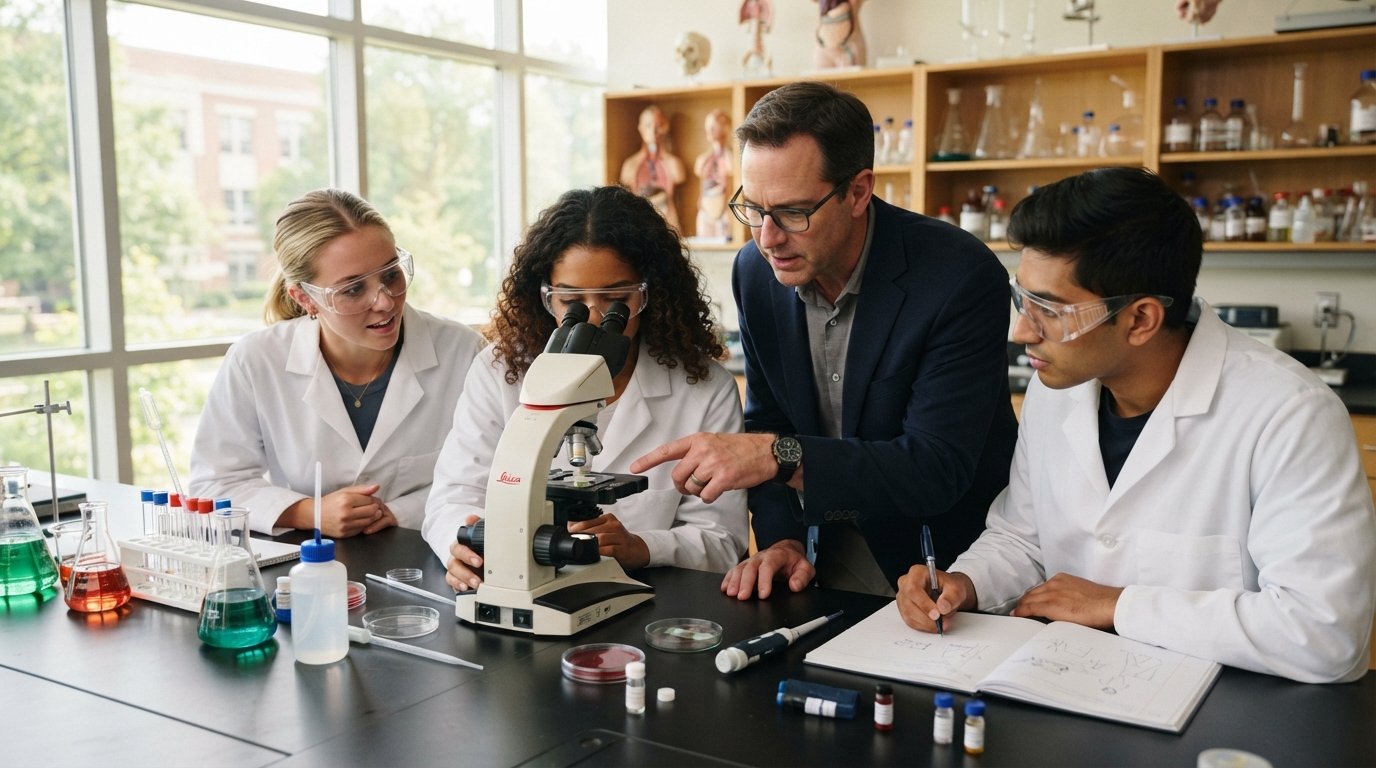
Beyond the classroom, students should expect a significant laboratory component. Lab work builds technical skills such as pipetting, microscopy, gel electrophoresis, and data analysis, all of which are valued by employers and graduate admissions committees alike. Many students also pursue undergraduate research opportunities with faculty members, which can strengthen applications to medical school, pharmacy school, or doctoral programs.
Here is a snapshot of what the four-year structure generally looks like:
- Year one: general biology, general chemistry, calculus, and core liberal arts courses
- Year two: organic chemistry, physics, and introductory microbiology or genetics
- Year three: biochemistry, human physiology, and upper-division electives plus lab work
- Year four: advanced electives, research or internship experiences, and capstone coursework
This progression is typical rather than rigid. Advisors help students adjust sequencing based on transfer credits, prerequisite chains, and post-graduation goals. Students aiming for medical school often need to complete additional prerequisite courses and prepare for the MCAT, so early planning with an advisor is essential.
Why Study Biomedical Sciences at Christian Brothers University
Christian Brothers University offers several advantages that distinguish its program from larger public universities. The most significant is the student-to-faculty ratio, which supports personalized mentorship and easier access to research opportunities. At a smaller institution, undergraduates are more likely to work directly with professors on research projects rather than being relegated to graduate-student-led labs.
The university's location in Memphis is another asset. Memphis is home to major healthcare and research institutions, including teaching hospitals, biomedical research centers, and a growing biotechnology sector. These local partners can provide internship and shadowing opportunities that give students real clinical and research exposure before they graduate.
The university's Lasallian Catholic heritage also shapes its approach to education. While the curriculum is scientifically rigorous, the mission emphasizes ethics, service, and community. For students interested in healthcare, this ethical framing can be valuable, since clinical practice and biomedical research both require strong grounding in professional responsibility and patient-centered thinking.
For students comparing programs, it helps to think about fit rather than prestige alone. A smaller, in-person program like this one rewards students who want close relationships with faculty, structured lab experiences, and a values-driven education. Students who thrive in large lecture halls or who need extensive online flexibility may prefer a different format. Prospective students can explore broader degree comparisons in resources such as this guide to the highest paying bachelor's degrees to weigh salary potential across fields.
Admissions and Prerequisites
Admission to the Biomedical Sciences, General Bachelor's degree, usually 4 years In-person at Christian Brothers University, follows the university's general undergraduate admissions process. Applicants typically submit a high school transcript, standardized test scores (though policies vary and should be confirmed with the admissions office), a personal statement, and letters of recommendation. Strong performance in high school biology, chemistry, and mathematics is especially important because the program is science-intensive from the first semester.
Students who enter with Advanced Placement or dual-enrollment credit in biology or chemistry may be able to accelerate their sequence, but they should confirm credit transfer policies early. Transfer students from community colleges should work with an advisor to map completed coursework against the program's prerequisite chain, since misaligned sequences can extend time to graduation.
It is also worth noting that admission to the university does not guarantee admission to professional schools later. Students planning to apply to medical, dental, pharmacy, or veterinary programs must maintain strong science GPAs and prepare for standardized entrance exams. The university's pre-health advising can help students stay on track.
Cost, Financial Aid, and Return on Investment
As a private institution, Christian Brothers University has a higher sticker price than many public universities, but the actual net cost varies widely based on financial aid, merit scholarships, and need-based grants. Prospective students should file the FAFSA and explore institutional scholarships early. External scholarship databases can also help offset costs; for example, Scholarship.Education aggregates scholarship and financial aid opportunities for undergraduate and graduate students across the US and abroad.
Return on investment for a biomedical sciences degree depends heavily on the path a student takes after graduation. Graduates who enter the workforce directly may start in roles such as research assistant, laboratory technician, or healthcare coordinator, with salaries that vary by region and employer. Graduates who continue to professional or graduate school often see substantially higher lifetime earnings, though they also take on additional tuition and delay earning years.
The key financial takeaway is that this degree is best viewed as a launchpad rather than a terminal credential. Students who plan for graduate study or professional school from the start tend to get the strongest return. Those who want to work immediately after graduation should seek internships and lab experience to strengthen their entry-level prospects.
Career Paths and Graduate School Options
A general biomedical sciences degree opens doors across healthcare, research, and industry. Because the training is broad, graduates are not confined to a single job title. Instead, they can choose from a range of roles depending on their interests and additional training.
Common entry-level paths include:
- Research assistant in academic, hospital, or pharmaceutical laboratories
- Laboratory technician in clinical or industrial settings
- Healthcare coordinator or administrative support in hospitals and clinics
- Quality control or regulatory support in biotechnology and medical device companies
- Science educator or outreach roles in schools and nonprofits
Many graduates pursue graduate or professional education. Medical school, dental school, pharmacy school, physician assistant programs, and doctoral programs in biomedical sciences are all common next steps. Others pursue master's degrees in public health, health administration, or biotechnology. Each path has its own prerequisites and timelines, so students should begin exploring options by their sophomore year.
The breadth of the general track is an advantage here. Students who discover a passion for public health, for example, can use electives to build relevant coursework, while students aiming for medical school can prioritize the prerequisites and shadowing experiences that admissions committees expect. The in-person format supports these goals by making it easier to access labs, faculty mentors, and local clinical settings.
How to Succeed in the Program
Success in a biomedical sciences program requires more than intelligence; it requires consistent study habits, time management, and a willingness to seek help early. Science courses build on one another, so falling behind in organic chemistry or biochemistry can create cascading problems. Students should use office hours, study groups, and tutoring resources proactively rather than waiting until exams approach.
Beyond academics, students should pursue experiences that clarify their career direction. Shadowing a physician, volunteering in a hospital, or joining a research lab can help confirm whether a particular path is the right fit. Internships and summer research programs also strengthen applications to graduate and professional schools.
Finally, students should build relationships with faculty. Letters of recommendation are a standard part of applications to medical school, graduate programs, and many jobs. Professors who know a student well can write detailed, persuasive letters, which is another reason the small-class environment at Christian Brothers University can be valuable.
Is This Program Right for You?
The Biomedical Sciences, General Bachelor's degree, usually 4 years In-person at Christian Brothers University, is a strong fit for students who want a science-heavy education with room to explore, who value close faculty mentorship, and who plan to pursue graduate study or healthcare careers. It is less ideal for students who need fully online flexibility or who want a highly specialized degree from day one.
Prospective students should visit campus if possible, meet with faculty, and ask detailed questions about research opportunities, advising, and outcomes for recent graduates. Comparing the program against other in-person and online options will help clarify whether the size, location, and mission of Christian Brothers University align with personal and professional goals. With careful planning, this degree can serve as a durable foundation for a wide range of careers in science, medicine, and health.