
Biotechnology Associate's Degree: 2-Year Hybrid at Athens Tech
Earn a Biotechnology Associate's degree in about 2 years with hybrid in-person and online classes at Athens Technical College. Start a lab career sooner.

A Biotechnology Associate's degree, usually 2 years with a mix of in-person and online at ATHENS TECHNICAL COLLEGE, offers a fast, hands-on route into one of the most dynamic sectors of the modern economy. For students who want to work in laboratories, support research and development, or move quickly into biomanufacturing, this program type delivers concentrated science training without the time and cost of a four-year degree. Athens Technical College, a public institution in Georgia, has built its biotechnology program around a practical blend of classroom instruction and laboratory practice, with a portion of coursework delivered online for flexibility. If you are weighing whether a two-year biotechnology credential fits your goals, this guide walks through the curriculum, admission steps, career outcomes, costs, and the questions you should ask before enrolling.
What the Biotechnology Associate's Degree at Athens Technical College Covers
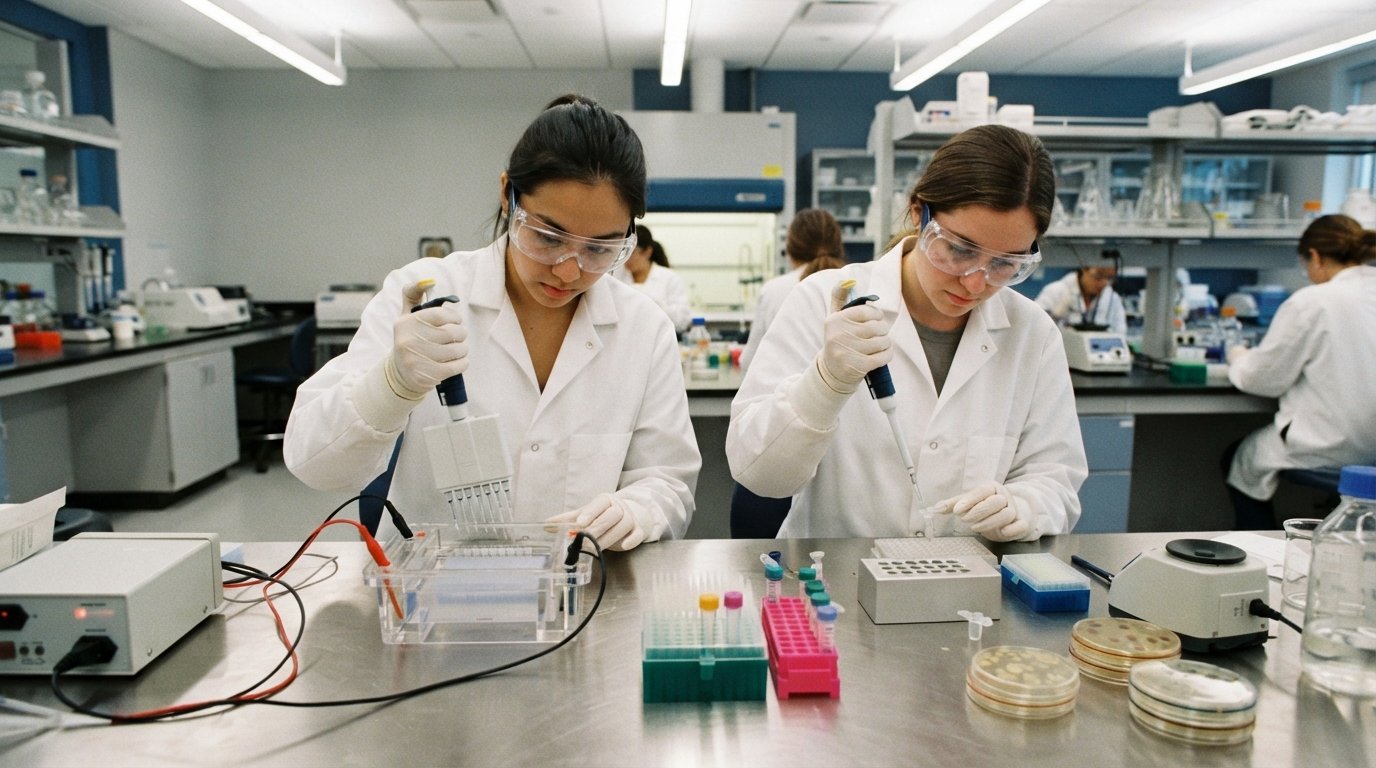
At its core, the program trains students in the laboratory techniques and scientific foundations that biotechnology employers expect from entry-level technicians. You will study molecular biology, cell culture, microbiology, biochemistry, and genetics, and you will spend significant time in wet labs performing procedures such as pipetting, DNA extraction, gel electrophoresis, and sterile technique. The degree also typically includes coursework in quality assurance, regulatory compliance, and good manufacturing practice (GMP), which are especially important for students heading into biopharmaceutical production.
The mix of in-person and online delivery is a practical design choice rather than a gimmick. Lecture-heavy courses and general education requirements can be completed online, which helps students who work part-time or commute. Hands-on laboratory courses meet on campus, where students have access to equipment, supervision, and the kind of repetition that builds real technical confidence. This hybrid format is common across technical colleges in Georgia and reflects how workforce programs are adapting to adult learners.
Because a Biotechnology Associate's degree, usually 2 years Mix of in-person and online at ATHENS TECHNICAL COLLEGE is designed as a terminal workforce credential, it emphasizes employability over transfer theory. That said, some graduates do continue into bachelor's programs in biology or biotechnology, and credits often transfer more smoothly to in-state institutions with articulation agreements. Students planning to transfer should confirm course-by-course equivalency with their intended four-year school before registering.
A Typical Course Sequence and What You Will Actually Learn
Most students complete the degree in four to five semesters, depending on whether they need developmental coursework or attend part-time. The first year generally focuses on foundational science and lab skills, while the second year moves into applied topics and a capstone or internship experience. A representative sequence looks like this:
- Semester 1: Biology I with lab, English composition, college algebra or statistics
- Semester 2: Biology II with lab, general chemistry with lab, introduction to biotechnology
- Semester 3: Microbiology, cell culture techniques, molecular biology methods
- Semester 4: Biomanufacturing or quality systems, instrumentation, capstone or internship
What you actually learn matters more than course titles. By graduation, you should be able to maintain a sterile workspace, document experiments according to standard operating procedures, operate common lab instruments such as spectrophotometers and centrifuges, and explain the regulatory environment that governs pharmaceutical and diagnostic labs. Employers hiring biotechnology technicians consistently rank documentation discipline and safety habits as highly as technical skill, so pay attention to the courses that emphasize record-keeping and compliance.
Internships and cooperative work experiences are often the most valuable part of the program. Local biotech and pharmaceutical employers in Georgia, including contract research organizations and manufacturing sites, regularly host students. If the program offers a placement, take it seriously: many graduates receive their first job offer from the site where they interned.
Admissions Steps and Who Should Apply
Admission to a technical college biotechnology program is generally accessible, but it is not automatic. Applicants typically need a high school diploma or equivalent, and placement in college-level math and English is determined by standardized test scores or a placement exam. Some programs require a minimum GPA or a qualifying score on an accuplacer-style assessment. Because laboratory courses have limited seats, early application is advised.
The typical applicant profile includes recent high school graduates, adult learners changing careers, and workers already in healthcare or manufacturing who want to move into laboratory roles. The hybrid format is particularly attractive to students with jobs or family obligations, since online lectures reduce the number of campus trips per week. Students should verify whether online courses require synchronous attendance or proctored exams, as these details affect scheduling.
Before applying, complete these steps in order:
- Confirm the program is currently accepting new students and check application deadlines.
- Submit transcripts and take any required placement tests.
- Meet with an academic advisor to map out the hybrid schedule, including which semesters require on-campus labs.
- Apply for financial aid and institutional scholarships using the FAFSA.
- Register for first-semester courses as soon as the registration window opens, since lab sections fill quickly.
Financial planning deserves its own attention. Beyond federal aid, students should search for external scholarships and grants that support technical and STEM students. Resources such as Scholarship.Education aggregate scholarship opportunities for undergraduate and non-traditional students, and checking a database like that early can reduce out-of-pocket costs substantially. For a broader look at how degree choices affect earnings, our analysis of the most valuable college degrees by salary provides useful context for comparing two-year and four-year pathways.
Career Outcomes and Earning Potential
Graduates with a biotechnology associate's degree typically enter the workforce as laboratory technicians, quality control analysts, manufacturing associates, or research assistants. Employment settings include pharmaceutical and biopharmaceutical companies, contract research organizations, diagnostic laboratories, agricultural biotechnology firms, and university research labs. The work is often shift-based in manufacturing environments, which can mean evening or weekend schedules, but it also means predictable overtime opportunities in many facilities.
Entry-level pay varies by region and industry. In Georgia and the broader Southeast, laboratory technicians with an associate's degree commonly start in the high $30,000s to mid $40,000s, with biomanufacturing roles sometimes paying more due to shift differentials. Technicians who gain GMP experience and move into quality or manufacturing roles can see earnings rise meaningfully within a few years. According to Bureau of Labor Statistics data, employment of biological technicians is projected to grow faster than the average for all occupations over the next decade, driven by expansion in biopharmaceutical research and production.
Career progression usually follows one of two tracks. The technical track moves from technician to senior technician to lead or specialist roles, often with employer-paid certifications. The supervisory track moves into shift supervision, quality management, or production management, sometimes requiring a bachelor's degree later. Students who want to keep advancing should ask employers about tuition assistance programs, which are common in large biotech companies.
Cost, Financial Aid, and Return on Investment
As a public technical college, Athens Technical College generally offers tuition well below the national average for private institutions. In-state students pay significantly less than out-of-state students, and many students qualify for federal Pell Grants, state workforce grants, and institutional aid. Because the degree takes about two years, the total cost is far lower than a four-year bachelor's degree, and graduates can begin earning and gaining experience sooner.
The return on investment depends heavily on how quickly you finish and whether you use employer tuition assistance or scholarships. Students who work part-time while completing online coursework can reduce borrowing further. It is worth calculating a simple payback estimate: divide total program cost by the difference between your expected annual salary after graduation and your current salary. For many career changers, the payback period is a few years, especially when they secure employment at a biomanufacturing site with overtime and shift differentials.
Prospective students should also confirm accreditation and program outcomes. Institutional accreditation matters for financial aid eligibility, and program-level information such as graduation rates, licensure pass rates (where applicable), and job placement rates can usually be requested from the college. Ask for these numbers directly rather than relying on marketing materials.
How the Hybrid Format Works in Practice
The online component of the program is typically delivered through a learning management system, with recorded lectures, discussion boards, and online quizzes. Laboratory courses meet in person, often in blocks of two to four hours, because bench work requires supervision and shared equipment. Students should plan for commuting on lab days and should check whether the college offers evening or weekend lab sections.
Hybrid learning rewards organization. Successful students treat online lectures like scheduled appointments, keep a lab notebook that mirrors professional practice, and form study groups for difficult courses such as microbiology and organic chemistry. Because laboratory skills are assessed in person, missing a lab session can be costly, so review the attendance policy before enrolling.
It is also worth asking about technology requirements. Some online science courses use virtual labs or simulation software, while others require students to purchase lab kits. Understanding these costs upfront prevents surprises in the first semester.
Comparing the Biotechnology Associate's Degree to Other Pathways
Students often compare three options: a two-year biotechnology associate's degree, a four-year biology bachelor's degree, and short-term certificates. The associate's degree is the fastest route to a laboratory job with a recognized credential, and it includes enough science coursework to support advancement. A bachelor's degree opens more research and management roles but takes twice as long and costs more. Short certificates can be useful for workers already in the field but usually carry less weight with employers hiring new technicians.
For students who are unsure, a practical approach is to start in the associate's program and keep the transfer option open. Advising offices can identify which courses satisfy both the associate's degree and general education requirements at four-year institutions. This preserves flexibility without delaying entry into the workforce.
The biotechnology field rewards reliability, documentation discipline, and willingness to learn new instruments. A two-year hybrid program at a technical college can provide exactly those foundations, especially when students take advantage of internships and employer partnerships. Before committing, visit the campus lab, speak with instructors, and ask current students about scheduling and job placement. Those conversations will tell you more about fit than any brochure.