
Carpentry Associate's Degree at American Samoa CC (2026)
Earn a Carpentry/Carpenter Associate's degree, usually 2 years In-person at American Samoa Community College, and start building a debt-light trade career fast.

By Dylan Richardson
What if you could learn a high-demand trade in one of the most unique places in the United States, surrounded by Pacific culture and a building boom that needs skilled hands? That is the opportunity hiding inside the Carpentry/Carpenter Associate's degree, usually 2 years In-person at American Samoa Community College. For students who want to build things with their hands, earn while they learn, and avoid years of costly university tuition, this program offers a direct route into construction work, project leadership, and even self-employment. The degree combines technical carpentry training with general education, giving you a credential that employers recognize and a skill set you can carry anywhere. This guide breaks down what the program covers, who it is for, how to apply, what it costs, and where graduates actually end up working.
Why a Carpentry Associate's Degree in American Samoa Makes Sense
American Samoa is a U.S. territory in the South Pacific, and its economy depends heavily on construction, infrastructure repair, government projects, and private home building. Cyclones, salt air, and a growing population create constant demand for carpenters who can frame, finish, repair, and remodel structures. At the same time, the territory has limited four-year university options, which makes American Samoa Community College (ASCC) the primary local pathway to higher education and technical credentials. A two-year carpentry degree there is not just a trade ticket; it is a community investment.
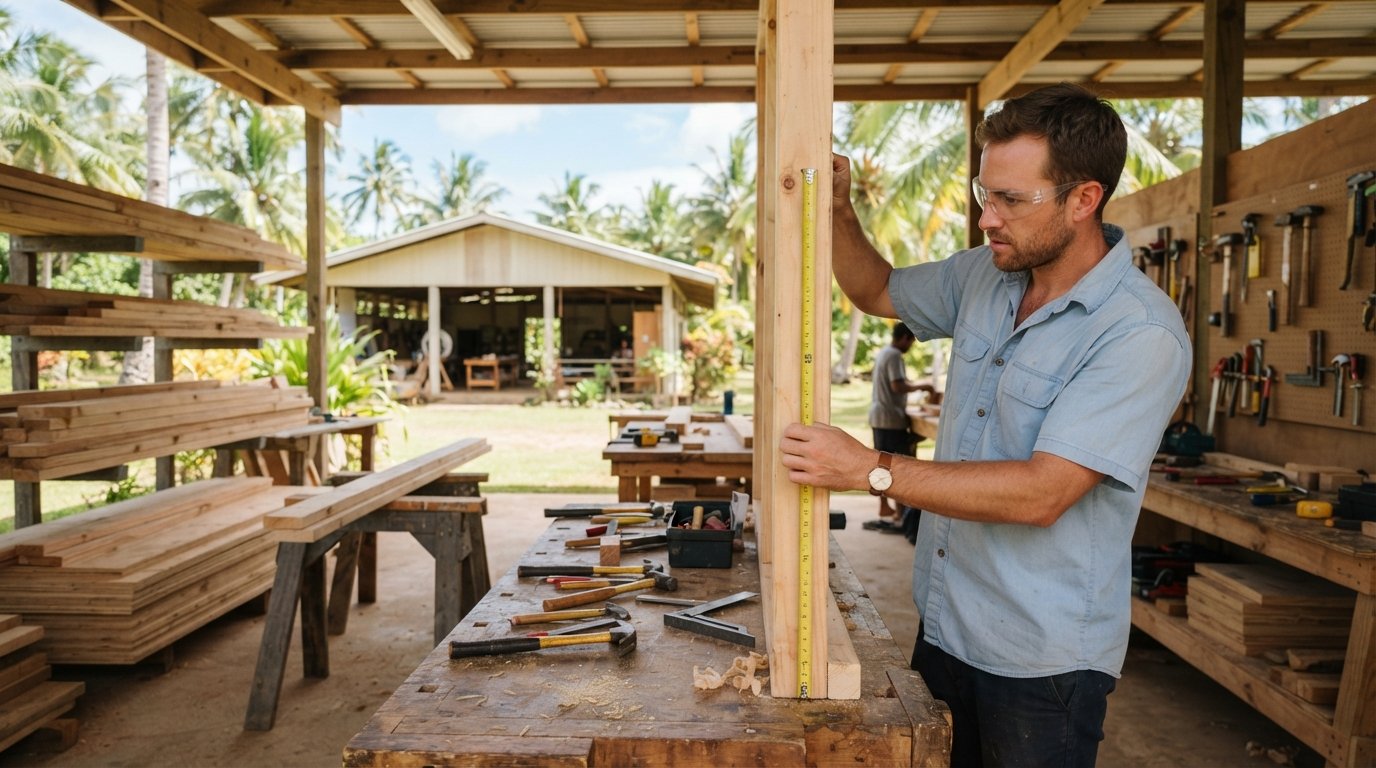
The program is delivered in person, which matters in carpentry. You cannot learn to read a framing square, operate a circular saw safely, or feel the tension in a nail gun through a video lecture. In-person instruction at ASCC means hands-on practice in a shop and on building sites, supervised by instructors who understand island building codes, materials, and climate challenges. Students learn how humidity affects lumber, how to anchor structures against wind, and how to work with local supply chains. Those are details no generic online course can replicate.
Another advantage is cost. Community college tuition in a U.S. territory is typically far lower than mainland universities, and federal financial aid, Pell Grants, and local scholarships can reduce the burden further. For families comparing the price of a mainland trade school against staying home, the math often favors ASCC. Students who want to understand how associate degrees compare across fields can explore top paying associate degrees for 2026 to see where carpentry fits in the broader earnings landscape.
What the Carpentry Program at ASCC Covers
The Carpentry/Carpenter Associate's degree, usually 2 years In-person at American Samoa Community College blends technical courses with general education requirements. That structure is deliberate: employers want workers who can communicate, do basic math, and understand safety regulations, not just swing a hammer. You should expect a mix of shop classes, blueprint reading, construction math, and written coursework that strengthens your resume.
Core technical topics usually include framing, roofing, interior and exterior finish work, cabinetmaking, concrete forms, and stair layout. Students learn to interpret construction drawings, estimate materials, and follow building codes. Safety training is woven throughout, covering personal protective equipment, ladder use, tool maintenance, and fall prevention. Because American Samoa faces tropical storms, instructors often emphasize wind-resistant construction and moisture control, which are valuable skills anywhere in the Pacific or the U.S. mainland.
General education requirements typically include English composition, basic algebra or technical math, and courses in the humanities or social sciences. These credits matter if you later decide to pursue a bachelor's degree in construction management or a related field. Many ASCC credits transfer to four-year institutions, so the associate's degree can serve as a stepping stone rather than a dead end. The program also usually includes a practicum or internship component, where students work on real projects under supervision.
Typical Coursework and Skills You Build
While exact course lists change, most carpentry associate programs follow a similar arc. In the first year, you focus on safety, tools, and basic framing. In the second year, you move into finish work, project planning, and more complex structures. Here is a representative sample of what students often encounter:
- Construction safety and tool operation, including power saws, drills, and nail guns
- Blueprint reading and construction drawing interpretation
- Wood framing for floors, walls, and roofs
- Exterior and interior finishing, including drywall, trim, and doors
- Construction math and material estimation
- Building codes and inspection preparation
These courses build a portfolio of skills that employers can verify. A graduate can walk onto a job site and contribute on day one, which is why associate-level carpentry programs often have strong local hiring relationships.
Admission Requirements and How to Apply
Admission to ASCC is generally open to students with a high school diploma or equivalent, though specific program requirements may vary. Prospective carpentry students should expect to complete an application, provide transcripts, and possibly take placement tests in math and English. Because the program is in person, applicants should also plan for transportation and scheduling around daytime classes and shop sessions.
Financial aid is a critical step. Students should complete the Free Application for Federal Student Aid (FAFSA) to determine eligibility for Pell Grants, work-study, and federal loans. ASCC's financial aid office can help with paperwork, and local scholarships may be available through community organizations and employers. It also helps to speak with an academic advisor early, because carpentry cohorts may have limited seats and specific sequencing. If you are comparing costs across institutions, a resource like CollegeAndTuition can help you understand tuition structures, aid options, and planning strategies before you commit.
Applicants should also consider whether they need to purchase tools or safety gear. Some programs provide shared equipment, while others expect students to bring basic hand tools. Checking with the department before the semester starts avoids surprise expenses. Finally, students who plan to transfer to a four-year construction management program should meet with an advisor to confirm which credits transfer and which electives satisfy general education requirements.
Cost, Financial Aid, and Return on Investment
Cost is one of the strongest arguments for the Carpentry/Carpenter Associate's degree, usually 2 years In-person at American Samoa Community College. Community college tuition is typically a fraction of mainland university prices, and living at home or with family can reduce housing costs dramatically. Federal aid can further lower the out-of-pocket price. For students who qualify for Pell Grants, a significant portion of tuition may be covered without loans.
Return on investment depends on how quickly you enter the workforce and how you manage your career. Carpenters in the United States earn a median annual wage in the mid-$50,000s, with experienced carpenters, foremen, and self-employed contractors earning considerably more. In American Samoa, wages are lower, but the cost of living and local demand can still make the degree worthwhile. Many graduates start as apprentices or helpers, then move into lead carpenter, supervisor, or estimator roles within a few years.
It is also worth noting that carpentry skills are portable. A graduate who moves to Hawaii, California, or the Pacific Northwest can use the same training in higher-wage markets. The associate's degree provides a credential that supports visa and employment applications, and it demonstrates commitment to safety and professionalism. Students who want to compare earnings across degree levels can review data on associate degree outcomes, but the core point is simple: carpentry offers a faster path to earning than many bachelor's programs, with far less debt.
Career Outcomes for Carpentry Graduates
Graduates of the program typically enter the workforce as carpenters, carpenter helpers, or construction apprentices. With experience, they advance into roles such as lead carpenter, job site supervisor, estimator, or project coordinator. Some graduates start their own contracting businesses, which can be lucrative but requires business skills, licensing, and insurance knowledge. Others pursue specialization in cabinetmaking, framing, concrete, or restoration work.
In American Samoa, graduates may find work with government agencies, private contractors, hotels, and infrastructure projects. The territory's construction sector relies on skilled labor, and local employers often prefer to hire graduates from local programs because they understand the local context. Graduates who relocate to the U.S. mainland can pursue union apprenticeships, which often accept associate degree holders at advanced standing, or apply directly to construction firms.
Career advancement often depends on certifications. The Occupational Safety and Health Administration (OSHA) 10-hour or 30-hour cards, forklift certifications, and first aid training can make a candidate more competitive. Some carpenters pursue contractor licenses, which require documented work experience and exams. The associate's degree shortens the time needed to qualify for those licenses in many jurisdictions.
Industries and Roles That Hire Carpenters
Carpenters work across a wide range of industries, which means graduates have options. The most common employers include residential construction firms, commercial contractors, government public works departments, and maintenance departments at hotels and resorts. Here are some typical job titles and settings:
- Residential carpenter for home builders and remodeling companies
- Commercial carpenter on office, retail, and institutional projects
- Maintenance carpenter at hotels, hospitals, and schools
- Cabinetmaker or finish carpenter in specialty shops
- Self-employed contractor serving local homeowners and businesses
Each path has different income potential and lifestyle tradeoffs. Residential work is often steady but seasonal in some climates. Commercial work pays well but requires strict safety compliance. Maintenance work offers predictable hours. Self-employment offers the highest upside but demands business management skills. The associate's degree gives graduates the technical foundation to move between these paths as their careers evolve.
Why In-Person Training Beats Online for Carpentry
Carpentry is a physical trade. You learn by doing, by making mistakes under supervision, and by practicing until movements become automatic. In-person training at ASCC provides access to tools, materials, and instructors who can correct your technique in real time. Online videos can supplement learning, but they cannot replace the experience of framing a wall with a team or troubleshooting a miter joint on an actual project.
In-person programs also build professional networks. Classmates become coworkers and business partners. Instructors become references and mentors. Local employers visit shop classes and recruit directly. Those relationships are difficult to replicate online, especially in a small territory where reputation and community ties matter. For students considering a trade, the face-to-face nature of the program is a feature, not a limitation.
Comparing Carpentry to Other Two-Year Pathways
Students often weigh carpentry against other associate degrees such as electrical, plumbing, or HVAC. All are skilled trades with strong demand, but carpentry offers certain advantages. It is broad, which means carpenters can work on many types of projects. It is visible, which means a finished product demonstrates your skill. And it is entrepreneurial, which means self-employment is a realistic goal. Electrical and plumbing often require more licensing steps, while HVAC requires specialized equipment knowledge. Carpentry offers a balance of accessibility and upward mobility.
Compared to a bachelor's degree, the carpentry associate's degree is faster and cheaper. It does not close the door to further education; graduates can transfer credits toward a construction management bachelor's degree if they want to move into project management or estimating. For students who want to start earning quickly and avoid heavy debt, carpentry is a pragmatic choice.
How to Succeed in the Program
Success in the program depends on showing up, staying safe, and asking questions. Carpentry rewards attention to detail and patience. Students who rush tend to make mistakes that cost time and materials. Students who listen carefully, measure twice, and clean up their workstations earn the trust of instructors and employers.
It also helps to build a simple portfolio of projects. Photograph your work, keep a list of skills you have mastered, and collect references from instructors. When you apply for jobs, those materials set you apart from applicants who only have a diploma. Finally, treat safety as a career skill, not a class requirement. Employers hire and promote workers who demonstrate that they can be trusted on a job site.
For students in American Samoa, the Carpentry/Carpenter Associate's degree, usually 2 years In-person at American Samoa Community College is a practical, affordable, and respected path into a trade that builds communities. Whether you want to stay local, move to the mainland, or eventually run your own business, the program provides the foundation. The work is demanding, but the rewards, including steady employment, visible results, and the satisfaction of building something real, are worth the effort.