
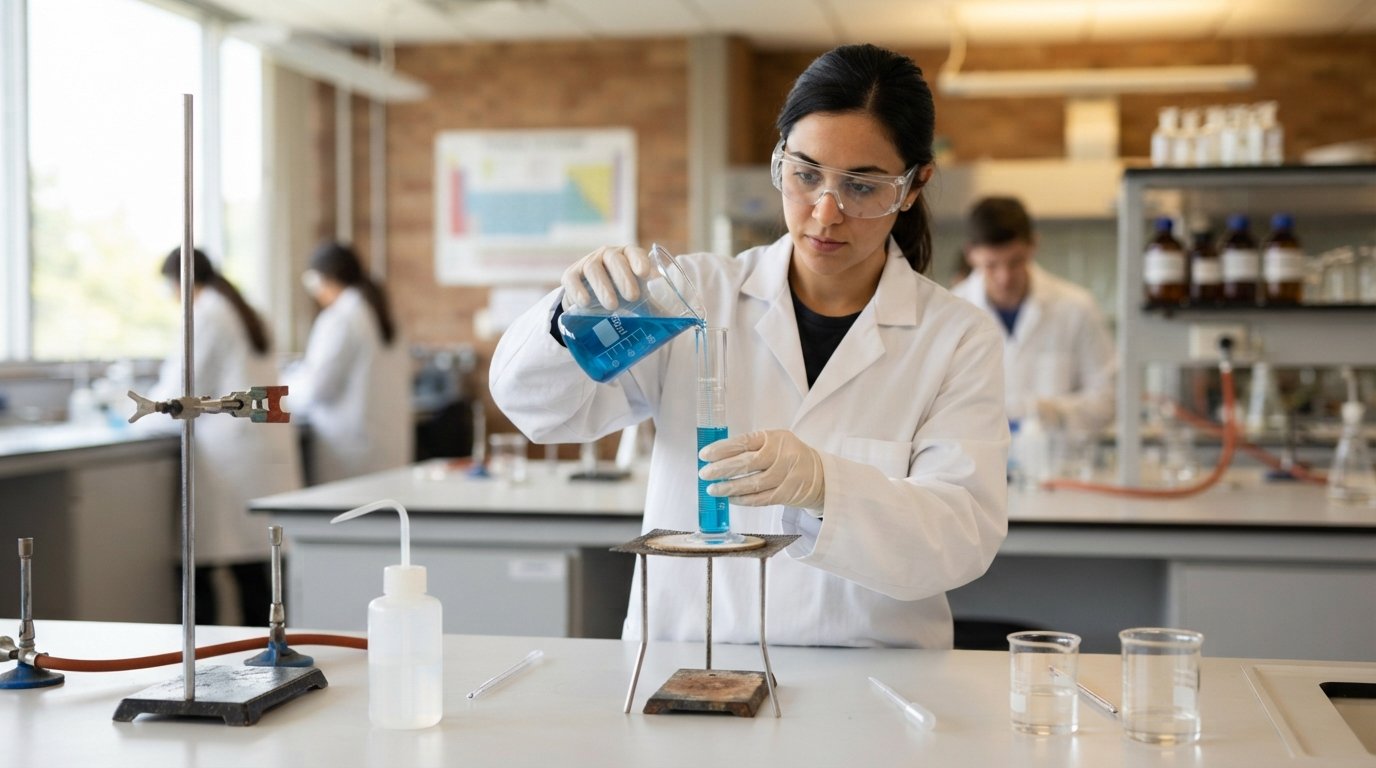
Chemistry Associate's Degree at Central Arizona College
Earn a Chemistry, General Associate's degree, usually 2 years In-person at Central Arizona College, with hands-on labs and transfer pathways to Arizona universities.

Choosing a science pathway after high school or during a career change can feel overwhelming, especially when you are balancing cost, location, and long-term goals. A Chemistry, General Associate's degree, usually 2 years In-person at Central Arizona College, offers a focused, lab-driven route for students who want a strong foundation in chemical science without committing to a four-year program right away. This degree is designed for learners who thrive in hands-on environments, plan to transfer to a university, or want to move quickly into entry-level laboratory roles in Arizona's growing industries.
Central Arizona College (CAC) serves Pinal County and surrounding communities with campuses in Coolidge, Apache Junction, Maricopa, and San Tan Valley. The in-person format matters here: chemistry is a tactile discipline, and working directly with instructors and lab equipment builds the skills and confidence that employers and transfer institutions expect. Whether you are a recent high school graduate, a working adult returning to school, or a student planning a pre-med or engineering pathway, understanding what this program includes, how it is structured, and where it can lead will help you decide if it is the right fit.
What the Chemistry, General Associate's Degree Covers
The Chemistry, General Associate's degree at Central Arizona College is built around core coursework in general chemistry, organic chemistry, analytical methods, and calculus-based physics, combined with general education requirements in English, mathematics, and social sciences. The program is typically completed in two years of full-time study, though part-time students can extend that timeline. Because it is delivered in person, students gain regular access to laboratory facilities, faculty office hours, and study groups that are harder to replicate online.
The curriculum is designed to satisfy the Arizona General Education Curriculum (AGEC) and transfer pathways to Arizona's public universities, including Arizona State University, the University of Arizona, and Northern Arizona University. That means credits earned at CAC are more likely to count toward a bachelor's degree in chemistry, biochemistry, or a related field. For students unsure about a four-year commitment, this associate's degree acts as a low-risk entry point with clear transfer options.
Below are the main components you can expect in this program:
- General chemistry sequence: Two semesters covering atomic structure, bonding, stoichiometry, thermodynamics, and lab safety.
- Organic chemistry sequence: Two semesters focused on carbon-based compounds, reaction mechanisms, and synthesis techniques.
- Supporting science and math: Calculus I and II, calculus-based physics, and possibly analytical chemistry or quantitative analysis.
- General education: Written communication, humanities, social sciences, and elective credits aligned with AGEC requirements.
- Laboratory work: Weekly hands-on sessions where students practice titration, distillation, spectroscopy, and safe chemical handling.
Beyond the list of courses, the value of this program lies in the lab culture. Students learn to write formal lab reports, interpret data, and troubleshoot experiments, all of which are transferable skills. Faculty at CAC often have industry or research experience, and small class sizes in lab sections mean more individualized feedback. That combination prepares graduates for upper-division coursework and for entry-level positions in quality control, environmental testing, and pharmaceutical support roles.
Why Choose the In-Person Format at Central Arizona College
Chemistry is one of those subjects where reading a textbook is not enough. You need to smell the reagents (safely), calibrate instruments, and see reactions happen in real time. The in-person format at Central Arizona College ensures that students spend significant time in laboratories with direct supervision. This is particularly important for students who plan to transfer into competitive university programs or apply to professional schools in medicine, pharmacy, or veterinary science.
In-person learning also builds professional habits. Showing up to a scheduled lab, collaborating with peers, and managing equipment are the same behaviors employers value in laboratory technicians and research assistants. Students who complete the Chemistry, General Associate's degree on campus often report stronger relationships with faculty, which can lead to research assistant opportunities, internships, and letters of recommendation. Those intangibles can make a difference when applying to scholarships or four-year institutions.
Another practical advantage is access to campus resources. CAC provides tutoring centers, science clubs, and advising services that are easier to use when you are on campus. For students in Pinal County, the commute to a CAC campus is often shorter than driving to a university in Phoenix or Tucson, which saves time and money. The in-person requirement also keeps students accountable and engaged, reducing the isolation that some online learners experience in rigorous science courses.
If you are comparing degree options and wondering how this program fits into broader earning potential, it helps to look at the bigger picture. According to our guide on top paying associate degrees for 2026, science and technical associate's degrees often outperform many liberal arts bachelor's degrees in early-career salary. That context matters when you are deciding whether to start with a two-year credential or go straight to a four-year school.
Admission Requirements and How to Apply
Central Arizona College maintains open-access admission policies, which means most students with a high school diploma or GED can enroll. However, the Chemistry, General Associate's degree has specific placement requirements in math and English. Students typically need to demonstrate readiness for college-level calculus, either through ACT or SAT scores, prior coursework, or a placement test. If you are not ready for Calculus I, CAC offers developmental math courses that can bridge the gap, though they may extend your timeline beyond two years.
The application process is straightforward and can be completed online through the CAC admissions portal. You will need to submit official transcripts from your high school and any previous colleges, complete the Free Application for Federal Student Aid (FAFSA) if you want financial aid, and meet with an academic advisor to map out your course sequence. Because chemistry courses are sequential (General Chemistry I before II, Organic Chemistry I before II), starting in the fall semester is usually the smoothest path.
Here is a step-by-step overview of the typical application sequence:
- Complete the CAC online application and pay any application fee (if applicable).
- Submit official high school transcripts or GED scores, plus transcripts from any colleges attended.
- Take the math and English placement assessments, or submit ACT, SAT, or prior college coursework for placement.
- File the FAFSA to determine eligibility for Pell Grants, work-study, and federal loans.
- Meet with an academic advisor to create an education plan and register for first-semester courses.
After registration, students should confirm lab fees and textbook costs, which can add several hundred dollars per semester. CAC offers payment plans and scholarship opportunities, and the financial aid office can help students compare options. It is also worth checking whether your employer offers tuition assistance, since many healthcare and manufacturing employers in Pinal County support employees pursuing science credentials.
Cost, Financial Aid, and Return on Investment
Cost is often the deciding factor for students considering a Chemistry, General Associate's degree, usually 2 years In-person at Central Arizona College. As a public community college, CAC charges significantly lower tuition than Arizona's public universities. For in-county residents, per-credit costs are among the lowest in the state, and even out-of-county students typically pay less than they would at a four-year institution. Books, lab fees, and supplies are additional costs, but they are manageable with planning.
Financial aid options include federal Pell Grants, Arizona Promise Program funds (for eligible students), institutional scholarships, and workforce development grants. The FAFSA is the gateway to most of these, and students should file it as early as possible each year. CAC also participates in work-study programs, which can place students in campus labs or administrative offices. For students who plan to transfer, maintaining a strong GPA can unlock merit scholarships at four-year institutions, further reducing the total cost of a bachelor's degree.
When evaluating return on investment, consider both transfer savings and earning potential. Completing two years at CAC before transferring can save tens of thousands of dollars compared with starting at a university. Graduates who enter the workforce directly with an associate's degree in chemistry often find roles as laboratory technicians, quality assurance assistants, or environmental sampling technicians. Salaries vary by employer and region, but science technicians in Arizona generally earn competitive wages with opportunities for advancement. For a deeper look at how associate's degrees compare across fields, resources like CollegeAndTuition provide useful context on college costs and financial planning.
It is important to note that program details, tuition rates, and financial aid availability can change. Students should verify current costs with CAC's financial aid office and confirm transfer agreements with their intended four-year institution. The Chemistry, General Associate's degree is a strong value proposition, but it works best when students plan ahead and use advising services regularly.
Transfer Pathways and University Partnerships
One of the strongest reasons to choose this program is its transferability. The Chemistry, General Associate's degree is designed to align with the AGEC and with major-specific transfer pathways. Students who complete the degree with a competitive GPA can apply to Arizona State University's School of Molecular Sciences, the University of Arizona's Department of Chemistry and Biochemistry, or Northern Arizona University's chemistry programs. Each university has specific lower-division requirements, so students should work with an advisor to select electives that match their target institution.
Transfer students sometimes face surprises when upper-division requirements differ from what they completed at community college. To avoid losing credits, CAC advisors recommend choosing courses from the Arizona Transfer Admission Guarantee (TAG) pathways when available. Some universities also offer dual enrollment or bridge programs that allow students to co-enroll while finishing the associate's degree. These arrangements can smooth the transition and shorten time to a bachelor's degree.
For students interested in professional programs such as pharmacy, medical school, or dental school, the associate's degree provides a foundation but is not sufficient on its own. Professional schools require a bachelor's degree and specific prerequisite courses, so transfer planning should begin in the first semester. Advisors can help students sequence organic chemistry, physics, and biology courses to meet both associate's and pre-professional requirements.
Career Outcomes and Next Steps After Graduation
Graduates with a Chemistry, General Associate's degree have several paths. The most common is transfer to a four-year institution to complete a bachelor's degree in chemistry, biochemistry, chemical engineering, or a health-related field. Others enter the workforce directly in laboratories, manufacturing facilities, water treatment plants, or environmental consulting firms. Entry-level roles may include laboratory assistant, quality control technician, or research aide. With experience and additional certifications, some technicians advance into supervisory or specialized positions.
For students who want to maximize earning potential, combining the associate's degree with industry certifications (such as hazardous materials handling or quality assurance) can improve job prospects. Internships and part-time lab work during the program are also valuable, and CAC's faculty and career services office can help students identify opportunities. Because the program is in person, students can build relationships with local employers through site visits, guest speakers, and job fairs.
Before enrolling, take these practical steps to stay on track:
- Meet with an academic advisor to confirm transfer requirements for your target university.
- File the FAFSA early and apply for CAC scholarships before priority deadlines.
- Plan your course sequence so that sequential chemistry courses are completed in order.
- Join a study group or science club to build support and stay motivated.
- Explore internship and research opportunities with faculty in your first year.
It is also wise to review the program's official catalog and speak with faculty about lab expectations, course loads, and workload. Chemistry is a demanding field, and success requires consistent study habits, time management, and a willingness to ask for help. Students who take advantage of tutoring and office hours tend to perform better and finish on schedule.
The Chemistry, General Associate's degree, usually 2 years In-person at Central Arizona College, is a practical, affordable, and transfer-friendly option for students who want a solid science foundation. It combines hands-on laboratory training with general education coursework and clear pathways to both employment and further study. By planning early, using financial aid resources, and working closely with advisors, students can turn this two-year program into a launchpad for a wide range of careers in science, healthcare, and industry.