
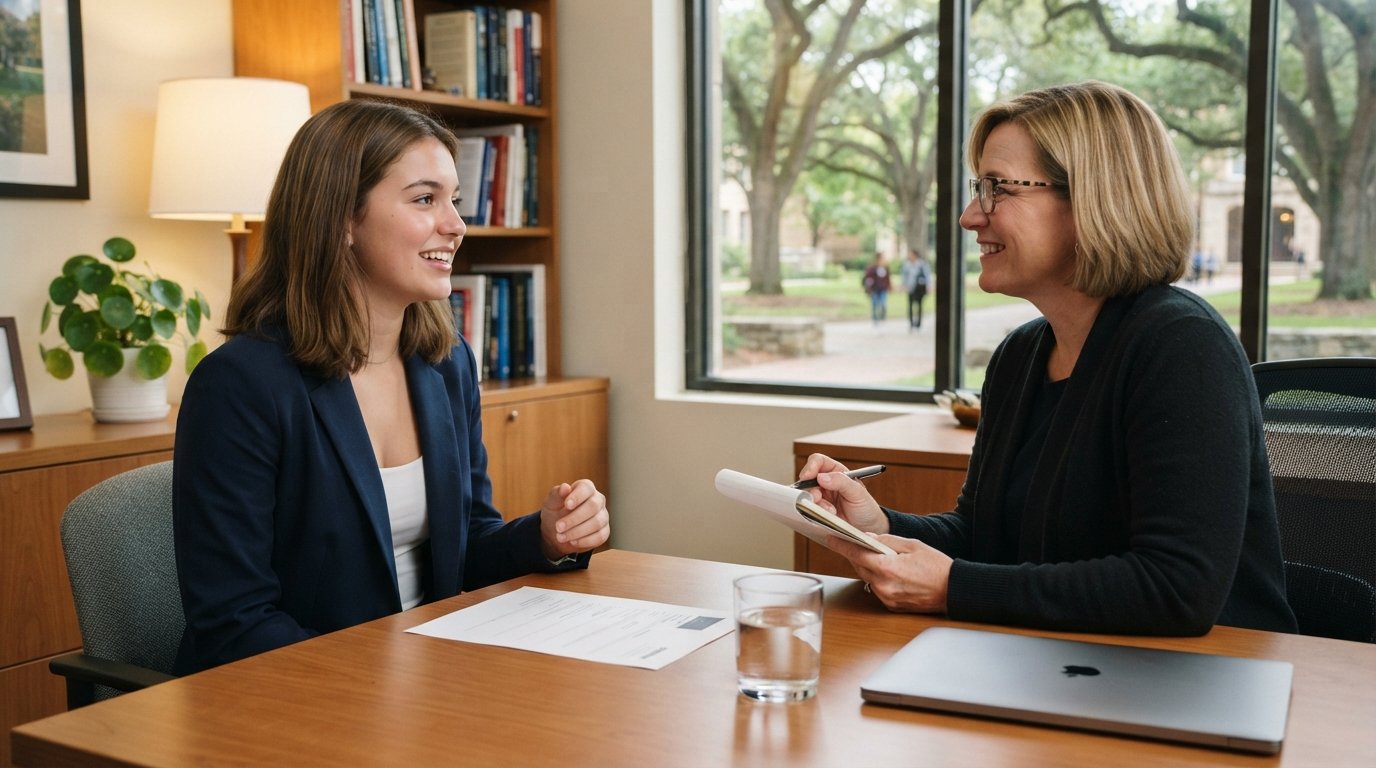
College Interview Preparation: Questions and Answers
College interview preparation questions and answers that help you craft authentic responses, ask smart questions, and leave a lasting impression.

By Natalie Simmons
You have submitted your applications, refreshed your email a hundred times, and now the invitation has arrived: an admissions interview. This conversation, whether it happens on campus, over video, or by phone, is your chance to move beyond test scores and transcripts. It is a genuine opportunity to show the person behind the application. The good news is that college interviews reward preparation far more than raw improvisation. With the right college interview preparation questions and answers in hand, you can walk in calm, confident, and ready to connect.
This guide breaks down the most common questions, explains what admissions officers are really listening for, and gives you frameworks for building answers that sound like you, not like a script. It also covers questions you should ask, logistics, and follow-up etiquette. By the end, you will have a complete practice plan you can start using today.
Why College Interviews Still Matter
Many selective schools receive thousands of applications from students with nearly identical grades and test scores. The interview is one of the few parts of the process that is fully human. It lets an admissions committee see how you think, how you communicate, and how you treat another person in a live conversation. Even at schools where interviews are optional or informational, a strong conversation can add a note to your file that tips a close decision in your favor.
Interviews also serve you, not just the college. They are a two-way evaluation. A good conversation helps you decide whether the campus culture, academic focus, and community actually fit who you are. Students who treat the interview as a genuine exploration often perform better because they are curious rather than defensive.
Finally, interviews build skills that outlast admissions season. The same preparation that helps you discuss your goals with an admissions officer will help you in scholarship interviews, internship conversations, and eventually job interviews. If you are still mapping out which programs to apply to, our guide on the best answers for college interview questions can help you align your story with the right schools before you ever sit down to talk.
The Core Questions You Will Almost Certainly Face
Most college interviews draw from a predictable pool of questions. The wording changes, but the underlying intent rarely does. Admissions officers want to know who you are, what you care about, and whether you will contribute to their community. The list below covers the questions that appear most often, along with the strategy behind each one.
- Tell me about yourself. This is an invitation to frame your narrative, not to recite your resume. Pick two or three threads (a passion, a value, a defining experience) and connect them.
- Why do you want to attend this college? Show that you have done specific research. Name a program, a professor, a tradition, or a resource that genuinely excites you.
- What are your academic interests? You do not need a declared major, but you should be able to explain what subjects energize you and why.
- What do you do outside the classroom? Choose activities that reveal commitment and character rather than listing everything you have ever joined.
- Describe a challenge you have overcome. Focus on how you responded, what you learned, and how you grew, not on the drama of the problem itself.
- Who has influenced you most? Pick a real person and be specific about what they taught you in practice.
- What do you want to do after college? It is fine to be uncertain, but show that you have thought about direction and impact.
Notice that none of these questions have a single correct answer. The interviewer is listening for authenticity, structure, and self-awareness. A student who says "I am not sure yet, but here is what I am exploring and why" often sounds stronger than one who recites a rehearsed five-year plan that does not match their actual interests.
One practical tip: record yourself answering each question in under two minutes. Most students either ramble past three minutes or answer in two sentences. The sweet spot is roughly sixty to ninety seconds per answer, with room for the interviewer to follow up.
How to Build Answers That Sound Like You
The biggest mistake students make is memorizing full scripts. Scripts collapse the moment the interviewer asks a follow-up question, and they make you sound like an admissions brochure. A better approach is to prepare flexible structures that you can fill with real details in the moment. One reliable framework is the STAR method, adapted for admissions conversations.
STAR stands for Situation, Task, Action, Result. You briefly describe the situation, explain what you were responsible for, describe what you actually did, and then share what happened. For a college interview, add a short reflection at the end: what did this experience teach you about yourself? That final sentence is what turns a story into an answer.
Consider a student asked about teamwork. A weak answer says, "I am a good team player." A STAR answer says, "Last spring our robotics team lost our lead programmer two weeks before competition. I organized daily practice sessions and rebuilt our code with two teammates. We placed fourth, but more importantly, I learned how to keep a group calm when the deadline is real." The second answer is specific, shows initiative, and reveals character.
You should also prepare a small set of "core stories" that can be reused across questions. Most students need only four or five: a leadership story, a failure story, a passion story, a community story, and a growth story. Once you have these polished, you can adapt them to almost any prompt without sounding scripted.
Questions You Should Ask the Interviewer
The interview is not an interrogation. When the interviewer asks, "Do you have any questions for me?" they are checking whether you are genuinely curious about the school. A blank stare wastes one of the best moments of the conversation. Prepare three to five questions in advance, and choose two or three that fit the flow of the discussion.
Good questions are specific and cannot be answered by a quick glance at the website. Instead of asking "How big is the school?" ask "How do students typically balance a heavy lab schedule with campus leadership roles?" That kind of question shows you are already imagining yourself on campus and thinking realistically about the experience.
If your interviewer is an alumnus, ask about their own experience. "What surprised you most about your first year here?" or "What would you do differently if you were starting over?" Alumni interviewers often love these questions because they invite reflection and personal storytelling. Just avoid questions whose answers are easily found online, such as application deadlines or tuition figures.
For students exploring online or hybrid options, the same principle applies. Ask how virtual students build community, how advising works across time zones, or how capstone projects are structured. If you are weighing multiple formats, resources like DegreesOnline.Education can help you compare accredited online programs and understand financial aid options before you commit.
Handling Difficult and Unexpected Questions
Not every question will be comfortable. Interviewers sometimes ask about weaknesses, conflicts, or controversial topics to see how you handle pressure. The goal is not to have a perfect answer. The goal is to stay thoughtful, honest, and composed.
When asked about a weakness, choose something real but not disqualifying. "I tend to take on too many commitments and then struggle to say no" is honest and shows self-awareness. Then explain what you are doing about it: setting weekly priorities, tracking commitments in a planner, or asking a mentor to help you evaluate opportunities. Never say "I am a perfectionist" as a way to avoid the question. Interviewers have heard it a thousand times and it signals evasion.
If you are asked about a current event or a social issue, take a moment to think before answering. It is completely acceptable to say, "That is a great question. Let me think for a second." A brief pause signals maturity. Then offer a balanced perspective, acknowledge complexity, and connect the issue to something you care about or have studied. You do not need to be an expert. You need to demonstrate that you can reason carefully and listen to other viewpoints.
If you genuinely do not know something, say so and pivot to what you do know. "I have not studied that yet, but it connects to a topic I have been reading about, which is..." Honesty builds more trust than bluffing ever will.
Logistics, Etiquette, and Follow-Up
Preparation also means handling the practical details well. For an in-person interview, arrive ten to fifteen minutes early, dress in business casual unless the school specifies otherwise, and bring a small notebook with your questions. For a virtual interview, test your camera, microphone, and internet connection the day before. Sit in a quiet, well-lit space with a neutral background. Look at the camera when you speak, not at your own image on the screen.
During the conversation, practice active listening. Nod, maintain appropriate eye contact, and let the interviewer finish before you respond. If you need clarification, ask for it. "Could you say a little more about what you mean by intellectual curiosity?" shows engagement rather than confusion.
Within twenty-four hours, send a brief thank-you email. Reference something specific from the conversation, such as a book the interviewer mentioned or a program you discussed. Keep it to three or four sentences. This small gesture is remembered, especially at schools where demonstrated interest matters.
Finally, remember that the interview is a conversation, not a performance. The most memorable candidates are not the ones with perfect answers. They are the ones who were curious, kind, and genuinely excited to talk about ideas. Prepare thoroughly, practice out loud, and then trust yourself to be present. That combination, more than any script, is what leaves a lasting impression.