
Dallas College Cloud Computing Associate Degree Guide
A Dallas College Cloud Computing Associate's degree takes about two years in person. Call (877)-218-7081 to explore low-cost cloud career paths.

By Dylan Richardson
Dallas College offers a Cloud Computing Associate's degree that most students complete in about two years of in-person study, and for anyone in North Texas who wants to move into cloud operations, support, or junior engineering work without a four-year commitment, the program deserves a close look. Cloud computing has moved from a niche IT specialty to the backbone of how modern organizations store data, run applications, and deliver services. That shift has created steady demand for technicians and administrators who understand platforms like Amazon Web Services, Microsoft Azure, and Google Cloud. A two-year degree can be a practical, affordable on-ramp to those roles, and Dallas College has built its program around exactly that goal.
This guide walks through what the degree covers, how the in-person format works, what it costs, what careers it can lead to, and how to decide whether it fits your situation. Whether you are a recent high school graduate, a career changer, or someone already working in IT who wants formal credentials, the details below should help you plan your next step. For a broader look at how two-year credentials pay off across fields, our guide on the top paying associate degrees puts cloud and IT programs in context with other high-return options.
What a Cloud Computing Associate's Degree Covers
An associate degree in cloud computing is a two-year undergraduate credential, typically around 60 credit hours, that blends general education with hands-on technical coursework. The general education portion usually includes English composition, college algebra or statistics, and a social or behavioral science elective. The technical portion is where the real value sits, and at Dallas College it centers on the skills employers actually list in job postings for cloud support and administration roles.
Core topics generally include networking fundamentals, server operating systems, virtualization, identity and access management, storage concepts, and at least one major cloud platform. Students also learn scripting basics, often in Python or PowerShell, because automation is central to how cloud environments are managed. Security fundamentals run through most courses, since misconfigured cloud resources remain one of the most common causes of data breaches.
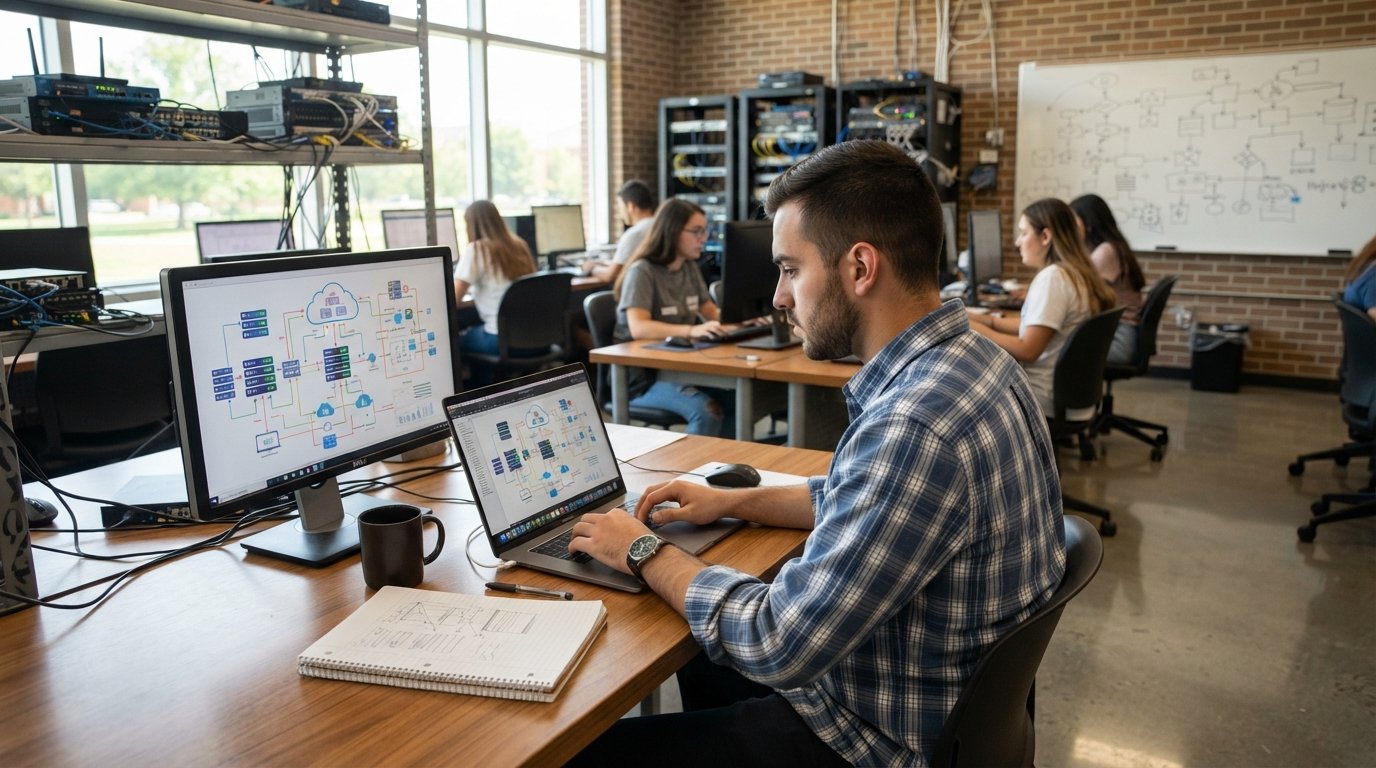
Because the program is delivered in person, lab work happens on campus with direct instructor support. That matters in cloud computing, where troubleshooting a failed deployment or a broken virtual network is far easier when someone experienced can look over your shoulder. Many students find that the in-person format also builds the professional communication habits that IT teams expect, from documenting a change to explaining an outage to a non-technical manager.
Typical Coursework and Skills You Build
The specific course list varies by catalog year, but most cloud computing associate programs at Dallas College cover a recognizable set of skill areas. The list below reflects the kinds of competencies employers expect from entry-level cloud hires.
- Network and security fundamentals, including TCP/IP, firewalls, and access controls
- Cloud platform administration on AWS, Azure, or both
- Virtualization and container basics, including virtual machines and Docker
- Scripting and automation with Python, PowerShell, or Bash
- Operating system administration for Windows Server and Linux
Beyond the technical list, the degree builds habits that matter over a career: reading documentation carefully, testing changes before deploying them, and working through problems methodically. Those habits transfer to any platform, which is important because cloud vendors release new services constantly and no single course can cover everything.
Why the In-Person Format at Dallas College Matters
Online degrees have real advantages for working adults, and it is worth being honest about that. If you already have a full-time job, a family, or a long commute, an online program may be the only realistic option. That said, the in-person format at Dallas College offers specific benefits that are easy to underestimate when you are comparing programs on a screen.
First, cloud computing is a lab-heavy field. In person, you get access to campus equipment, structured lab time, and immediate feedback when something breaks. Second, instructors who teach in person often have current industry ties, and those relationships can turn into referrals, internships, or job leads. Third, the in-person setting creates a cohort of peers you will study with for two years, and those peers often become your professional network for years afterward.
Dallas College also operates multiple campuses across the Dallas metro area, which means many students can find a location within a reasonable drive. The in-person schedule typically follows a traditional semester calendar, with fall and spring starts and optional summer sessions that can shorten your time to graduation. If you want to finish faster, stacking summer courses is one of the most reliable ways to do it.
Admission Requirements and How to Apply
Dallas College uses an open admission model for most associate programs, which means you do not need a competitive GPA or standardized test scores to get started. The main steps are straightforward, but they do take time, so it helps to work through them in order rather than all at once.
- Submit an application to Dallas College and receive your student ID.
- Provide proof of Texas residency if you want in-district tuition rates.
- Submit transcripts from any prior colleges, or take placement measures if needed.
- Complete any required advising or orientation session for new students.
- Register for first-semester courses, ideally with an advisor's help.
One practical note: many students save money by completing general education courses at Dallas College and confirming in advance that those credits will transfer if they later pursue a bachelor's degree. Transfer planning is much easier in the first semester than in the last, so ask an advisor early about any four-year school you might consider.
Cost, Financial Aid, and Return on Investment
Cost is one of the strongest arguments for the associate degree route. Dallas College charges tuition per credit hour, and students who live in the college's service area typically pay a lower in-district rate than out-of-district or out-of-state students. Because the program is about 60 credit hours, total tuition and fees often land in a range that is a fraction of what a four-year private university would charge for the same two years.
Financial aid options include federal grants, work-study, and student loans, plus Texas-specific aid programs and institutional scholarships. Many students qualify for enough grant aid to cover most or all of their tuition, especially if they file the FAFSA early. Employer tuition assistance is another underused option, and some IT employers will reimburse part of the cost if the degree relates to your current role.
To judge the return on investment, compare total program cost against realistic starting salaries for cloud support and administration roles in the Dallas-Fort Worth market. Even a conservative estimate usually shows the degree paying for itself within a few years, particularly for students who avoid heavy borrowing. Families weighing these numbers across multiple schools may find general college cost and financial aid resources useful before committing, and sites like CollegeAndTuition publish planning guides aimed at that exact decision.
Careers and Earning Potential After Graduation
Graduates of a Cloud Computing Associate's degree typically enter the workforce in roles that sit between help desk support and full cloud engineering. These positions are common in Dallas because the metro area hosts a large concentration of corporate headquarters, data centers, and technology employers. The table below outlines several realistic entry points and what they tend to involve.
- Cloud support associate: troubleshoots cloud services, manages tickets, and assists users
- Junior cloud administrator: handles user accounts, permissions, and basic infrastructure
- Network operations technician: monitors uptime and responds to connectivity issues
- IT support specialist with cloud focus: supports hybrid environments mixing on-premises and cloud
- Junior DevOps or automation technician: writes scripts and maintains deployment pipelines
Earnings vary by employer, shift, and certifications, but entry-level cloud roles in the Dallas market generally pay meaningfully more than general help desk positions. Adding a certification such as AWS Certified Cloud Practitioner or Microsoft Azure Fundamentals while you are still enrolled can improve both your starting offers and your confidence in interviews. Many students sit for one or two certifications before graduation because the exam objectives overlap heavily with coursework.
Career progression from these roles is well documented. With two to four years of experience and additional certifications, many technicians move into cloud engineer, site reliability, or security roles, where salaries rise substantially. The associate degree is not the ceiling; it is the first step in a ladder that rewards continued learning.
How to Succeed in the Program
Students who do well in cloud computing programs tend to share a few habits. They treat the degree as a full-time commitment even when enrolled part-time, because technical skills fade quickly without practice. They build a small home lab or use free-tier cloud accounts to experiment outside class. They document what they learn, both for themselves and as portfolio material. And they start networking early, through classmates, instructors, and local user groups.
It also helps to sequence certifications alongside coursework rather than after graduation. A common approach is to earn a foundational certification in the first year, then a more specialized one in the second year. This spreads the exam cost over time and gives you resume items to show employers while you are still a student. Internships and part-time IT jobs, even at a campus help desk, add practical experience that makes the first job search much easier.
Finally, plan your transfer options before you finish. If you may eventually want a bachelor's degree in cloud computing, cybersecurity, or information technology, confirm which four-year schools accept your Dallas College credits and under what conditions. Doing that work early keeps the door open without adding cost or time later.
A Cloud Computing Associate's degree completed in about two years of in-person study at Dallas College is a practical path into one of the most durable corners of the technology job market. The combination of low cost, hands-on labs, local employer demand, and clear pathways to certifications and further education makes it a strong choice for students who want to start working sooner rather than later. If you are ready to compare programs or find a school near you, contact our team at (877)-218-7081 to talk through your options.