
Fresno State School Counseling Master's: In-Person Guide
Earn your school counseling master's in person at Fresno State. Explore admission steps, fieldwork, PPS credentialing, and career outcomes.
By Connor Howard
Choosing a graduate program in school counseling is one of the most consequential decisions you will make as an aspiring counselor, and the format you choose matters as much as the curriculum itself. At California State University-Fresno, students who pursue Counselor Education/School Counseling and Guidance Services beyond a bachelor's degree in person gain something that online cohorts often struggle to replicate: sustained face-to-face mentorship, live supervision, and deep community ties that translate directly into stronger job placement across the Central Valley and beyond.
This guide walks through what makes the Fresno State in-person pathway distinctive, how the program is structured, what it takes to get admitted, and how the degree positions you for licensure, career advancement, and long-term earning potential. Whether you are a recent graduate, a working educator, or a career changer exploring advanced study, understanding these details helps you decide whether this program fits your goals.
Why In-Person Counselor Education at Fresno State Stands Apart
California State University-Fresno sits at the heart of a region with acute demand for school counselors. Districts across Fresno, Madera, Kings, and Tulare counties consistently report counselor-to-student ratios far above the national average, and state funding initiatives have pushed schools to hire more credentialed counseling professionals. That demand creates a rare advantage for graduates: the clinical placements, internship sites, and professional networks you build during your studies are often located in the very districts that will later hire you.
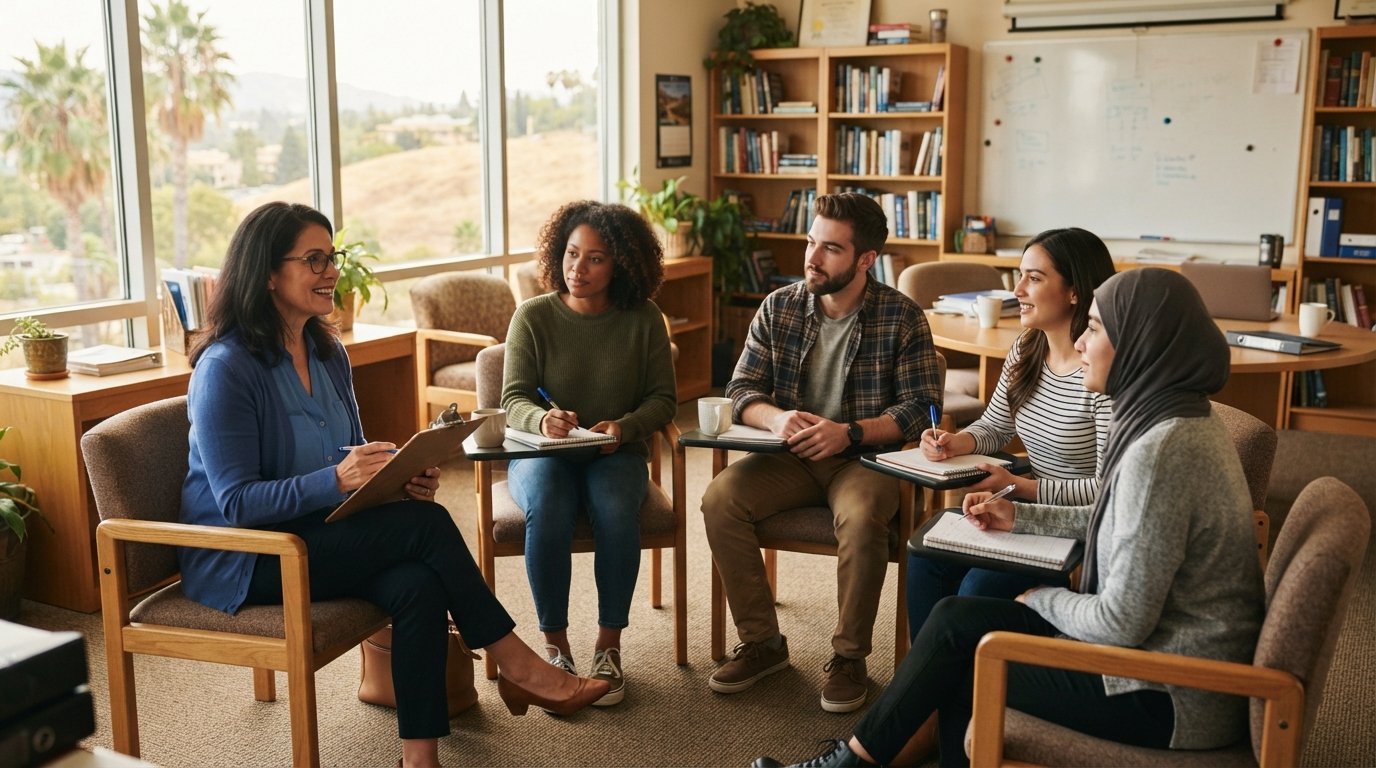
In-person study amplifies that advantage. When you attend classes on campus, you practice counseling skills in real time with peers and faculty observing your technique. You receive immediate feedback on your active listening, your ability to structure a session, and your handling of crisis scenarios. These are skills that simply cannot be developed as effectively through asynchronous discussion boards. The American School Counselor Association and the Council for Accreditation of Counseling and Related Educational Programs (CACREP) both emphasize supervised clinical experience as a cornerstone of counselor preparation, and Fresno State's in-person format is built around that principle.
Beyond clinical skill development, the in-person format fosters relationships that last. Faculty members who know you by name can write detailed letters of recommendation, connect you with district hiring managers, and guide you through the credentialing process. Fellow students become colleagues who share job leads and collaborate on professional development long after graduation. For adult learners and career changers, this sense of cohort community can be the difference between finishing the program and feeling isolated.
Program Structure and What You Will Study
The Counselor Education/School Counseling and Guidance Services program at Fresno State is designed as a graduate-level pathway, typically culminating in a Master of Science degree with an embedded Pupil Personnel Services (PPS) credential. That credential is the license California public schools require for school counseling roles, and it is awarded only after you complete approved coursework, practicum hours, and fieldwork.
Coursework blends counseling theory with practical application. You will study human development, multicultural counseling, career development, group counseling, assessment and testing, and legal and ethical issues in school settings. Each of these areas maps directly to the knowledge domains tested in credentialing and licensing examinations, so the curriculum doubles as exam preparation. In-person seminars allow professors to adapt discussions to the real challenges students are encountering in their field placements, which keeps the material current and relevant.
Fieldwork is where the program truly comes alive. Students complete supervised practicum hours and a longer internship, usually placed in K-12 schools under the guidance of a credentialed site supervisor. Because Fresno State maintains partnerships with numerous local districts, you may find yourself working in elementary, middle, or high school settings, depending on your career interests. The following components form the core of the in-person experience:
- Face-to-face seminar courses covering counseling theory, ethics, and multicultural practice
- Supervised practicum with live observation and feedback from faculty and site supervisors
- Full-year internship in a K-12 school setting, aligned with PPS credential requirements
- Electives or specialization coursework in areas such as college readiness, crisis intervention, or trauma-informed counseling
- Comprehensive exams or a capstone project, depending on the track you select
What sets this structure apart is the sequencing. Rather than treating fieldwork as an afterthought, the program weaves it into the academic calendar so that what you learn in class on Monday informs what you practice in a school on Tuesday. That integration is hard to achieve when coursework and fieldwork are geographically or temporally disconnected, which is often the case in fully online programs.
Admission Requirements and Who Should Apply
Admission to the Fresno State counselor education program is competitive, and the requirements reflect the professional nature of the degree. Applicants typically need a bachelor's degree from an accredited institution, a minimum GPA that meets university and program thresholds, and a completed application that includes personal statements, letters of recommendation, and evidence of suitability for counseling work. Some applicants come from education backgrounds, while others arrive from psychology, social work, sociology, or entirely unrelated fields.
Because the program leads to a credential that involves working with minors, you should also expect a background check, fingerprinting, and possibly a TB test as part of the enrollment process. These are standard requirements for anyone entering California public school settings, and they are not unique to Fresno State.
If you are unsure whether your undergraduate record or professional experience aligns with the program's expectations, it helps to explore broader resources on graduate degree pathways and accreditation. Sites such as DegreesOnline.Education provide guides on master's and doctoral programs, financial aid, and how to evaluate whether a program's accreditation and outcomes match your career plans. That kind of research can clarify whether the in-person Fresno State route or a different format is the better fit for your situation.
Ideal candidates tend to share a few traits: a genuine interest in working with young people, comfort with emotional complexity, and a willingness to examine their own biases and communication patterns. The program is rigorous, and the in-person format demands that you show up prepared, both intellectually and emotionally, for every class and every field placement.
Licensure, Credentialing, and Career Outcomes
Graduates of the Counselor Education/School Counseling and Guidance Services program at Fresno State typically pursue the Pupil Personnel Services credential, which authorizes them to work as school counselors in California public schools. The credential is issued by the California Commission on Teacher Credentialing and requires completion of an approved program, a bachelor's degree, and the recommendation of the university. Some graduates also pursue licensure as professional clinical counselors or marriage and family therapists, though those paths require additional coursework and supervised hours beyond the school counseling credential.
Career outcomes for school counselors in California are strong. According to the U.S. Bureau of Labor Statistics, school and career counselors nationally earn a median annual wage in the mid-$50,000s, with California salaries often exceeding that figure due to the state's higher cost of living and strong union representation. Counselors in districts with high needs may qualify for loan forgiveness programs and stipends, and many professionals advance into lead counselor, department chair, or district coordinator roles after several years of experience.
For those who want to expand their options further, the master's degree opens doors to doctoral study in counselor education and supervision, which can lead to faculty positions, research roles, or leadership in district-level student services. The in-person format at Fresno State gives you the faculty relationships and research exposure that make doctoral applications more competitive, particularly if you are interested in studying issues specific to the Central Valley, such as rural mental health access or bilingual counseling services.
Practical Considerations for Adult Learners and Career Changers
Many students who pursue the Fresno State program are not traditional full-time graduate students. They are working teachers, paraprofessionals, parents, and career changers who need to balance coursework with employment and family responsibilities. The in-person format can be challenging for these students, but it is also manageable with planning. Evening and late-afternoon classes are common, and fieldwork placements can sometimes be arranged near your home or workplace.
Financial planning is another important consideration. Graduate tuition at Fresno State is relatively affordable compared with private institutions, and students may qualify for federal financial aid, state grants, and employer tuition assistance if they work in education. Some districts offer stipends or reimbursement for employees pursuing counseling credentials, particularly in hard-to-staff areas. Exploring scholarship databases and speaking with the program's financial aid advisors early in the application process can reduce the financial burden significantly.
Time management matters as much as money. The combination of evening classes, weekend fieldwork, and personal responsibilities requires discipline and a supportive network. Students who succeed in the in-person program often form study groups, share childcare arrangements, and rely on cohort peers for emotional support. That mutual reliance is one of the hidden benefits of the face-to-face format, because it mirrors the collaborative nature of the counseling profession itself.
How This Program Compares With Online Alternatives
Online counselor education programs have grown rapidly, and they offer flexibility that in-person programs cannot match. For students who live far from campus, have unpredictable work schedules, or need to relocate frequently, online study may be the only viable option. However, online programs vary widely in quality, and some struggle to secure adequate fieldwork placements for students in remote areas.
The Fresno State in-person program's primary advantage is its embedded clinical infrastructure. Faculty have established relationships with local schools, and they can place students in sites where supervision is strong and the experience is meaningful. In contrast, online students often have to find their own placement sites, which can be stressful and may result in less consistent supervision. If your goal is to work in Central Valley schools, the in-person network is difficult to beat.
That said, the best program is the one that fits your life. If you are weighing options, consider factors such as accreditation, licensure pass rates, fieldwork support, and total cost. A program that is convenient but lacks proper accreditation or fieldwork support will not serve you well, no matter how flexible it is. Conversely, an in-person program that requires relocation or a long commute may be impractical if you cannot adjust your work or family obligations. Honest self-assessment is essential before committing to any graduate pathway.
Steps to Apply and Prepare
If you decide that the Fresno State in-person program aligns with your goals, the application process is straightforward but requires attention to detail. Most applicants begin preparing several months before the deadline. The following sequence reflects the typical steps:
- Review the program's admission requirements and confirm that your undergraduate degree and GPA meet the minimum thresholds.
- Request official transcripts from all colleges you have attended and arrange for them to be sent directly to the university.
- Identify and contact recommenders who can speak to your academic ability and suitability for counseling work.
- Draft a personal statement that explains your interest in school counseling, your relevant experience, and your career goals.
- Complete the online application, pay the fee, and submit all supporting materials before the posted deadline.
- Prepare for a possible interview or group assessment, which some cohorts use to evaluate interpersonal skills.
After admission, you will need to complete orientation, register for classes, and begin the credentialing paperwork. If you are working while studying, speak with your employer early about scheduling flexibility and any tuition benefits that may be available. Planning ahead reduces stress and helps you focus on what matters most: becoming an effective counselor.
It also helps to connect with current students or recent graduates before you enroll. They can offer candid insight into workload, faculty expectations, and the realities of balancing fieldwork with coursework. Alumni are often willing to share their experiences, and those conversations can confirm whether the program is the right fit for you.
Final Thoughts on Advancing Your Counseling Career
Pursuing Counselor Education/School Counseling and Guidance Services beyond a bachelor's degree in person at California State University-Fresno is a commitment that rewards students with strong clinical preparation, meaningful professional relationships, and a credential that opens doors in California's public schools. The face-to-face format demands time and presence, but it also provides the supervision, mentorship, and community that help new counselors thrive in a demanding and deeply human profession.
If you are ready to take the next step, start by researching the program's current admission requirements, speaking with faculty or advisors, and mapping out your financial and scheduling plan. The path to becoming a school counselor is challenging, but it is also one of the most fulfilling ways to make a lasting difference in the lives of young people.