
Manufacturing Engineering Technology Degree at CCCC
Earn a Manufacturing Engineering Technology/Technician Associate's degree in about 2 years, in person at Central Carolina Community College, and start a hands-on technical career.

By Connor Howard
A two-year credential can put you on the plant floor, in the quality lab, or beside the automation cells that keep modern production lines running. The Manufacturing Engineering Technology/Technician Associate's degree, usually 2 years In-person at Central Carolina Community College, is built for exactly that path: a hands-on program that trains students to troubleshoot machines, program equipment, read technical drawings, and improve production processes. If you want a fast route into a high-demand technical career without committing four years to a bachelor's degree, this program deserves a serious look.
Central Carolina Community College (CCCC) serves Lee, Harnett, and Chatham counties in North Carolina, with campuses in Sanford, Lillington, and Pittsboro. The college has long been tied to the region's manufacturing base, from advanced materials to food processing to automotive suppliers. That local industry connection shapes how the program is taught: students work with real equipment, learn from instructors with plant experience, and often step into jobs with employers who already know the college's graduates.
What the Manufacturing Engineering Technology/Technician Associate's Degree Covers
The core of this degree is applied engineering. You are not just learning theory; you are learning how to make things, fix things, and make processes better. Coursework typically blends mechanical and electrical fundamentals with computer-aided design, industrial automation, and quality systems. Students learn to interpret blueprints and schematics, set up and operate machine tools, program logic controllers, and apply lean manufacturing principles to reduce waste.
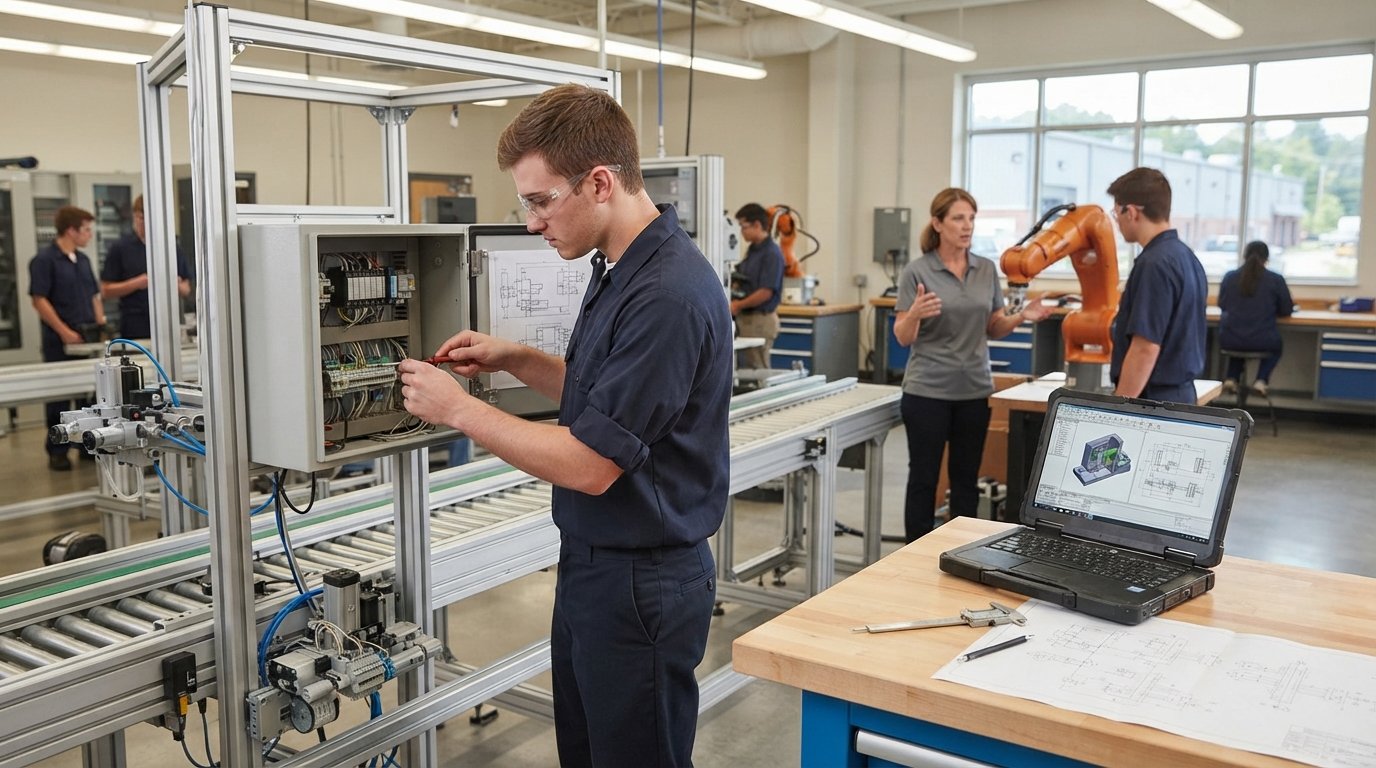
Because the program is delivered in person, the lab component is central. You will spend significant time with your hands on equipment: mills, lathes, robotics trainers, PLCs, and measurement instruments. That in-person format matters in this field. Employers want technicians who have already stood at a machine, diagnosed a fault, and corrected it under supervision. Online simulations cannot fully replace that experience.
Typical topic areas in a program like this include:
- Manufacturing processes and materials (machining, welding, forming, and assembly)
- Computer-aided design and drafting (CAD), often with solid modeling software
- Industrial electricity, electronics, and motor controls
- Programmable logic controllers (PLCs) and automation systems
- Quality assurance, metrology, and statistical process control
- Lean manufacturing, safety, and production planning
General education courses round out the degree, usually in math, communication, and technical writing. Those classes are not filler. Technicians write reports, document process changes, and communicate with engineers and operators, so clear communication is a job skill, not an academic formality.
It helps to see this credential in a broader context. If you are comparing technical fields and wondering how compensation stacks up across engineering specialties, our guide to the highest paying engineering degrees for 2026 shows where hands-on engineering technology roles fit in the wider salary landscape.
Why Central Carolina Community College Stands Out
CCCC is not a generic option. The college sits in a manufacturing corridor that includes biotech, automotive parts, and industrial equipment makers. That geography creates partnerships, internships, and advisory boards that keep the curriculum current. When local employers tell the college which skills are missing in new hires, the program adjusts. That feedback loop is one reason graduates tend to be job-ready quickly.
The in-person requirement is also a feature, not a bug. Manufacturing engineering technology is a tactile discipline. Learning to align a machine, read a micrometer, or trace a wiring fault requires repetition in a physical lab. At CCCC, students get access to equipment and instructor feedback that simply is not available in a fully online format. For adult learners juggling work and family, the tradeoff is real, but many students find that the hands-on hours are what make them competitive in interviews.
Class sizes in technical programs at community colleges tend to be small, and that means more individual attention. If you struggle with a concept, you are not a face in a 300-person lecture hall. You are in a lab with an instructor who can watch you work and correct your technique in real time.
Admission Requirements and How to Apply
Admission to a community college associate's degree program is generally accessible, but it is not automatic. You will need to complete the college's application, submit transcripts, and likely take a placement test or provide evidence of college readiness in math and English. Some programs have additional requirements, such as a minimum GPA or specific coursework in high school algebra.
A practical sequence for most applicants looks like this:
- Apply to Central Carolina Community College online and pay any application fee.
- Request official transcripts from your high school and any colleges you have attended.
- Complete placement testing or submit SAT, ACT, or prior college coursework for waiver consideration.
- Meet with an academic advisor to map the manufacturing engineering technology plan of study.
- Apply for financial aid by completing the FAFSA, and ask about scholarships or employer tuition programs.
- Register for first-semester classes early, since lab sections can fill quickly.
Because this is an in-person program, schedule planning matters. Many students attend full time during the day, but some technical programs offer evening or hybrid options for working adults. Ask the department directly about section times, because availability changes each term.
Financial aid is a common concern. In addition to federal grants and loans, North Carolina offers state aid programs, and many manufacturers reimburse tuition for employees pursuing technical degrees. If you already work in a plant, talk to your supervisor before you enroll. Some employers will pay upfront or reimburse you after each semester, which can dramatically improve the return on your investment.
Careers and Earning Potential After Graduation
Graduates of manufacturing engineering technology programs typically move into roles such as manufacturing technician, process technician, quality technician, automation technician, or production supervisor. These are not dead-end jobs. Many technicians move into engineering roles over time, especially if they continue their education or earn certifications in areas like robotics or lean manufacturing.
Pay varies by region, industry, and shift. Manufacturing technicians in North Carolina often start in the $40,000 to $55,000 range, with higher pay for automation and controls skills. Overtime and shift differentials can push total compensation higher. Supervisors and senior technicians with several years of experience frequently earn $60,000 to $80,000 or more. Those numbers are not guaranteed, but they reflect the reality that skilled technicians are in short supply.
It also helps to think beyond the first job. An associate's degree can stack into a bachelor's degree later, often with transfer agreements that let you apply technical credits toward a four-year program. That pathway can lead to roles in manufacturing engineering, industrial engineering, or operations management. For students who want to keep climbing, the two-year degree is a starting point, not a ceiling.
If you are still exploring options and want to compare accredited programs, formats, and costs, resources like DegreesOnline.Education can help you evaluate what fits your schedule and budget, even if you ultimately choose an in-person path.
Is This Degree Worth It for You?
The honest answer depends on your goals, your schedule, and your willingness to work with your hands. If you want a desk job and prefer abstract theory, this may not be the right fit. If you like solving physical problems, improving processes, and seeing the result of your work at the end of a shift, it is a strong choice.
Consider the math. Two years of tuition at a community college is far less than four years at a university, and you can often work part time while enrolled. Graduates enter the workforce sooner and start earning sooner. In fields where employers are desperate for skilled technicians, that speed matters. You are not waiting for a degree to pay off in some distant future; you are building a career while you learn.
There are also risks to weigh. Manufacturing can be cyclical. Plants close, production moves, and technology changes. The best protection is versatility: learn automation, learn quality systems, learn to program and troubleshoot. The more systems you understand, the more valuable you are when the plant floor evolves. The Manufacturing Engineering Technology/Technician Associate's degree, usually 2 years In-person at Central Carolina Community College, is designed to build that versatility from day one.
Finally, talk to people who have done it. Ask the college for alumni contacts, visit the campus, and walk through the labs. Ask about job placement rates and which employers hire graduates. A program that fits your life and your goals is worth more than one that merely looks good on paper. If you are ready to move from curiosity to a plan, start with an advising appointment and a financial aid conversation. The path from student to skilled technician can be shorter than you think.