
Medical/Clinical Assistant Certificate at Charter College Yakima
The Medical/Clinical Assistant Certificate at Charter College Yakima can be completed in 12 weeks to under a year. Call 8772187081 for details.

By Giovanna Rivera
Finding a healthcare career that gets you working with patients quickly, without spending years in a classroom, is a challenge many career changers face. The Medical/Clinical Assistant Certificate offered at Charter College Yakima is designed to address exactly that problem. This program can be completed in as little as 12 weeks to less than 1 year, and it uses a mix of in-person and online instruction to fit around real life. If you live in the Yakima Valley and want to step into a medical office, clinic, or hospital setting with practical skills and a recognized credential, this pathway deserves a close look.
What Is a Medical/Clinical Assistant Certificate?
A medical/clinical assistant certificate is a short-term credential that prepares you to work in healthcare settings, performing both administrative and clinical tasks. Medical assistants are often the people who greet patients, take vital signs, prepare exam rooms, update medical records, and assist physicians during procedures. The role sits at the intersection of patient care and office operations, which makes it a versatile entry point into the healthcare field.
Unlike a two-year associate degree, a certificate program focuses on the core skills you need to start working. That shorter timeline means less time out of the workforce and a faster return on your education investment. At Charter College Yakima, the certificate is structured to deliver that training through a blend of hands-on labs, classroom instruction, and online coursework, so you get both the practical experience and the flexibility that adult learners need.
Healthcare is one of the most stable industries in the country, and demand for medical assistants continues to grow as clinics and hospitals expand services. According to the U.S. Bureau of Labor Statistics, medical assistant employment is projected to grow much faster than the average for all occupations over the next decade. That makes a certificate like this one a practical choice for anyone who wants a career with staying power.
How the 12-Week to Less Than 1 Year Timeline Works
One of the most appealing aspects of this program is the compressed timeline. You can finish in as little as 12 weeks if you enroll in the accelerated option, or take up to less than a year if you prefer a more manageable pace. This range accommodates different schedules, whether you are working full-time, caring for family, or simply want to move quickly into a new career.
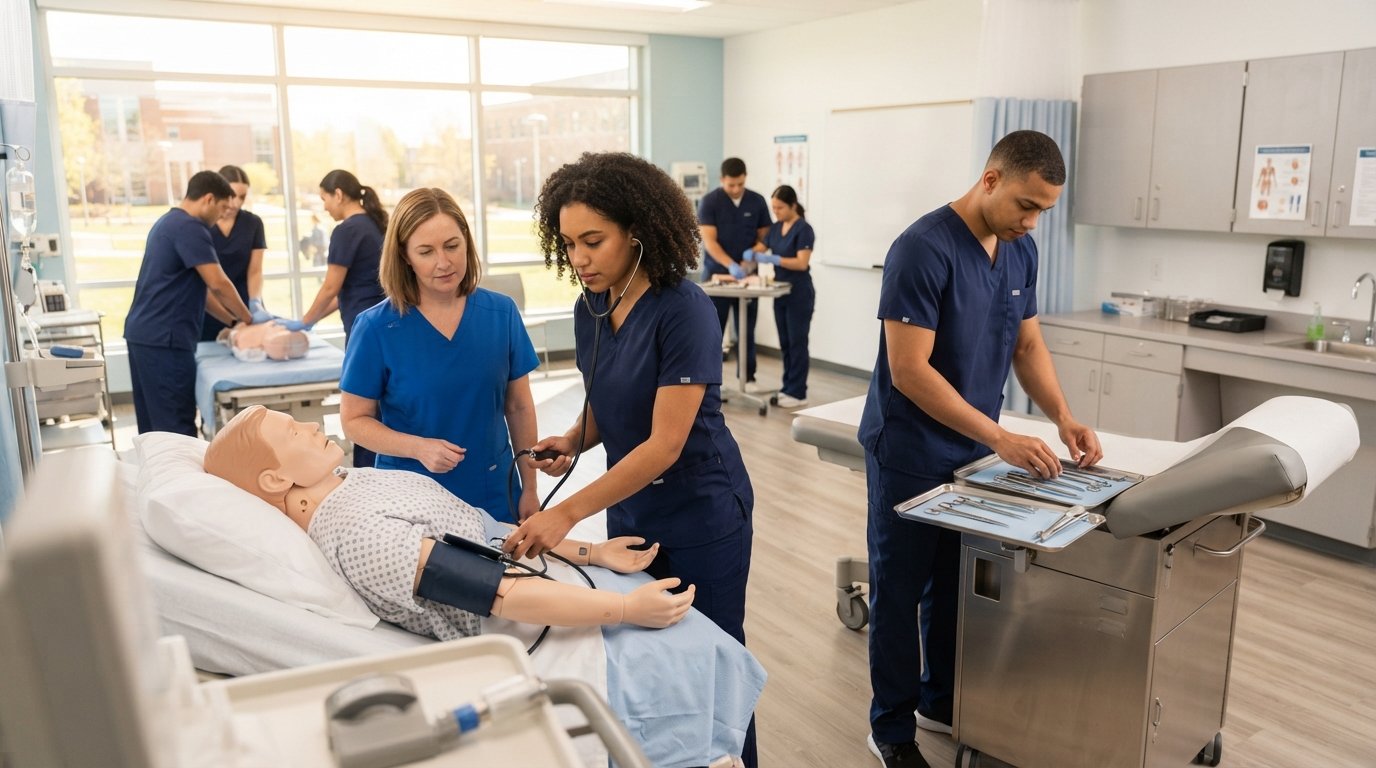
The program is delivered through a mix of in-person and online formats. The online portion typically covers foundational knowledge such as medical terminology, anatomy, insurance billing, and electronic health records. The in-person portion focuses on hands-on skills like venipuncture, injections, vital sign measurement, and patient interaction. This hybrid approach is especially valuable because it lets you learn theory on your own schedule while still getting the face-to-face practice that healthcare employers expect.
Here is a general breakdown of how the program is structured:
- Online coursework: Medical terminology, anatomy and physiology, healthcare law and ethics, and administrative procedures.
- In-person labs: Clinical skills practice, including blood draws, EKG placement, and sterile technique.
- Externship or practicum: Supervised experience in a real healthcare setting, often arranged by the college.
- Career readiness: Resume building, interview preparation, and job search support.
Because the program is short, it is important to stay organized and committed from day one. Students who treat the certificate like a full-time job, even if they are studying part-time, tend to get the most out of it. The payoff is a credential that can lead directly to employment in a growing field.
If you are also considering other online options for your education, a resource like DegreesOnline.Education can help you compare accredited programs and understand what different schools offer. That kind of research can be useful when you are weighing a local certificate against a broader degree path.
Admissions and Enrollment at Charter College Yakima
Charter College Yakima is located in the heart of Washington's Yakima Valley, a region with a strong agricultural economy and a growing healthcare sector. The campus serves students from Yakima, Union Gap, Selah, and surrounding communities. Because the program is designed for adult learners, the admissions process is typically straightforward and does not require previous healthcare experience.
Most applicants need to provide proof of high school graduation or an equivalent credential, complete an application, and meet with an admissions representative. Some programs may also require a background check or immunization records before the clinical portion begins. It is always a good idea to speak directly with the college to confirm current requirements, as they can change.
Financial aid may be available for eligible students, and the college can help you understand your options. For anyone comparing schools, it is worth noting that program details, admission criteria, and outcomes vary by institution. Charter College Yakima's specific schedule, start dates, and externship placements should be confirmed with the school directly.
One advantage of a local program is the connection to regional employers. Yakima-area clinics, hospitals, and physician practices often look to local training programs when hiring. That means your externship could turn into a job offer, and your instructors may have direct knowledge of who is hiring in the area.
What You Will Learn in the Medical/Clinical Assistant Certificate Program
The curriculum is built around the real tasks medical assistants perform every day. You will learn how to take patient histories, measure vital signs, assist with exams, administer medications under supervision, and handle administrative duties like scheduling and billing. The goal is to make you job-ready, not just theoretically knowledgeable.
Clinical skills typically include infection control, phlebotomy, electrocardiography, and basic laboratory procedures. Administrative skills cover medical coding, insurance claims, patient records, and use of electronic health record systems. Communication and professionalism are woven throughout, because medical assistants are often the first and last person a patient sees during a visit.
By the end of the program, you should be able to:
- Prepare patients and exam rooms for procedures.
- Record vital signs and medical histories accurately.
- Assist physicians and nurses during examinations.
- Perform basic laboratory tests and specimen collection.
- Manage patient schedules, records, and billing tasks.
These competencies align with what employers list in job postings for medical assistants in Washington and across the country. That alignment is what makes a certificate program valuable: it focuses on the skills that hiring managers actually need.
Career Outcomes and Earning Potential
Graduates of medical/clinical assistant certificate programs typically find work in physician offices, outpatient clinics, hospitals, nursing homes, and urgent care centers. Job titles may include medical assistant, clinical assistant, patient care technician, or medical office assistant. Some graduates use the certificate as a stepping stone toward nursing, radiology, or healthcare administration.
Earnings vary by location, experience, and employer. In Washington State, medical assistants generally earn above the national median, and those with certification or additional skills often command higher pay. The short training period means you can start earning sooner, which can improve the overall return on your education investment. For adults comparing a certificate to a longer degree, that faster entry into the workforce is a significant factor.
Career advancement is also possible. With experience, you might move into a lead medical assistant role, specialize in a particular area like pediatrics or cardiology, or pursue further education. The certificate gives you a foundation you can build on, whether you stay in the role long-term or use it as a launchpad.
If you are exploring how different credentials compare, a guide like Does Hamilton College Online Degree Offer Online? can give you a sense of how online and hybrid programs are structured at other institutions. That context can help you decide whether a local certificate or a broader degree is the right fit for your goals.
Why Choose a Hybrid Program at Charter College Yakima?
The mix of in-person and online instruction is one of the strongest features of this program. Online learning gives you flexibility for lecture-based material, while in-person sessions ensure you get the hands-on practice that healthcare employers require. For students in Yakima, this means you do not have to relocate or commute long distances to get quality training.
Charter College Yakima also emphasizes small class sizes and personalized attention. Instructors often have real-world healthcare experience, which means they can share practical insights that go beyond textbooks. The campus environment is designed for adult learners, with support services for career planning, tutoring, and job placement.
Another benefit is the local network. Because the college is embedded in the Yakima community, it has relationships with regional healthcare providers. Those relationships can lead to externship placements and job leads that might not be available through a purely online program. For anyone who wants to work in the Yakima area, that local connection is a real advantage.
Is This Program Right for You?
The Medical/Clinical Assistant Certificate at Charter College Yakima is a good fit for people who want to enter healthcare quickly, prefer a blend of online and hands-on learning, and are ready to commit to a focused program. It is also a strong option for career changers who need a credential that leads to employment without a long detour through a degree program.
If you are unsure, consider these questions:
- Do you want to work directly with patients?
- Are you looking for a program you can finish in under a year?
- Do you prefer a mix of online and in-person learning?
- Are you interested in a field with steady demand?
- Do you want to start earning sooner rather than later?
If you answered yes to most of these, the certificate is worth exploring. The next step is to contact Charter College Yakima directly to ask about start dates, tuition, financial aid, and externship opportunities. You can also use resources like CollegeDegrees.School to compare programs and understand how this certificate fits into the broader landscape of healthcare education.
Taking the Next Step Toward a Healthcare Career
Starting a new career in healthcare does not have to take years. The Medical/Clinical Assistant Certificate at Charter College Yakima offers a practical, fast, and flexible path for people in the Yakima Valley who want to work in patient care. With a mix of online and in-person instruction, a timeline of 12 weeks to less than 1 year, and a curriculum built around real job skills, it is a pathway designed for action.
Before you enroll, take the time to visit the campus, speak with advisors, and confirm the details that matter most to you. Ask about class schedules, externship sites, certification exam pass rates, and job placement support. The more you know, the better you can decide whether this program aligns with your goals.
Healthcare needs skilled, compassionate people, and medical assistants are often the first point of contact for patients. If that sounds like meaningful work, a short-term certificate could be your fastest route into the field. Reach out to Charter College Yakima today to learn more, and take the first step toward a career that makes a difference.