
Collision Repair Certificate at Edgecombe CC
The Autobody/Collision and Repair Technology/Technician Certificate at Edgecombe CC builds hands-on collision repair skills in under two years, preparing you for entry-level shop jobs.

Every dinged fender and crumpled quarter panel tells a story, and the technicians who restore those vehicles to factory condition are in steady demand across body shops, dealerships, and insurance-backed repair centers. If you want a fast, hands-on route into that trade, the Autobody/Collision and Repair Technology/Technician Certificate, 1 year to less than 2 years In-person at Edgecombe Community College is a practical starting point. This program packs foundational collision repair skills into a short, face-to-face format that gets you working with real tools and real vehicles instead of watching videos from a laptop. In this guide, you will learn what the certificate covers, who it suits, how to apply, what it costs, and how to turn the credential into a job or further study.
What This Autobody Certificate Actually Is
The program is a for-credit certificate in collision repair technology offered at Edgecombe Community College, a public community college in Tarboro, North Carolina. The credential is designed to be completed in roughly one year to less than two years of full-time study, though part-time schedules can stretch that timeline. Because it is a certificate rather than an associate degree, the curriculum focuses tightly on the technical skills employers expect in entry-level body shop roles: panel replacement, metal finishing, painting and refinishing, structural repair basics, and shop safety.
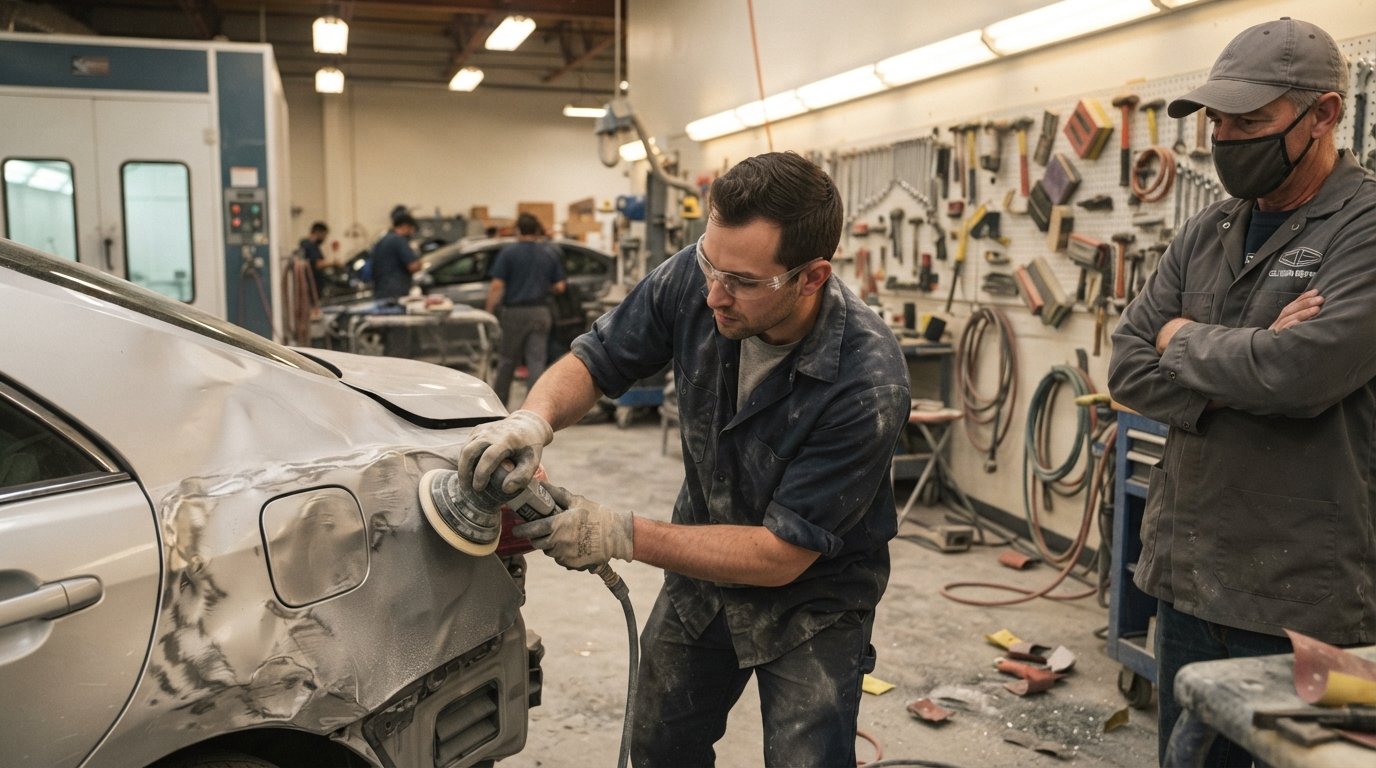
The in-person requirement is a feature, not a bug. Collision repair is a tactile trade. You cannot learn to feather-edge a repair or match a tri-coat paint job through a screen. Edgecombe's format puts students in a lab environment with spray booths, frame equipment, and instructor supervision, which mirrors the conditions of an actual body shop. That hands-on time is what hiring managers look for when they review applicants.
It helps to think of the certificate as a bridge. On one side is zero experience and no credential. On the other side is a resume that says you have completed structured training in collision repair, you understand industry safety standards, and you have handled the tools. The bridge is short by design, which is why so many career changers and recent high school graduates choose certificate paths over two-year degrees when they want to enter the workforce quickly.
Who Should Consider This Program
The certificate attracts a surprisingly wide range of students. Some are high school graduates who want a skilled trade without committing to four years of college. Others are adults leaving warehouse, manufacturing, or retail jobs for something more hands-on and better paying. Still others are hobbyists who already restore cars in their garage and want formal training to turn that passion into income.
This path tends to fit well if you can answer yes to most of the following:
- You prefer learning by doing over sitting in lecture halls.
- You want to enter the workforce in under two years rather than four.
- You are comfortable with physical work, including lifting, bending, and standing for long stretches.
- You are detail-oriented and care about finish quality.
- You want a credential that employers in the collision industry recognize.
If you are still weighing trade certificates against other short programs, it helps to compare them side by side. For example, our breakdown of the Surgical Tech Certificate at College of Central Florida shows how another one-year allied health credential structures its coursework and clinical hours. Reading both profiles can clarify whether your temperament leans toward a shop floor or an operating room, since both fields reward precision and steady hands but differ sharply in daily environment.
Students who are unsure whether they want a certificate or a degree should note that many community colleges, including Edgecombe, allow certificate credits to stack into a diploma or associate degree later. That flexibility means the certificate is not a dead end; it can be a first step.
Inside the Curriculum: Skills You Will Build
Exact course lists vary by catalog year, but collision repair certificate programs generally follow a predictable arc. Early courses cover shop safety, tool identification, and basic vehicle construction so students understand what they are working on before they touch a panel. Later courses move into non-structural repair, structural repair, and refinishing.
Across the program, you can expect to develop competencies in these areas:
- Non-structural panel repair: dent removal, metal straightening, plastic and composite repair, and panel alignment.
- Refinishing: surface preparation, primer application, color matching, blending, and spray gun technique inside a controlled booth.
- Structural fundamentals: measuring systems, frame straightening concepts, and understanding when a vehicle must be totaled versus repaired.
- Estimating and documentation: reading damage, writing estimates, and communicating with insurers and customers.
- Safety and environmental compliance: personal protective equipment, ventilation, hazardous waste handling, and OSHA-aligned practices.
What separates a strong graduate from a weak one is not memorizing procedures but developing judgment. Instructors in a face-to-face program can watch you work and correct bad habits in real time, which is far harder to do in a remote format. That feedback loop is one reason employers trust in-person training transcripts more than self-paced online certificates for this trade.
Admission Steps and Practical Logistics
Applying to a community college certificate program is typically simpler than applying to a four-year university, but it still involves several concrete steps. Because requirements and deadlines can change, always confirm details with Edgecombe Community College directly before you rely on them.
Most students move through the process in this order:
- Complete the college admission application and any residency documentation required for in-state tuition.
- Submit official high school transcripts or equivalency records, plus any prior college transcripts.
- Take placement assessments or submit qualifying test scores if the college requires them for program entry.
- Meet with an academic advisor or program coordinator to confirm the collision repair certificate pathway and course sequence.
- Register for classes and arrange payment, financial aid, or a payment plan before the term begins.
Two logistics deserve extra attention. First, this is an in-person program, so you need reliable transportation to campus and enough schedule flexibility to attend daytime labs, which is when most hands-on courses run. Second, lab-based programs often have limited seats because of equipment ratios. Applying early improves your odds of getting the courses you need in the term you want.
Financial aid is a common concern for adult learners. Certificate programs at accredited public colleges frequently qualify for federal student aid, state grants, and workforce development funding, but eligibility rules are specific. Before you assume you cannot afford training, spend time with a legitimate scholarship database and the college financial aid office. Resources such as Scholarship.Education aggregate scholarship and financial aid opportunities for students at many levels, including non-traditional learners pursuing short credentials, and pairing that research with a conversation with the financial aid office is a smart first move.
Cost, Time, and Return on Investment
Community college certificate programs are generally among the lowest-cost routes into a skilled trade. Tuition at North Carolina community colleges is set at a relatively modest per-credit rate for residents, and a certificate typically requires far fewer credits than an associate degree. That said, collision repair students should budget for more than tuition: safety glasses, respirators, shop uniforms, and sometimes tools can add several hundred dollars over the program.
The time investment is the bigger selling point. Finishing in roughly a year to eighteen months means you can be earning a paycheck while peers in bachelor's programs are still taking general education courses. Entry-level collision repair technicians commonly start in the high teens to low twenties per hour depending on region and shop type, and experienced technicians, especially those who master refinishing or structural work, can earn considerably more. Pay scales vary widely by employer, certification, and location, so treat any figure as a starting reference rather than a promise.
A useful way to evaluate the certificate is to compare it against alternatives on three dimensions: time to completion, out-of-pocket cost, and hiring demand in your area. If a local body shop is already short-staffed and willing to train, the certificate may accelerate your start date. If you want management or ownership options later, the certificate plus work experience plus a few business courses can be more valuable than a generic degree.
Career Paths and Advancement After the Certificate
Graduates typically enter the workforce as collision repair technicians, refinish technicians, or estimator trainees. Dealership body shops, independent collision centers, insurance-direct repair networks, and fleet maintenance operations all hire certificate holders. Some graduates also find work in related niches such as restoration shops, custom paint, or automotive glass and trim.
Advancement in this field is driven by certifications and specialization. Industry credentials such as I-CAR and ASE refinishing or collision repair certifications signal competence to employers and can unlock higher pay tiers. Technicians who learn estimating software and customer communication often move into estimator or shop manager roles within a few years. Others open their own shops after building a client base and saving capital.
The trade also offers geographic flexibility. Collision repair is needed everywhere there are cars, so technicians are not tied to a single metro area. That portability is attractive to students who are not sure where they want to settle long term.
How to Get the Most From the Program
Treat the certificate as a launchpad rather than a finish line. Students who get the most out of programs like this one tend to do a few things deliberately. They show up early, volunteer for extra lab time, and ask instructors for feedback on finish quality instead of waiting for grades. They also build relationships with local shops through part-time work or job shadowing while enrolled, which often converts into a first job offer before graduation.
It also pays to document your work. Photograph repairs before, during, and after, and keep a simple portfolio. When you interview, being able to show a clean blend or a straight panel says more than a transcript line. Finally, plan for lifelong learning. Vehicle materials are changing quickly, with more aluminum, high-strength steel, and advanced driver assistance systems showing up in everyday cars, and technicians who keep training stay employable.
If you are ready to compare programs, costs, and career outcomes across fields, exploring accredited certificate and degree options is the next practical step. The Autobody/Collision and Repair Technology/Technician Certificate, 1 year to less than 2 years In-person at Edgecombe Community College offers a focused, affordable, and hands-on entry into a trade that rewards skill and reliability. Confirm current admission requirements, tuition, and course schedules with the college, then decide whether this short credential is the right on-ramp for your career.