
EMT Paramedic Certificate in Under 12 Weeks at Corbin
Start a healthcare career fast with the EMT Paramedic certificate at Corbin Area Technology Center. Call 8772187081 to enroll in under 12 weeks.

By Natalie Simmons
When a cardiac arrest, a highway collision, or a workplace injury happens, the first trained hands on the scene are often those of an emergency medical technician. That moment, where calm skill meets raw urgency, is exactly what the Emergency Medical Technology/Technician (EMT Paramedic) Certificate, less than 12 weeks In-person at Corbin Area Technology Center is designed to prepare you for. Instead of spending years in a traditional classroom before you can help anyone, this accelerated, hands-on credential puts you on a fast track toward a career where every shift matters. For adults in southeastern Kentucky and nearby communities, it offers a rare combination: a short timeline, an in-person learning environment, and a direct path into one of the most respected roles in healthcare.
Choosing a training program is really a decision about how quickly and confidently you can step into a real job. A sub-12-week format is not a shortcut around hard work; it is an intensive schedule built for people who want to learn by doing and enter the workforce without delay. Below, we break down what this certificate covers, who it is for, how to enroll, what it costs, and how it fits into the broader landscape of healthcare and medical technology careers.
What This EMT Paramedic Certificate Actually Covers
Emergency medical services education is built on a ladder of certifications, and the terminology can confuse newcomers. Most entry-level programs train students to become EMTs (sometimes called EMT-Basics), who provide basic life support: CPR, oxygen administration, bleeding control, splinting, and safe patient transport. Paramedic training is the advanced level that adds IV therapy, cardiac monitoring, advanced airway management, and medication administration. A short certificate program typically focuses on the EMT level, giving you the foundational license you need to work on an ambulance, in an emergency room, or at special events.
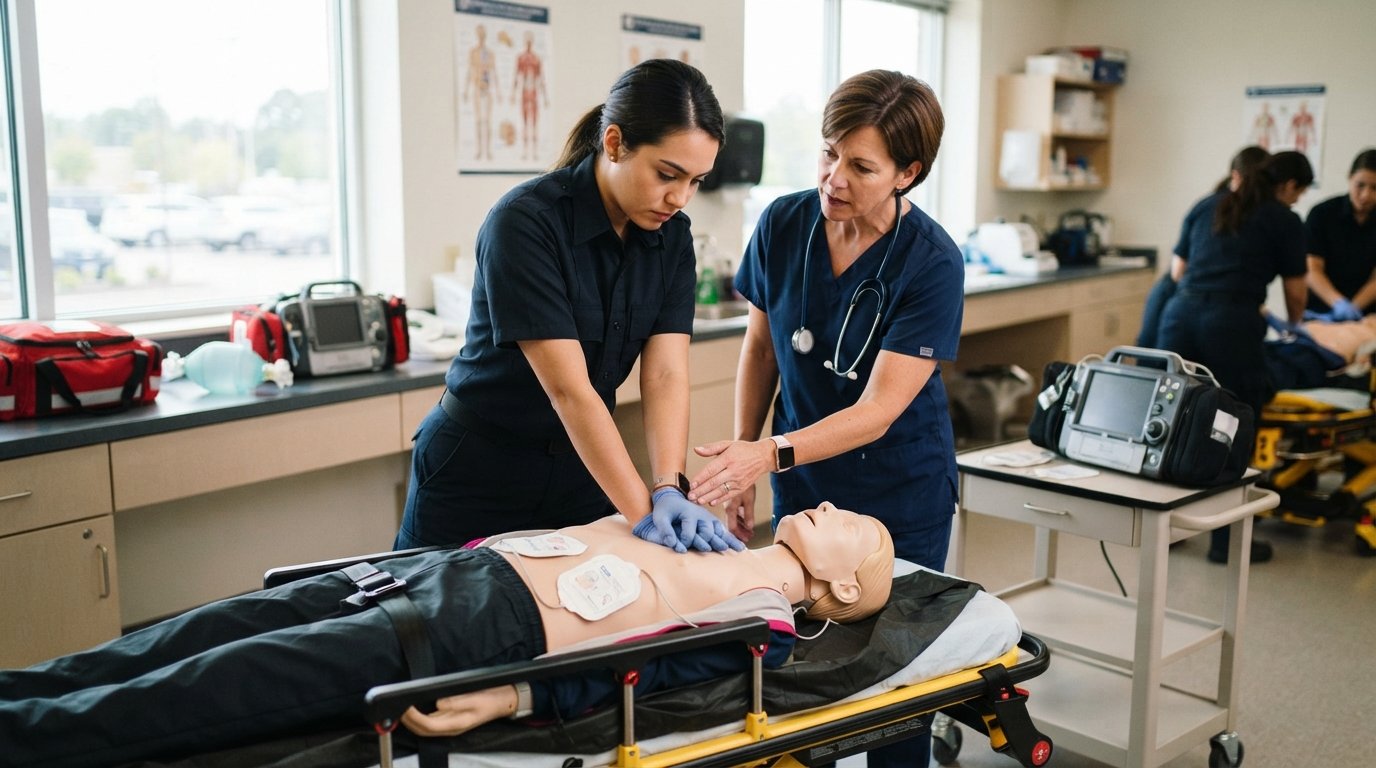
At Corbin Area Technology Center, the in-person format matters enormously. EMS is a tactile profession. You cannot master backboard placement, bag-valve-mask ventilation, or patient assessment by watching videos alone. Sitting in a classroom with instructors who have ridden on real ambulances means you practice on manikins, run live scenarios, and receive immediate correction on your technique. That feedback loop is what turns knowledge into muscle memory, and muscle memory is what saves lives under pressure.
Coursework in a program like this generally blends classroom instruction, skills labs, clinical observation, and certification exam preparation. You should expect to study anatomy and physiology, medical terminology, legal and ethical issues in EMS, scene safety, and the assessment process for trauma and medical emergencies. The compressed timeline means the material comes at you quickly, so a consistent study routine outside class hours is essential.
Who Thrives in a Less Than 12 Week In-Person Program
Accelerated formats are not for everyone, but they are ideal for specific types of learners. If you are a career changer who cannot afford to spend two years in school before earning income, a short certificate gets you credentialed and employable fast. If you are a recent high school graduate who wants to test the healthcare field before committing to a nursing or pre-med degree, this is a low-cost way to gain real clinical exposure.
Working adults also benefit because many short programs schedule classes in concentrated blocks, and some offer evening or weekend options. The in-person requirement means you need reliable transportation and the ability to be physically present, but it also means you are building a professional network of classmates and instructors who often become your first job references. Employers in EMS value candidates who have already demonstrated they can show up, work in teams, and handle pressure, and a rigorous in-person program proves exactly that.
Before enrolling, it helps to understand the common requirements that nearly every EMT certificate program shares:
- Minimum age of 18 (some programs allow 17 with parental consent)
- High school diploma or GED equivalent
- Current CPR certification for healthcare providers, often earned within the program
- Clean background check and drug screening for clinical placements
- Up-to-date immunizations, including TB testing
- Physical ability to lift and move patients safely
Meeting these prerequisites early prevents last-minute delays. If you are missing a document, such as an immunization record or a diploma copy, gather it before the application window closes, because seats in accelerated cohorts fill quickly and are often capped to maintain safe student-to-instructor ratios in skills labs.
Why Corbin Area Technology Center Stands Out for EMS Training
Corbin Area Technology Center is part of Kentucky's network of area technology centers, which were created to deliver practical, workforce-focused training to local communities. That mission translates into several concrete advantages for EMS students. First, the facilities are built for hands-on learning: classrooms configured for scenario training, equipment that mirrors what you will use on an actual rig, and instructors drawn from regional EMS agencies who know the local protocols and employers.
Second, the location serves a real regional need. Rural and small-city EMS agencies across Kentucky and neighboring states struggle to fill open positions, which means graduates often find hiring pipelines that are shorter and less competitive than in major metro areas. Third, because these centers are public workforce institutions, tuition tends to be far lower than at private career colleges, and financial aid options such as Pell Grants, Kentucky state aid, and workforce development funding frequently apply.
The in-person nature of the program also connects you to clinical and ride-along opportunities with local ambulance services and hospitals. Those hours are not just a graduation requirement; they are an extended job interview. Many students receive offers from the very agencies where they completed their clinical rotations.
From Enrollment to Certification: A Step-by-Step Roadmap
The path from curious applicant to certified EMT follows a fairly predictable sequence, and knowing the steps in advance keeps you from missing deadlines. While exact procedures vary, most students move through the process in the following order:
- Contact the program office to confirm the next start date, tuition, and admission requirements.
- Submit your application along with proof of age, education, and any required health documentation.
- Complete CPR certification if you do not already hold a current card.
- Attend orientation, where you will receive your schedule, uniform requirements, and equipment list.
- Finish the classroom and skills portion of the program, passing all practical evaluations.
- Complete clinical or field observation hours with a partner agency.
- Pass the National Registry of Emergency Medical Technicians (NREMT) cognitive exam and psychomotor exam.
- Apply for state licensure and begin job hunting, often with help from your instructors.
One step deserves extra emphasis: the NREMT exam. Most states, including Kentucky, use the National Registry as the gateway to licensure. Your program will prepare you for it, but passing is ultimately on you, so treat every quiz and practical scenario as exam practice. Students who take the NREMT seriously during the course, rather than cramming afterward, consistently report smoother testing experiences.
It is also worth thinking beyond the first credential. Many EMTs later return for paramedic training, which typically takes one to two years and significantly increases responsibility and pay. If your long-term goal is a career in emergency medicine, nursing, or fire service, this certificate is an excellent first rung. For readers weighing broader healthcare career options, resources such as high paying medical tech jobs and healthcare degrees can help you map out where EMS fits alongside other allied health paths.
Costs, Financial Aid, and Return on Investment
One of the strongest arguments for a short certificate is financial. Compared with a two-year or four-year degree, an EMT program requires a fraction of the tuition and gets you earning years sooner. At a public area technology center, total program costs often land in the low thousands of dollars, covering tuition, textbooks, uniforms, and exam fees. That figure can drop further through federal Pell Grants, Kentucky Educational Excellence Scholarship funds for eligible students, Workforce Innovation and Opportunity Act training vouchers, and employer sponsorship from ambulance services that are desperate for staff.
On the earning side, EMT wages vary by region, shift differentials, and whether you work for a private ambulance company, a fire department, or a hospital. Entry-level pay is modest compared with nursing or paramedic roles, but the credential opens overtime opportunities, per-call bonuses, and a fast route to advanced training. Many graduates use EMT work as a paid stepping stone while completing a nursing degree or paramedic program, effectively earning while they learn.
To evaluate the return on investment honestly, compare three numbers: total program cost, expected starting wage in your area, and the time to your first paycheck. For most students in this format, the break-even point arrives within months, not years. That is a fundamentally different financial equation than taking on tens of thousands in student loans for a longer degree before earning anything.
If you are also exploring online options for later stages of your education, whether an associate degree in emergency management or a bachelor's in healthcare administration, a resource like DegreesOnline.Education can help you compare accredited programs and understand how online study fits around shift work.
Career Outcomes After the Certificate
Graduates of EMT certificate programs enter a job market with multiple entry points. The most common first role is EMT or emergency medical technician on a 911 response ambulance or a private transport service. Hospitals also hire EMTs for emergency department technician roles, where you assist nurses with patient care, vital signs, and equipment setup. Other settings include fire departments that require EMT certification, industrial safety teams at manufacturing plants and mines, event medical services at racetracks and festivals, and ski patrol or wilderness rescue operations.
From there, career ladders branch in several directions. You can advance vertically to paramedic, then to critical care paramedic or flight paramedic. You can move into supervision, training, or operations management. You can pivot into nursing, respiratory therapy, or physician assistant programs, often with clinical experience that makes your application stand out. You can also move into public health, emergency management, or safety compliance roles that value field experience.
Because healthcare is one of the most durable sectors in the economy, demand for emergency responders tends to remain steady even during downturns. An aging population, ongoing retirements in fire and EMS agencies, and expanded rural coverage all point to continued hiring. For someone who wants a meaningful job with a short training runway, that combination is hard to beat.
How to Succeed in an Accelerated Format
Twelve weeks sounds short, and it is. The students who thrive treat the program like a full-time job rather than an evening hobby. That means attending every session, arriving early, practicing skills beyond required hours, and forming study groups with classmates. Flashcard apps, anatomy coloring books, and NREMT practice question banks are inexpensive tools that pay off enormously.
Physical and mental preparation matter too. EMS work involves lifting, long shifts, and emotional exposure to trauma. Building strength and sleep habits before the program starts makes the pace more manageable. It also helps to have a support system at home that understands your schedule will be intense for a few months.
Finally, ask questions before you commit. What is the exact start and end date? What are the clinical hour requirements? What is the program's NREMT pass rate? What job placement support is offered? A reputable program will answer all of these openly, because its reputation depends on graduates who succeed in the field, not just in the classroom.
An Emergency Medical Technology/Technician (EMT Paramedic) Certificate, less than 12 weeks In-person at Corbin Area Technology Center is more than a credential; it is a compressed, practical launch into a profession built on service. If you are ready to train hard, learn fast, and start helping people in a matter of months rather than years, this kind of program deserves a serious look. Reach out to the center, confirm the next cohort date, and take the first step toward the back of an ambulance and the front line of care.