
Erie Community College Food Prep Certificate: 1-Year Path
The Food Preparation/Professional Cooking/Kitchen Assistant Certificate, 1 year to less than 2 years In-person at Erie Community College builds job-ready kitchen skills fast.

By Grace Carter
If you want to work in a commercial kitchen but are not ready to commit to a full two-year degree, a short, hands-on certificate can be the fastest route from interest to employment. The Food Preparation/Professional Cooking/Kitchen Assistant Certificate, 1 year to less than 2 years In-person at Erie Community College is designed for exactly that kind of learner: someone who wants practical knife skills, food safety knowledge, and line-cook confidence without spending four years in a classroom. This program sits at the intersection of vocational training and career planning, and it can open doors to entry-level kitchen roles, apprenticeships, and further study in hospitality management.
Erie Community College (ECC) is a public two-year institution in Western New York with campuses in Buffalo, Williamsville, and Orchard Park. Its culinary and hospitality programs are built around kitchen labs, sanitation certification, and real production experience. The certificate described here is a sub-two-year credential, which means it is shorter than an associate degree but longer than a single-semester course. That middle ground matters: it gives you enough training to be hireable while keeping tuition and time commitments relatively modest. In this guide, we will walk through what the program covers, who it suits, how to apply, what it costs, and how to turn the certificate into a paycheck or a stepping stone toward an associate or bachelor's degree.
What the Food Preparation and Kitchen Assistant Certificate Covers
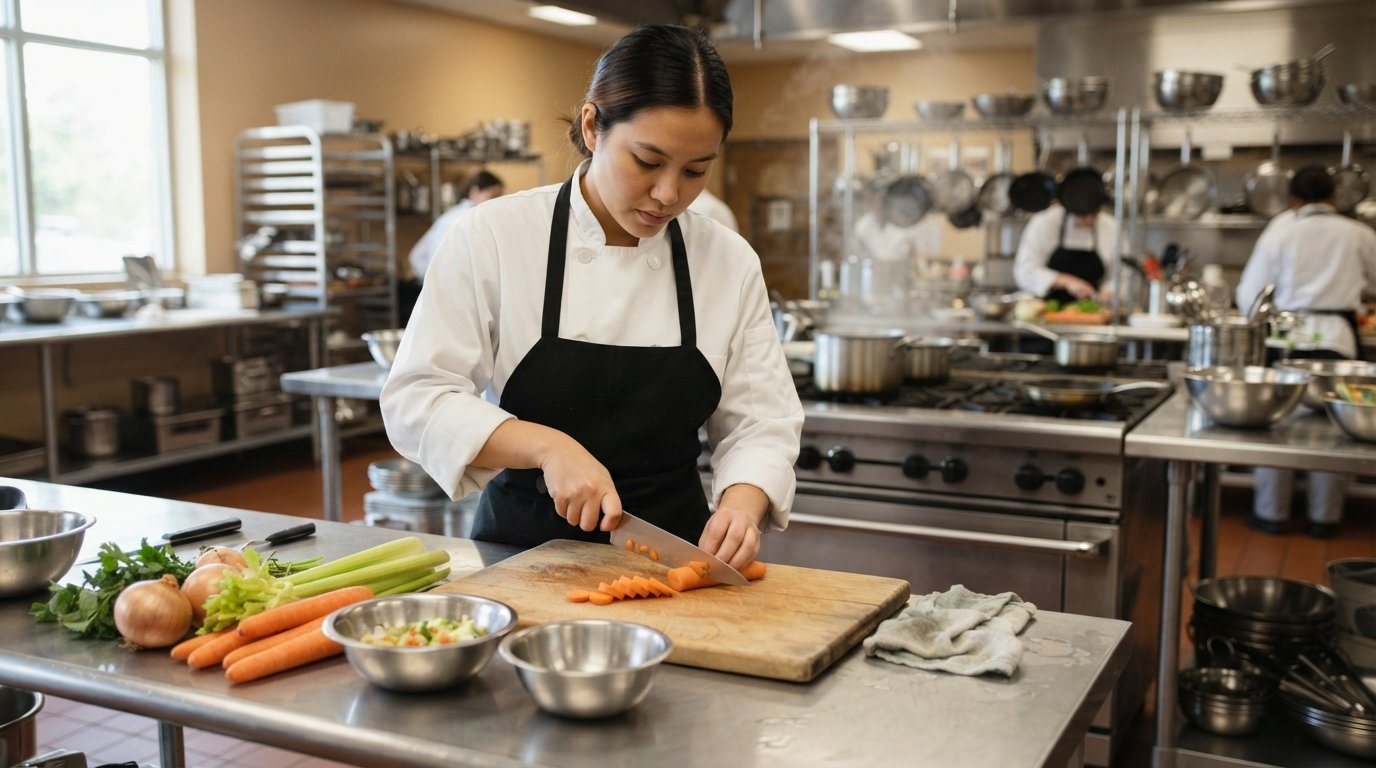
At its core, this certificate trains you to be useful on day one in a working kitchen. That means understanding how a commercial kitchen is organized, how to handle food safely, how to use and care for equipment, and how to produce consistent dishes under time pressure. Coursework typically blends classroom instruction in sanitation and nutrition with lab sessions in a teaching kitchen, where you practice knife cuts, stocks, sauces, and basic cooking methods. Because the program is delivered in person, you get direct feedback from chef instructors and repeated reps on the same techniques, which is hard to replicate online.
The kitchen assistant angle is important. Many culinary programs focus narrowly on cooking, but this certificate also prepares you for support roles that keep a kitchen running: prep cook, pantry cook, dishwasher-to-line-cook pipelines, and inventory helpers. Employers in restaurants, hotels, hospitals, schools, and catering companies all need reliable prep staff, and a certificate signals that you have been trained in food safety and basic production rather than learning entirely on the fly.
Typical topics you can expect to encounter include:
- Food safety and sanitation, often aligned with ServSafe or a similar certification
- Knife skills, kitchen terminology, and equipment identification
- Basic cooking methods such as roasting, sauteing, braising, and steaming
- Recipe reading, scaling, and mise en place
- Professionalism, teamwork, and kitchen communication
Beyond the specific techniques, the in-person format builds the habits employers care about: showing up on time, working clean, communicating during a rush, and taking direction. Those soft skills are often what separate a hireable graduate from someone with only home-cooking experience. If you are weighing whether a short credential is worth the investment, our guide on whether a college degree is worth it in 2026 offers a useful framework for comparing cost, time, and earnings across program types.
Who This Certificate Is Built For
This program is not only for high school graduates. It attracts career changers who want to move into hospitality, adults re-entering the workforce, and current restaurant employees who want formal training to move from dishwasher or server into the kitchen. Because the credential takes one year to less than two years, it fits around part-time work better than a full associate degree, though you should still plan for daytime lab commitments since the format is in person.
It is also a sensible choice for students who are unsure whether a full culinary degree is right for them. Trying a certificate first lets you test your interest in professional cooking without taking on the cost and time of a two-year or four-year program. If you enjoy it, you can often stack the certificate credits into an associate degree in culinary arts or hospitality management. If you do not, you have lost far less time and money than you would have in a longer program.
On the other hand, this certificate is probably not the best fit if your goal is to become an executive chef, open your own restaurant immediately, or work in high-end fine dining from day one. Those paths usually require broader management training, business coursework, and years of kitchen experience. The certificate is a starting point, not a finish line. Students who want a broader academic foundation often pair it with general education courses or transfer to a four-year hospitality program later.
Admission Requirements and How to Apply
Admission to a community college certificate program is generally more accessible than admission to a four-year culinary school. Most applicants need a high school diploma or equivalency, and some programs ask for placement testing in math and English or a brief advising conversation. Because this is a hands-on program with limited lab seats, you should apply early and confirm whether there are any health or safety requirements, such as a physical or immunizations, before the semester starts.
The application process usually follows a predictable sequence. Exact steps vary by campus and term, so confirm with ECC admissions, but the general flow looks like this:
- Complete the college application and submit transcripts or equivalency documentation.
- Take any required placement assessments or meet with an academic advisor.
- File the Free Application for Federal Student Aid (FAFSA) if you want to be considered for grants, loans, or work-study.
- Register for first-semester courses and attend orientation, including kitchen safety training.
- Purchase or rent required supplies, such as a knife kit, uniform, and non-slip shoes.
Because the program is in person, you should also think about logistics before you enroll: commute time to the campus, parking, and whether your work schedule can accommodate daytime labs. A quick conversation with an advisor can save you from discovering a scheduling conflict after registration. It also helps to ask about cohort start dates, since some culinary programs admit students only in the fall.
Cost, Financial Aid, and Return on Investment
Community college certificate programs are generally among the lowest-cost options in higher education, but the total price depends on residency, credit load, and fees. New York residents typically pay lower tuition than out-of-state students, and additional costs for knives, uniforms, and certification exams can add several hundred dollars. You should request a current cost estimate from ECC rather than relying on older figures, since tuition and fees change.
Financial aid is often available. Certificate programs that are eligible for federal student aid can be covered by Pell Grants, and some students qualify for state aid or workforce development funding. Employers in the hospitality industry sometimes offer tuition assistance or apprenticeships, so it is worth asking a current or prospective employer whether they support culinary training. The return on investment calculation for a certificate is usually straightforward: compare total program cost against the wages you can earn as a prep cook or line cook and the speed with which you can move up.
Entry-level kitchen wages vary widely by region and establishment, and tips, shift meals, and overtime can change the picture. The real financial value often comes from advancement: a trained kitchen assistant can move into lead prep, station cooking, or supervisory roles faster than someone without formal training. For a broader look at how career guides evaluate training paths and job requirements, Careers.org is a useful reference for understanding typical duties, work settings, and the credentials employers expect in food service and other trades.
Skills You Will Build and How They Translate to Jobs
The most visible outcome of the program is technical skill: you will be faster and safer with a knife, more confident with heat and seasoning, and more comfortable reading a recipe at scale. But employers also value the invisible skills, such as understanding FIFO (first in, first out) inventory, keeping a station clean during service, and communicating clearly when tickets are stacking up. These are the skills that let a kitchen assistant become a reliable line cook.
Job titles that graduates commonly pursue include prep cook, pantry cook, line cook, kitchen assistant, catering assistant, and food service worker in institutional settings such as hospitals, schools, and senior living communities. Institutional kitchens often offer more regular hours and benefits than restaurants, which matters if you need predictable scheduling. Restaurant roles may pay less at the start but can offer faster promotion for people who thrive in high-volume environments.
If you want to keep growing, the certificate can serve as the first step in a longer pathway. Many community colleges allow certificate credits to count toward an associate degree in culinary arts, baking and pastry, or hospitality management. From there, transfer agreements with four-year schools can lead to a bachelor's degree in hospitality or food service management. That stacked pathway is often more affordable than starting at a four-year school, and it lets you earn while you learn.
In-Person Training: What to Expect Day to Day
In-person culinary training is physical. You will stand for long lab sessions, work in a shared kitchen with other students, and rotate through different stations. Classes often start with a demonstration, followed by supervised production, then a tasting or critique. Cleanup is part of the curriculum, not an afterthought; professional kitchens run on discipline, and instructors use cleanup as a way to teach workflow and sanitation.
You should expect to buy or rent a uniform, including a chef's coat, apron, hat, and non-slip shoes, and to follow hair and jewelry rules for safety. Knife kits are sometimes included in course fees and sometimes purchased separately. Attendance policies in lab courses tend to be strict because missed sessions are hard to make up. If you have a disability or health condition that affects standing, lifting, or temperature exposure, talk to the program early about accommodations.
The in-person format also gives you access to instructors who have worked in the industry and can connect you with local employers. Those relationships matter in a field where hiring often happens through referrals. Treat your instructors and classmates as part of your professional network from the first week.
Comparing the Certificate to Other Culinary Pathways
Prospective students usually compare three options: a short certificate, an associate degree, and a four-year bachelor's degree. The certificate is the fastest and least expensive route to entry-level employment. An associate degree adds general education, more advanced cooking and baking courses, and often a management component, which can qualify you for supervisory roles. A bachelor's degree in hospitality management is typically aimed at people who want to manage operations, work in hotel administration, or eventually own a business.
There is no single right answer. If your priority is to start earning quickly and learn on the job, the certificate is a sensible first step. If you want to move into management within a few years, an associate or bachelor's degree may be worth the extra time. Many students combine approaches: earn the certificate, work for a year or two, then return for an associate degree with employer tuition support. The key is to be honest about your timeline, your budget, and the kinds of kitchens where you want to work.
It also helps to visit campuses and talk to current students before you decide. Ask about lab size, instructor experience, job placement support, and whether the program helps with internships or externships. Those details often matter more than the brochure language. A program with strong local employer connections can make the transition from student to paid cook much smoother.
Next Steps for Prospective Students
If the Food Preparation/Professional Cooking/Kitchen Assistant Certificate, 1 year to less than 2 years In-person at Erie Community College sounds like a fit, the next step is to contact ECC admissions and request current program details, start dates, and cost estimates. Ask specifically about financial aid eligibility, supply costs, and whether certificate credits can be applied to an associate degree later. If you are still exploring options, use CollegeDegrees.School's program finder to compare local schools and request information from featured institutions; note that CollegeDegrees.School receives compensation from featured schools, and that compensation may influence placement and order.
A culinary career rewards people who are willing to start at the bottom and learn fast. A short, in-person certificate gives you a structured way to build that foundation, a credential that signals commitment to employers, and a pathway that can grow into something larger if you choose. Whether you stop after the certificate or stack it into a degree, the training is a practical investment in a field that always needs skilled hands.