
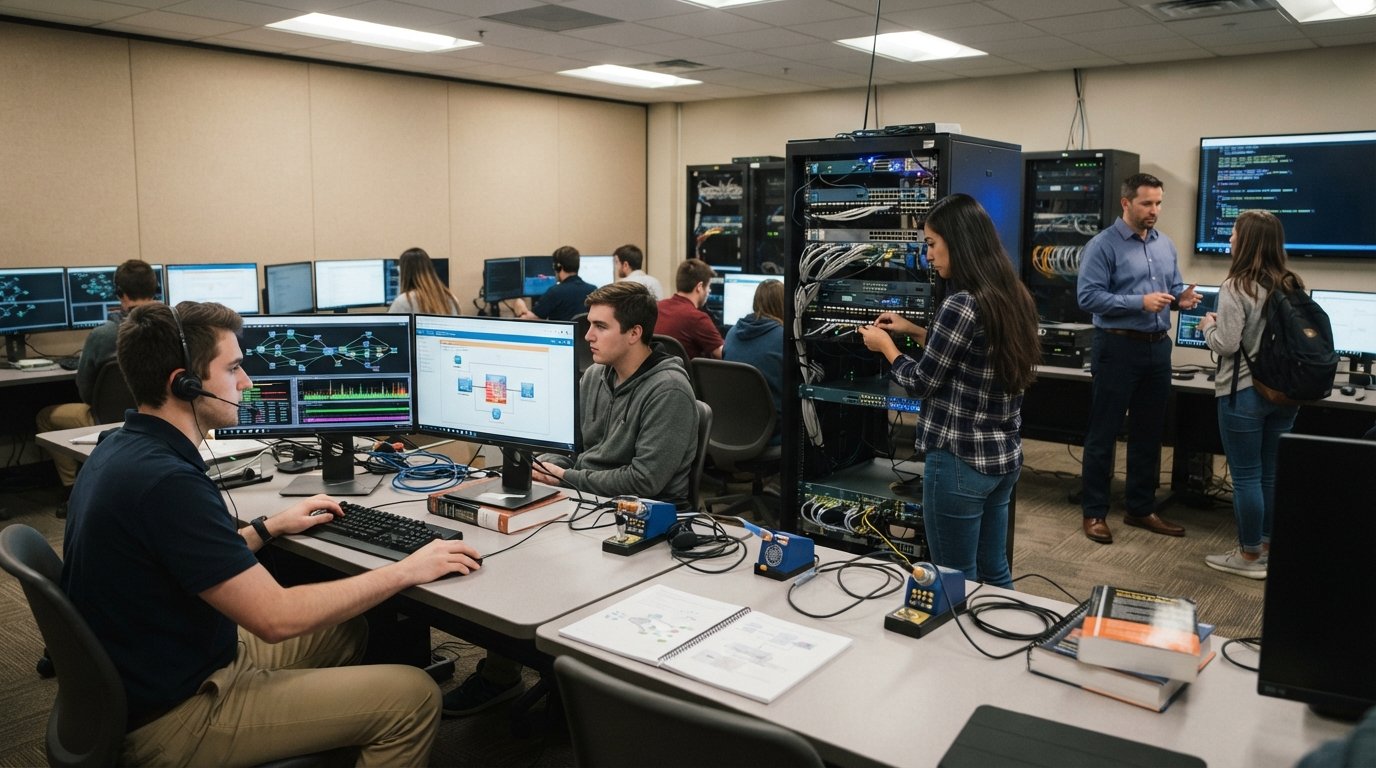
Security Associate Degree at College of Lake County
Explore the Computer and Information Systems Security/Auditing/Information Assurance Associate's degree, usually 2 years In-person at College of Lake County. Call 8772187081 to learn more.

By Stella Ward
Every day, banks, hospitals, and government agencies lose millions of dollars to cyberattacks, and the professionals who stop those attacks are in short supply. If you want to enter that fight without spending four years and tens of thousands of dollars on a bachelor's degree, the Computer and Information Systems Security/Auditing/Information Assurance Associate's degree, usually 2 years In-person at College of Lake County, offers one of the fastest, most affordable on-ramps into the cybersecurity workforce. This program blends hands-on network defense training with auditing and compliance coursework, preparing graduates for entry-level roles that employers across the Chicago metro area are actively trying to fill.
College of Lake County (CLC) sits in Grayslake, Illinois, roughly an hour north of Chicago, and its technology division has built a reputation for pairing classroom instruction with real lab environments. The cybersecurity associate degree is designed for students who want job-ready skills, not just theory. You will configure firewalls, analyze packet captures, audit systems against industry frameworks, and learn how attackers think so you can stop them. Just as importantly, you will do it alongside instructors who have worked in the field and classmates who become your professional network.
This article breaks down what the program covers, who it is for, what it costs, what careers it opens, and how to decide whether this two-year, in-person path is the right move for your situation. If you have been comparing degree options, our guide to the best computer science degrees for salary potential can help you weigh a broader range of technology credentials alongside this focused security pathway.
What the Computer and Information Systems Security Associate Degree Actually Covers
The program's title is long, but each word matters. "Computer and information systems security" refers to protecting networks, servers, endpoints, and data from unauthorized access. "Auditing" means examining systems against standards to verify that controls actually work. "Information assurance" is the broader discipline of ensuring data remains confidential, intact, and available when authorized users need it. Together, these three strands produce a graduate who can both defend a network and prove to auditors, regulators, or clients that the defense is functioning.
At CLC, the curriculum typically moves through a logical sequence. Early semesters build foundational knowledge in operating systems, networking, and programming logic. Middle semesters introduce security-specific topics such as access control, cryptography basics, and vulnerability assessment. Final semesters push into auditing frameworks, incident response, and a capstone or practicum where you apply everything to a simulated or real environment. Because the program is delivered in person, you get access to physical labs, face-to-face troubleshooting with instructors, and the kind of spontaneous collaboration that online-only programs often struggle to replicate.
Core topic areas usually include:
- Network security fundamentals, including firewalls, VPNs, and intrusion detection
- Operating system hardening for Windows and Linux environments
- Security auditing and compliance frameworks such as NIST, ISO 27001, and HIPAA
- Incident response, digital forensics basics, and disaster recovery planning
- Ethical hacking concepts and penetration testing methodology
That list matters because employers hiring for entry-level security roles rarely expect deep specialization. They want someone who understands the whole landscape well enough to be trained on their specific stack. A two-year associate degree built around these competencies gives you exactly that breadth. It also positions you to pursue industry certifications, which many hiring managers weigh heavily alongside or even above a degree.
Who Should Consider This Two-Year, In-Person Program
The strongest candidates for this degree tend to fall into a few recognizable groups. Recent high school graduates who are technically inclined but not ready to commit to a four-year university often thrive here because the coursework is concrete and the job outcomes are visible. Career changers coming from IT help desk, retail management, military service, or administrative roles frequently choose this path because it converts existing work discipline into a credential that hiring managers recognize. And working adults who tried a bachelor's program and found it too slow or too expensive often discover that a focused associate degree gets them into the field faster.
There is also a practical geographic dimension. Because the program is in person at College of Lake County, it suits students who live in Lake County, northern Cook County, or southern Wisconsin and want to avoid relocation costs. If you are weighing whether to move for a program or stay local, it helps to compare total costs carefully. Resources like DegreesOnline.Education can help you evaluate online alternatives and understand how format affects price, flexibility, and employer perception.
This program is probably not the right fit if you need maximum schedule flexibility, if you already hold a bachelor's degree in a related field, or if you are targeting research-oriented roles that require a graduate degree. In those cases, a certificate, bootcamp, or master's program may serve you better. But for the majority of people who want a stable, well-paid job in a growing field without four years of tuition, the associate degree is a strong default.
Before enrolling, ask yourself these questions:
- Can I commit to in-person classes two to three days per week for two years?
- Am I comfortable with hands-on lab work, not just reading and exams?
- Do I want to enter the workforce quickly, or am I planning to transfer to a bachelor's program later?
- Have I checked whether my employer offers tuition reimbursement or scheduling support?
- Am I prepared to sit for at least one industry certification within a year of graduating?
Answering honestly will save you time and money. The students who struggle most in this program are those who enrolled because "cybersecurity sounds cool" without understanding that the work involves patient, methodical attention to detail as much as it involves dramatic hacking scenes.
Careers and Earning Potential After Graduation
Graduates of security associate degree programs typically enter the workforce in roles such as security analyst, SOC (security operations center) technician, IT auditor, network administrator with security duties, or compliance analyst. In the Chicago metropolitan area, entry-level security analyst salaries commonly start in the mid-$50,000s to low $60,000s, with rapid increases as you gain certifications and experience. Within three to five years, many professionals in this track reach $80,000 or more, particularly if they move into cloud security, penetration testing, or security engineering.
The job market itself is favorable. The U.S. Bureau of Labor Statistics projects strong growth for information security analysts through the end of the decade, driven by rising cybercrime, regulatory pressure, and the expansion of cloud infrastructure. Employers in healthcare, finance, manufacturing, and government all need security staff, and the Chicago area has a dense concentration of all four. That means you are not betting on a single industry; you are entering a skill set that transfers across sectors.
It is worth noting that a degree alone rarely guarantees a specific salary. Compensation depends on your location, certifications, portfolio, interview performance, and willingness to keep learning. The associate degree gets you past the resume filter and into interviews. What you do after that determines how quickly you advance. If you are comparing this path against other technology degrees, it helps to understand the full range of outcomes; our analysis of computer science degree salary potential provides useful context for those decisions.
Cost, Financial Aid, and Return on Investment
One of the strongest arguments for the Computer and Information Systems Security/Auditing/Information Assurance Associate's degree, usually 2 years In-person at College of Lake County, is its cost profile relative to four-year alternatives. Community college tuition in Illinois is a fraction of what public universities charge, and CLC serves a district where many students qualify for reduced rates. Add in the ability to live at home, work part time, and avoid student loan debt, and the return on investment can be compelling within the first year of employment.
Financial aid options typically include federal Pell Grants, Illinois MAP grants, institutional scholarships, and employer tuition assistance. Because the program is only two years, even modest aid packages can cover a large share of the total cost. Many students also qualify for work-study positions in campus IT labs, which doubles as relevant experience for your resume. If you are evaluating multiple programs, compare not just sticker price but also completion rates, job placement support, and certification pass rates.
A simple framework for evaluating ROI:
- Total tuition and fees for the full two years
- Estimated living costs if you must relocate or reduce work hours
- Expected starting salary in your target metro area
- Time to first job after graduation (placement rate matters)
- Additional certification costs you will likely incur
Run those numbers for CLC and for any alternative you are considering. In most cases, the in-person associate degree wins on cost and speed, while a bachelor's degree wins on long-term ceiling for management roles. Neither answer is universally correct; it depends on your timeline, your finances, and your career goals.
Certifications That Strengthen Your Degree
Employers in cybersecurity treat certifications as proof that you can apply knowledge, not just recall it. While earning your associate degree, you should plan to pursue at least one entry-level certification and one intermediate certification within your first two years after graduation. The most commonly recognized entry points are CompTIA Security+, CompTIA Network+, and ISC2 Certified in Cybersecurity. These are affordable, widely respected, and often embedded into community college coursework.
As you gain experience, consider Certified Ethical Hacker (CEH), CompTIA CySA+, or ISACA's CISA for auditing-focused roles. The auditing and information assurance side of your degree aligns particularly well with CISA, which is highly valued in compliance-heavy industries like healthcare and finance. Many CLC students sit for Security+ before graduation, which immediately makes them more competitive in the job market.
Certifications do not replace your degree, and your degree does not replace certifications. Together, they signal to employers that you have both formal education and validated practical skill. That combination is what moves resumes from the rejection pile to the interview pile.
Transferring to a Bachelor's Degree Later
One of the underappreciated advantages of starting with an associate degree is that it does not lock you out of further education. Many CLC graduates transfer to four-year institutions to complete a bachelor's in cybersecurity, information systems, or computer science. Articulation agreements between Illinois community colleges and state universities often allow you to carry most or all of your credits forward, meaning you enter as a junior rather than a freshman.
This matters because the cybersecurity field has a ceiling. Individual contributor roles pay well, but management, architecture, and consulting roles increasingly expect a bachelor's or master's degree. Starting with the associate degree lets you earn money and gain experience while you decide whether to pursue that next step. Some employers will even pay for your bachelor's degree while you work for them, turning your two-year investment into a four-year education at a fraction of the cost.
The key is to plan early. Talk to an advisor in your first semester about which four-year schools accept your credits, what GPA you need to maintain, and which courses transfer cleanly. Doing this in year one prevents the frustration of discovering in year three that a course does not count.
How to Apply and What to Expect
Admission to CLC is generally open, meaning you do not need a competitive GPA or entrance exam to enroll. You will need to complete the college's application, submit transcripts, and take placement assessments in math and English unless you have qualifying test scores. Because the security program has technical prerequisites, expect to meet with an advisor to map out your sequence of courses before registering.
Once enrolled, plan for a mix of lecture and lab time. You will spend significant hours in front of real hardware and virtual machines, configuring systems and troubleshooting problems. The workload is manageable if you stay organized, but it is not trivial. Students who treat it like a full-time commitment, even if they are working part time, tend to finish on schedule. Students who treat it casually often take three or four years instead of two.
Finally, use the program's career services early. Resume reviews, mock interviews, and employer networking events are available to students, not just graduates. Attending them in your first year builds relationships that pay off when you start applying for jobs. The students who land the best positions are almost always the ones who started treating the program as a career launchpad from day one, not just a series of classes to pass.
The Computer and Information Systems Security/Auditing/Information Assurance Associate's degree, usually 2 years In-person at College of Lake County, is a practical, affordable, and respected way to enter one of the fastest-growing fields in technology. If you are ready to trade two years of focused effort for a career that protects people and organizations from real threats, this program deserves a serious look.