
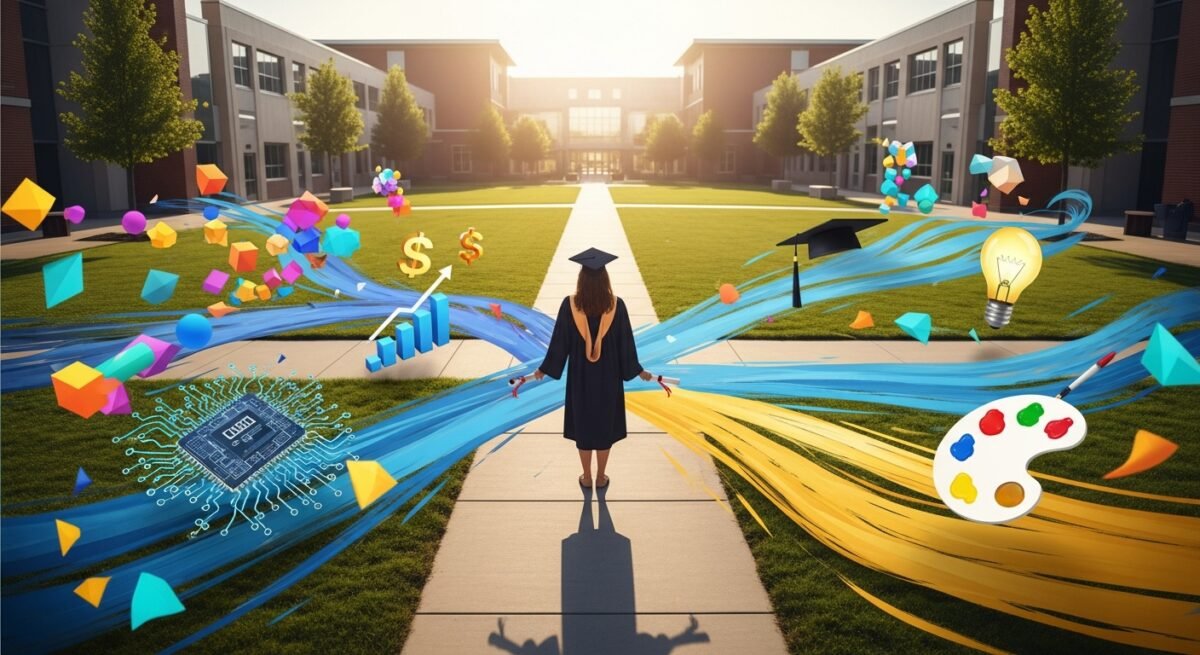
Top College Degrees for High-Demand Careers and Earnings
Explore college degrees that merge personal passion with strong job growth and earning potential. This guide analyzes STEM, healthcare, business, and versatile liberal arts paths.

By Benjamin Clarke
Choosing a college degree is one of the most significant decisions a student can make, shaping not just the next four years but the trajectory of an entire career. With rising tuition costs and an ever-evolving job market, the pressure to select a “good” major is immense. Yet, the concept of “best” is deeply personal, intertwining individual passion with practical realities like employment prospects and earning potential. The most successful graduates often find the sweet spot where their interests align with market needs, leading to fulfilling and financially stable careers. This guide explores degrees that offer this powerful combination, providing a roadmap for students to make informed, confident choices about their future.
Beyond Passion: A Framework for Choosing Your Degree
The old adage to “follow your passion” is only half the formula. A strategic approach to selecting a college degree balances intrinsic motivation with external market data. This involves honest self-assessment about your skills and interests, coupled with rigorous research into industry growth, salary benchmarks, and long-term career paths. Consider not only the starting salary but also the ceiling for advancement, the geographical availability of jobs, and the degree’s adaptability to different sectors. For instance, a degree in computer science offers not just a high starting wage but also the flexibility to work in finance, healthcare, entertainment, or tech startups. It’s also crucial to understand the different levels of academic commitment, which you can explore in our detailed explanation of the four types of college degrees and how they serve distinct career stages.
When evaluating potential degrees, ask these key questions: Does this field have a demonstrated growth trajectory over the next decade? What are the typical entry-level requirements, and does this degree meet them? How does this program build not just knowledge but also tangible, transferable skills? The best college degrees for students are those that provide a robust toolkit of analytical, technical, and communication abilities, ensuring resilience even as specific job titles change.
Degrees at the Intersection of Growth and Opportunity
Certain academic fields consistently demonstrate strong demand, competitive salaries, and opportunities for innovation. These degrees often sit at the crossroads of technology, societal need, and complex problem-solving.
STEM and Healthcare: The Persistent Powerhouses
Degrees in Science, Technology, Engineering, and Mathematics (STEM) alongside Healthcare remain top contenders due to their direct application to critical industries. A Bachelor of Science in Computer Science or Computer Engineering is arguably one of the most versatile and sought-after credentials today. Graduates can pursue roles in software development, cybersecurity, data science, and artificial intelligence, with the Bureau of Labor Statistics projecting much faster-than-average growth for these occupations. Similarly, degrees in Nursing (BSN), Biomedical Engineering, and Data Science/Statistics offer near-guaranteed pathways to employment. These fields are not just about technical prowess; they require critical thinking and a capacity to adapt to rapid technological change, making them future-proof investments.
Business and Quantitative Analysis
A Bachelor’s in Business Administration, especially with concentrations in Finance, Management Information Systems (MIS), or Supply Chain Management, provides a foundational understanding of how organizations operate in a global economy. The strength of a business degree lies in its breadth. However, the most impactful variants are those that incorporate quantitative rigor. Degrees in Economics, Finance, and Accounting teach students to model complex systems, assess risk, and interpret financial data—skills prized in every sector, from government and non-profits to Fortune 500 companies. For those interested in the backbone of modern commerce, exploring associate and bachelor’s degree paths in logistics or operations management can be an excellent start.
The Value of Versatile and Adaptive Degrees
Not every high-potential degree is explicitly technical. Some of the best college degrees for students provide deep analytical and communication skills that can be applied across a wide spectrum of careers, offering longevity and adaptability.
Degrees in the social sciences, such as Economics, Political Science, and Psychology, train students in research methodology, data interpretation, and understanding human behavior—assets in marketing, human resources, public policy, and user experience design. A major in Communications or English, often underestimated, hones the ability to craft persuasive narratives, analyze texts, and communicate clearly, which are indispensable skills in leadership, content strategy, and public relations. The key for graduates in these fields is to complement their major with internships, minors, or certifications that signal specific applied skills to employers, such as digital marketing analytics or technical writing.
The rise of online education has dramatically increased access to these versatile and specialized programs. Students can now pursue accredited degrees from reputable institutions regardless of location, a flexibility that is particularly valuable for working adults or those seeking specific programs not available locally. For a comprehensive look at accredited programs and flexible learning pathways, prospective students can consult independent online degree resources to compare options.
Aligning Your Degree Path with Your Learning Context
The “best” degree is also a function of how and where you choose to earn it. Traditional four-year universities, community colleges, and online platforms each offer distinct advantages that can align with different goals and life situations.
Community colleges provide an invaluable and cost-effective entry point into higher education. An associate degree in fields like Nursing, Information Technology, or Paralegal Studies can lead directly to well-paying, in-demand jobs in just two years. Furthermore, community college serve as a springboard, allowing students to complete general education requirements at a lower cost before transferring to a four-year institution to complete a bachelor’s degree. This 2+2 model is a strategic way to manage student debt while still accessing high-quality education and the expanded career opportunities that come with a bachelor’s credential.
For maximum flexibility, online degrees have shed any lingering stigma and are now offered by most major universities. They are ideal for self-motivated learners, career-changers, and those with family or work obligations. From online degrees in aviation management to fully digital MBAs, the quality and rigor match their on-campus counterparts. When considering an online program, accreditation is the non-negotiable benchmark of quality. It ensures the degree will be recognized by employers and other educational institutions.
Future-Proofing Your Education: Skills Over Specifics
While choosing a degree in a growing field is wise, the ultimate goal is to develop a durable skill set. The job market of 2030 will undoubtedly feature roles that don’t exist today. Therefore, the best college degrees for students are those that cultivate adaptive intelligence.
Look for programs that emphasize:
- Critical Thinking and Complex Problem-Solving: The ability to deconstruct ambiguous challenges and design solutions.
- Digital and Data Literacy: Comfort with analyzing data, understanding algorithmic processes, and using digital tools, regardless of major.
- Communication and Collaboration: Proficiency in conveying complex ideas clearly in writing and speech, and working effectively in teams, including remote ones.
- Ethical Reasoning and Emotional Intelligence: Navigating the societal implications of technology and business, and managing interpersonal relationships.
Degrees that integrate projects, internships, co-ops, or capstone experiences are particularly effective at building these competencies. They provide the crucial bridge between theoretical knowledge and real-world application, making graduates immediately more valuable to potential employers.
Selecting a degree is not about finding a single “right” answer but about making a strategic choice based on a fusion of self-awareness and market awareness. The best college degrees for students are those that ignite curiosity, build a versatile and resilient skill portfolio, and open doors to careers with growth and purpose. By focusing on programs that develop both technical capability and human-centric skills, students can invest in an education that pays dividends in satisfaction and security for decades to come.