
Top Healthcare Degrees in South Dakota: Accredited Programs
Discover accredited South Dakota healthcare degrees with high job placement rates, leading to stable careers in nursing, lab science, and advanced practice roles.

By Emily Foster
For students and career-changers seeking a stable, rewarding profession with strong regional demand, South Dakota offers a compelling landscape for healthcare education. The state’s universities and technical colleges have developed robust, highly-rated programs designed to meet critical workforce needs in hospitals, clinics, and rural health settings. These degrees are not just academic pathways, they are direct conduits to in-demand careers in a sector that forms a cornerstone of both the state’s economy and community well-being. From nursing and medical laboratory science to physician assistant studies and health administration, the options are diverse and tailored to produce skilled professionals ready to serve South Dakota’s unique population.
Defining “Highly-Rated” in a South Dakota Context
When evaluating healthcare degrees in South Dakota, “highly-rated” encompasses several key factors beyond simple popularity. First and foremost is accreditation from specialized, program-specific bodies. For nursing, this means accreditation by the Commission on Collegiate Nursing Education (CCNE) or the Accreditation Commission for Education in Nursing (ACEN). For other clinical programs, look for accreditation from organizations like the Commission on Accreditation of Allied Health Education Programs (CAAHEP) or relevant specialized boards. This accreditation is non-negotiable, as it ensures the curriculum meets national standards and is required for graduates to sit for licensure exams.
Another critical rating factor is licensure exam pass rates. Consistently high first-time pass rates on exams like the NCLEX-RN for nurses or national certification exams for other fields are a strong indicator of program quality and effective preparation. Prospective students should also investigate clinical placement networks and partnerships. Programs with strong relationships with major health systems like Sanford Health, Avera Health, and Monument Health, as well as regional critical access hospitals, provide students with superior hands-on training and often lead directly to employment. Finally, consider outcomes data: job placement rates within the field, graduate satisfaction surveys, and employer feedback. South Dakota’s public institutions often publish this data, offering a transparent view of a program’s effectiveness in launching careers.
Leading Undergraduate Healthcare Programs in South Dakota
South Dakota’s public university system, along with its technical colleges, provides the backbone for undergraduate healthcare education. These programs are typically the most direct route to a clinical career and are structured to combine rigorous science coursework with extensive practical experience.
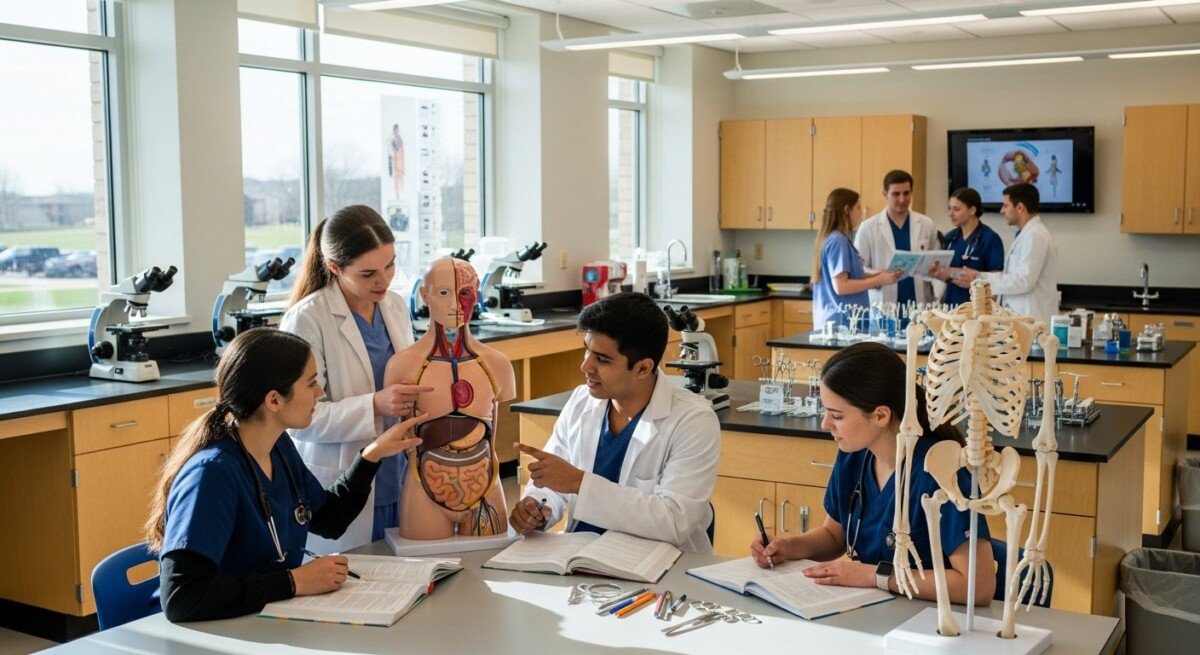
The Bachelor of Science in Nursing (BSN) is arguably the flagship healthcare degree in the state. South Dakota State University (SDSU) and the University of South Dakota (USD) both offer highly-regarded, CCNE-accredited BSN programs. SDSU’s program, in particular, is noted for its strong rural health focus and extensive simulation labs. For those seeking an accelerated path, several schools offer RN-to-BSN completion programs online, catering to the state’s existing associate-degree nurses aiming to advance. Another standout undergraduate option is the Bachelor of Science in Medical Laboratory Science (MLS). SDSU’s MLS program boasts exceptional certification exam pass rates and a 100% job placement rate, reflecting the high demand for these crucial diagnostic professionals in every hospital and lab across the state.
Allied health fields are equally well-represented. Dakota State University and other institutions offer robust programs in Health Information Management and Technology, a field growing in importance with digital health records. Technical colleges like Southeast Technical College and Lake Area Technical College provide excellent Associate of Applied Science degrees in fields like Radiologic Technology, Surgical Technology, and Dental Hygiene. These two-year programs are intensely practical, closely aligned with employer needs, and feature near-perfect job placement rates, making them some of the most efficient and highly-rated career launches in the healthcare sector. For those interested in the business and leadership side of healthcare, a Bachelor of Science in Health Sciences or Health Administration from USD provides a strong foundation for management roles or further graduate study.
Graduate and Advanced Practice Healthcare Degrees
For those with a bachelor’s degree seeking advanced clinical roles or leadership positions, South Dakota’s graduate programs offer pathways to the highest levels of the healthcare profession. These programs are selective and intensive, designed to create expert practitioners and leaders.
The University of South Dakota’s Master of Science in Nursing (MSN) programs are central to this ecosystem. USD offers specializations to become a Family Nurse Practitioner (FNP), Psychiatric-Mental Health Nurse Practitioner (PMHNP), or a Nurse Educator. The FNP program is especially critical for South Dakota, as it prepares advanced practice nurses to provide primary care, often in underserved rural areas. Similarly, the PMHNP program addresses a profound statewide and national need for mental health providers. USD also houses the state’s premier Doctor of Nursing Practice (DNP) program, the terminal clinical practice doctorate for nurses. For aspiring physicians, the University of South Dakota’s Sanford School of Medicine is the state’s only medical school, offering a community-based, rural-focused medical education that consistently produces physicians who stay to practice in the region.
A standout graduate program is the Master of Science in Physician Assistant Studies (MSPAS) at the University of South Dakota. This highly competitive program trains PAs to practice medicine under physician supervision, a model that is increasingly vital for expanding access to care. The program’s curriculum includes extensive clinical rotations across the state, ensuring graduates are prepared for the realities of South Dakota healthcare. For non-clinical leadership, consider a Master of Public Health (MPH) or a Master of Health Administration (MHA). These degrees, available through USD and online partnerships, prepare professionals to manage healthcare organizations, develop public health policy, and improve population health outcomes. The financial return on these advanced degrees can be significant. For a broader perspective on educational investment, our guide on the best paying undergraduate degrees explores how specific fields offer strong salary potential, a principle that holds true for advanced healthcare degrees as well.
Online and Hybrid Learning Options for Flexibility
Recognizing the needs of working professionals and those in rural locations, South Dakota’s institutions have developed robust online and hybrid formats for many healthcare degrees. This flexibility is a key component of their high rating among non-traditional students.
Many of the RN-to-BSN completion programs are offered fully online, allowing registered nurses with an associate degree to earn their bachelor’s while continuing to work. Similarly, graduate nursing programs (MSN and DNP) at USD utilize a hybrid model, combining online coursework with intensive on-campus sessions and local clinical placements arranged near the student’s home. This model is instrumental in building an advanced practice workforce across the entire state, not just in university towns. For entirely online pathways, degrees in Health Information Management, Health Administration, and Public Health are widely available. These programs leverage digital learning platforms to deliver content while often incorporating project-based learning tied to the student’s local healthcare environment.
When evaluating online programs, it is crucial to verify that the online format does not compromise on accreditation or clinical requirements. The best programs provide dedicated online student support, including clinical placement coordinators who help distance students secure the required hands-on experiences. This seamless integration of online theory and in-person practice is what sets the top programs apart. For students exploring digital education pathways, seeking out academic program insights from reliable sources is a critical step in finding an accredited and reputable online degree that aligns with career goals.
Career Pathways and Statewide Demand
Choosing a healthcare degree in South Dakota is a strategic decision heavily influenced by the state’s specific demographic and economic landscape. The demand for healthcare professionals is not uniform, it is particularly acute in certain specialties and geographic areas.
The most consistent demand across the state is for registered nurses, especially those with BSN preparation and those willing to work in rural or critical access hospitals. Family Nurse Practitioners and Physician Assistants are also in extremely high demand to fill primary care provider shortages. In diagnostic fields, Medical Laboratory Scientists and Radiologic Technologists are essential, with job openings consistently available. Mental and behavioral health providers, including counselors and psychiatric nurse practitioners, represent one of the most urgent need areas. The aging population also drives demand for professionals in gerontology, physical therapy, and occupational therapy.
South Dakota offers distinct advantages for healthcare graduates. The cost of living is relatively low, and many health systems offer significant signing bonuses, tuition repayment assistance, and loan forgiveness programs for commitments to work in underserved areas. The close-knit professional community often means faster career progression and the opportunity to make a tangible impact. Graduates from South Dakota’s programs are not just entering a job, they are becoming part of a vital infrastructure serving their communities. The alignment between state need and educational output is a defining feature of the value offered by these highly-rated degrees.
Frequently Asked Questions
What is the most direct path to a healthcare career in South Dakota?
For immediate entry into a high-demand clinical role, an Associate of Applied Science degree from a technical college in fields like Nursing (ADN), Surgical Technology, or Radiologic Technology is often the fastest path, typically taking two years. These programs have excellent job placement rates and can serve as a foundation for further bachelor’s degree completion later.
Are online healthcare degrees from South Dakota schools respected by employers?
Yes, provided the program is properly accredited. Employers in South Dakota are very familiar with the hybrid and online programs offered by USD, SDSU, and the technical colleges. They prioritize the accreditation status and clinical competency of the graduate, not the delivery format of the degree.
How important is a degree’s focus on rural health?
Extremely important, even if you plan to work in a larger city like Sioux Falls or Rapid City. Understanding rural health challenges, such as distance, resource limitations, and population health trends, is integral to healthcare in South Dakota. Programs that incorporate this focus provide more relevant and comprehensive preparation for the state’s healthcare environment.
What financial aid is unique to South Dakota healthcare students?
Beyond federal aid, look for the South Dakota Health Care Workforce Loan Repayment Program, which repays student loans for practitioners who work in underserved communities. Many regional health systems like Avera and Sanford also offer substantial tuition assistance or sign-on bonuses for new graduates in high-need specialties.
Can I start a healthcare degree at a community college and transfer?
Absolutely. South Dakota has a well-articulated system for transfer. Many students begin with pre-requisite courses or an associate degree at a community or technical college and then seamlessly transfer to a university BSN or health sciences program. It is crucial to work with an advisor early to ensure all credits will transfer toward your intended bachelor’s degree.
Ultimately, pursuing a healthcare degree in South Dakota represents an investment in a career with profound purpose and stability. The state’s educational institutions have tailored their programs to meet real-world needs, creating a pipeline of skilled professionals. By carefully evaluating factors like accreditation, exam pass rates, clinical partnerships, and delivery format, you can select a program that not only earns high ratings but also provides the knowledge, skills, and connections for a successful and impactful career serving the people of South Dakota and beyond.