
What Defines Outstanding Clinical Nursing Programs Today
These programs transform students into confident practitioners through immersive clinical partnerships and innovative simulation training, defining the gold standard in nursing education.

By Emily Foster
What separates a good nursing school from an exceptional one? The answer lies not in glossy brochures or rankings, but in the profound depth and quality of its clinical education. Outstanding clinical nursing programs are distinguished by their unwavering commitment to transforming students into confident, competent, and compassionate practitioners. They move beyond mandated clinical hours to create immersive, high-fidelity learning environments that mirror the complexities and pressures of modern healthcare. For aspiring nurses, identifying and securing a spot in such a program is the single most critical step in launching a resilient and rewarding career. This exploration delves into the core components that define clinical excellence and how these programs cultivate the next generation of nursing leaders.
The Hallmarks of Clinical Excellence
Outstanding clinical nursing programs share a set of non-negotiable characteristics that create a fertile ground for professional growth. First and foremost is the quality of the academic-clinical partnership. Top programs don’t just place students at hospitals, they cultivate deep, strategic alliances with leading healthcare systems, specialty clinics, and community health centers. These partnerships are built on mutual respect and a shared educational mission, ensuring that students are integrated into the care team as learners, not merely observers. This access to diverse and high-acuity clinical settings is a cornerstone of a superior education.
Furthermore, curriculum integration is paramount. In the best programs, classroom theory and clinical practice are not sequential but simultaneous and interdependent. What is learned in a pharmacology lecture on Tuesday is applied in a patient care scenario on Wednesday. This deliberate weaving of knowledge and practice reinforces learning and develops critical thinking. The faculty are another critical pillar. Clinical instructors in these programs are often seasoned experts still engaged in practice. They serve as role models and mentors, providing real-time feedback that bridges the gap between textbook knowledge and the nuanced realities of patient care. Finally, a focus on adaptive learning and resilience training prepares nurses for the inherent stressors of the profession, equipping them with coping strategies and a supportive professional network from day one.
Beyond the Bedside: A Spectrum of Clinical Experiences
While acute care hospital rotations form the backbone of clinical training, outstanding programs deliberately expose students to the full continuum of care. This breadth is essential for understanding patient journeys and the various roles nurses play. Students might find themselves in community public health departments managing population health initiatives, in school-based clinics providing adolescent health education, or in outpatient surgical centers learning about efficient perioperative care. This diversity not only builds a versatile skill set but also helps students discover their passions and potential career paths.
Specialty rotations are another key differentiator. Early exposure to areas like critical care, emergency nursing, labor and delivery, pediatrics, and mental health allows students to test their aptitudes and interests. For those drawn to mental health, the path to becoming a psychiatric nurse practitioner requires targeted graduate education. Aspiring professionals can explore the specific requirements and top training pathways in our dedicated resource on finding the best psychiatric nursing programs for your career. Furthermore, many leading programs now incorporate interprofessional education (IPE) experiences, where nursing students collaborate with medical, pharmacy, social work, and physical therapy students on simulated or real patient cases. This mirrors modern healthcare’s team-based model and teaches essential communication and collaboration skills.
The Infrastructure of Innovation: Simulation and Technology
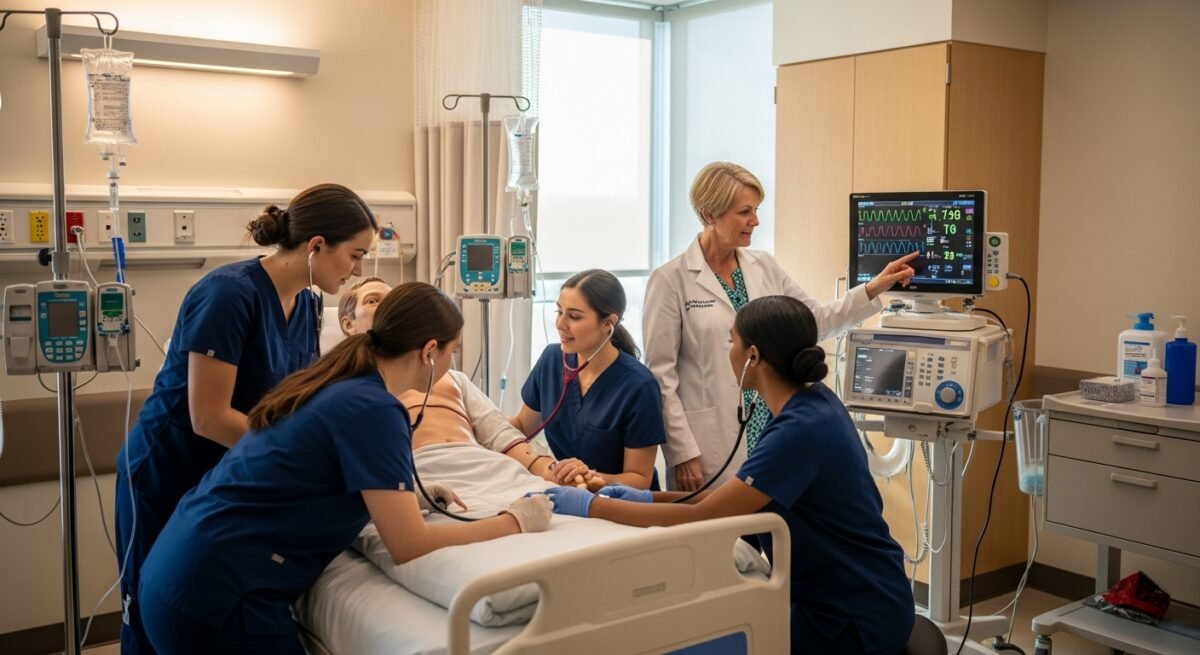
Modern clinical education is powerfully augmented by simulation-based learning. Outstanding programs invest significantly in high-fidelity simulation labs that replicate hospital rooms, ICU bays, and even home health environments with startling realism. These controlled settings allow students to practice high-risk, low-frequency procedures, manage deteriorating patient scenarios, and hone communication skills without any risk to actual patients. Simulation is not a replacement for live clinical hours but a vital complement that accelerates competency and builds confidence.
The effective use of this technology follows a deliberate structure. A typical simulation learning cycle includes several key steps designed to maximize educational outcomes.
- Pre-briefing: Students receive patient background and objectives, setting the stage for the scenario.
- Scenario Execution: Students engage with high-fidelity manikins or standardized actors, applying assessment and intervention skills in real time.
- Debriefing: This is the most critical phase. Facilitated by an expert instructor, students reflect on their performance, decisions, and team dynamics in a psychologically safe environment.
- Reinforcement: Key takeaways are documented and connected back to theoretical knowledge for future application.
This cyclical process turns experience into deep learning. Additionally, programs are increasingly utilizing virtual reality (VR) for specific training modules and electronic health record (EHR) systems identical to those used in partner hospitals, ensuring students are not just clinically proficient but also technologically fluent upon graduation.
Identifying and Selecting the Right Program for You
With an understanding of what constitutes excellence, the next step is evaluation and selection. Prospective students must become discerning researchers, looking beyond general rankings to specific indicators of clinical strength. Key factors to investigate include the program’s NCLEX-RN first-time pass rates, which are a baseline indicator of how well the curriculum prepares students for licensure. More importantly, delve into the details of clinical placements. Where do students go? For how long? What is the student-to-preceptor ratio on units?
Direct conversations with current students and alumni are invaluable. They can provide honest insights into the culture of the program, the supportiveness of faculty, and the true nature of the clinical experiences. When evaluating programs, whether at a university or a community college, focus on these concrete elements of the clinical curriculum.
- Partner Institution Prestige and Variety: Are placements at well-regarded hospitals, clinics, and community sites?
- Dedicated Clinical Coordination: Does the program have staff solely dedicated to securing and supporting quality placements?
- Preceptor Model: Does the program use a consistent preceptor model, allowing for longitudinal mentorship?
- Global or Unique Opportunities: Are there options for international clinical rotations or placements in unique settings like forensic nursing or telehealth?
- Career Support: What percentage of graduates have job offers at their clinical sites? What is the career center’s role?
Your search should also align with your personal career vision. If you are certain about a specialty like pediatrics or oncology, a program with strong affiliations in that area is crucial. If you are unsure, prioritize programs offering the broadest range of rotations. Remember, the goal is to find an environment where you will be challenged, supported, and inspired to reach your full potential as a clinical nurse.
The pursuit of a nursing education is a commitment to a lifetime of service and learning. Choosing a program with an outstanding clinical foundation is the first and most significant clinical decision you will make. It invests in your ability to think critically under pressure, to perform skillfully with compassion, and to adapt to the ever-evolving landscape of healthcare. By prioritizing deep clinical partnerships, integrated curricula, innovative simulation, and broad experiential learning, these programs do more than produce graduates, they launch resilient practitioners ready to deliver exceptional patient care and lead the profession forward. Your journey begins with choosing the right training ground.