
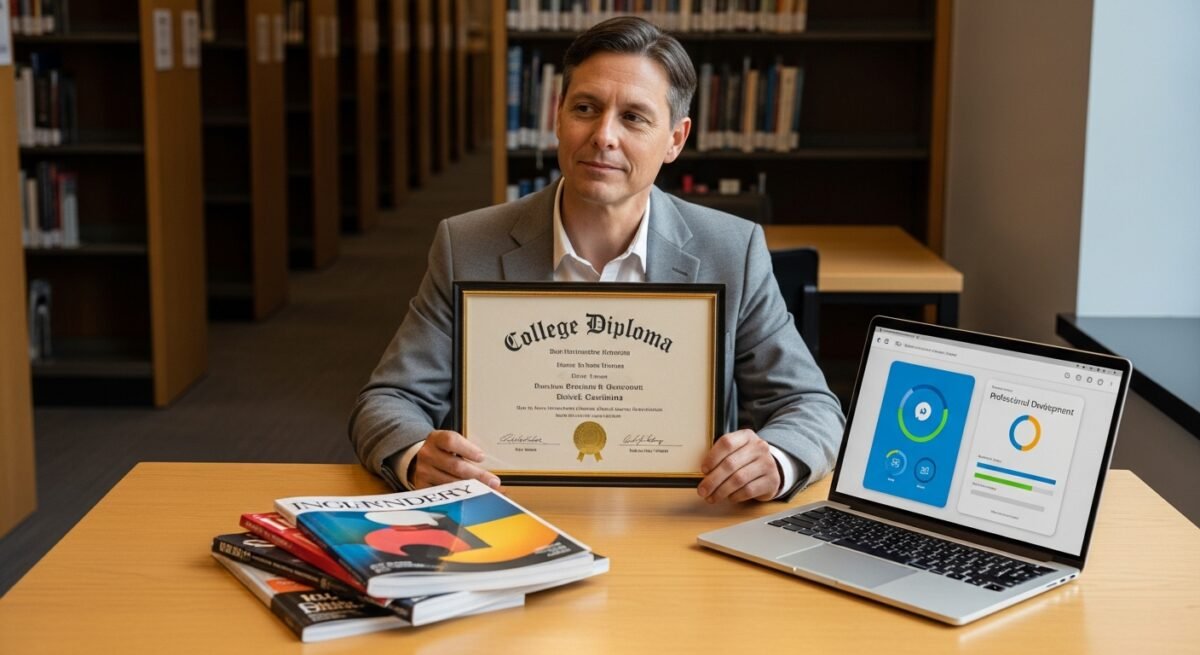
How Long Does a College Degree Stay Relevant?
A college degree’s value changes throughout your career. Learn proactive strategies to maintain its relevance and your competitive edge over time.

By Giovanna Rivera
You invested years of your life and significant resources into earning your college degree. It opened doors, qualified you for your first professional role, and served as a foundational credential. But as the years pass, a quiet question often emerges: is my degree still relevant? In a world where technology evolves at a breakneck pace and industries transform overnight, the concept of degree relevance over time is a critical consideration for every professional. The value of a degree is not static, it is a dynamic asset that can appreciate or depreciate based on how you manage your career and continuing education. Understanding this lifecycle is key to maintaining your competitive edge and ensuring your educational investment pays dividends for decades.
The Factors That Erode Degree Relevance
Degree relevance does not simply fade with age like an old photograph. Its decline is driven by specific, identifiable forces. The most powerful is technological disruption. Consider how artificial intelligence, automation, and data analytics have reshaped fields from marketing to manufacturing. A curriculum designed a decade ago likely did not comprehensively cover these tools, creating a knowledge gap for graduates who haven’t pursued further learning. Similarly, industry standards and best practices are in constant flux. Regulatory changes in healthcare, new building materials in engineering, or shifting pedagogical theories in education can render once-current knowledge obsolete.
Another major factor is the evolution of the job market itself. Entirely new roles emerge (e.g., UX designer, data scientist, cloud architect) that didn’t exist when many professionals were in school. These roles often require hybrid skill sets that blend traditional disciplines in novel ways. Furthermore, the core skills demanded within established professions change. Soft skills like complex problem-solving, adaptability, and emotional intelligence have surged in importance, often outstripping the weight placed on purely technical, degree-specific knowledge. This creates a scenario where the degree remains a necessary ticket for entry, but its ongoing relevance is contingent on the graduate’s ability to supplement it with contemporary, practical skills.
Strategies to Maintain and Enhance Your Degree’s Value
The good news is that degree relevance over time is largely within your control. Proactive professionals treat their degree not as an endpoint, but as the launchpad for a lifetime of learning. The most effective strategy is the deliberate pursuit of continuing education. This doesn’t always mean returning for another full degree. Targeted, flexible options often provide a better return on investment. Certificate programs, for instance, offer deep dives into specific, high-demand areas like cybersecurity, project management, or digital marketing. They can be completed in months rather than years and signal to employers an up-to-date skill set.
Professional development workshops, industry conferences, and online courses from platforms like Coursera or edX are excellent for filling knowledge gaps and staying abreast of trends. For some, a graduate degree becomes strategically valuable later in a career, providing advanced specialization or facilitating a pivot into leadership, research, or a new field. The choice depends on your career goals. Beyond formal education, cultivating a professional network is invaluable. Engaging with alumni associations, attending industry meetups, and connecting with mentors provides insights into emerging trends and opportunities that you won’t find in any textbook. Our analysis on how degree relevance by industry shapes career success explores this dynamic further, highlighting why a one-size-fits-all approach to continuing education fails.
To build a sustainable plan, consider the following actionable steps:
- Conduct an Annual Skills Audit: Honestly assess your current skills against job descriptions for your target role. Identify gaps in technical knowledge, software proficiency, or industry regulations.
- Set Learning Goals: Based on your audit, commit to one or two specific learning objectives each year. This could be mastering a new software, earning a certificate, or deeply understanding a new regulation.
- Diversify Your Learning Portfolio: Blend different formats. Read industry publications, listen to relevant podcasts, take a short online course, and attend one conference annually.
- Document and Showcase: Add new certifications to your LinkedIn profile and resume. Discuss your learnings in performance reviews to demonstrate initiative and commitment to growth.
The Lifespan of Relevance by Degree Field
The rate at which a degree’s relevance evolves varies dramatically across disciplines. Understanding your field’s typical lifecycle is crucial for planning. Degrees in fast-moving, technology-centric fields like computer science, information systems, and biotechnology face the most rapid relevance decay. The programming languages, frameworks, and lab techniques taught to undergraduates can become outdated within five to seven years. Professionals in these fields must engage in almost continuous learning to remain employable. Conversely, degrees in foundational disciplines like mathematics, philosophy, or the core sciences (physics, chemistry) often have remarkable longevity. The fundamental principles and critical thinking skills they impart are less susceptible to obsolescence, though their application in industry will still require updated technical knowledge.
Professional degrees such as law, medicine, and engineering occupy a middle ground. Their core ethical frameworks and foundational knowledge are enduring, but the practice itself is governed by constantly updated laws, medical protocols, and engineering standards. Here, relevance is maintained through mandatory continuing education units (CEUs) and licensure renewals. For example, a civil engineer must stay current on new seismic safety codes, just as a physician must learn about new treatment protocols. The degree grants the license to practice, but the professional is responsible for keeping that practice current. For broader guidance on navigating these educational pathways, academic program insights can be a valuable resource.
Frequently Asked Questions
Is a 20-year-old degree worthless?
No, it is not worthless. The degree itself still validates a level of discipline, foundational knowledge, and the ability to complete a rigorous program. It remains a key credential on your resume. However, relying solely on the knowledge gained 20 years ago without demonstrating subsequent learning or career achievement will hinder advancement. The value lies in combining the credential with an updated portfolio of skills and experience.
How do employers view older degrees?
Employers typically view the degree as a baseline requirement or a positive data point, especially if it’s from a reputable institution. Their primary focus, however, is on your most recent 5-10 years of experience, accomplishments, and demonstrable skills. They are looking for evidence that you have evolved with your field. An older degree paired with a history of promotions, relevant recent training, and tangible results is far more compelling than a recent degree with no practical application.
Should I go back to school for a new bachelor’s degree?
Rarely. A second bachelor’s degree is often inefficient in terms of time and cost. For a career change or major skill update, consider a master’s degree (which builds on your first degree), a post-baccalaureate certificate, or a bootcamp-style program focused on specific job-ready skills. These options are typically more targeted and respected by employers seeking advanced or updated qualifications.
Can experience completely replace degree relevance?
In some fields and roles, extensive, demonstrable experience can offset an outdated or unrelated degree. This is common in tech, sales, and creative industries where portfolios and proven results speak loudly. However, in many regulated professions (healthcare, law, public school teaching, engineering), the specific degree is a non-negotiable licensure requirement, and experience alone cannot substitute for it. Experience maintains the practical relevance of the degree but rarely replaces the credential itself where it is mandated.
What is the single best investment to maintain my degree’s value?
Cultivating a disciplined habit of lifelong learning. Allocate time and a budget annually for professional development. This consistent, incremental investment in updating your skills is more sustainable and impactful than periodic, panic-driven returns to academia. It shows proactive career management and ensures your knowledge base never becomes dangerously obsolete.
The journey of your degree does not end at graduation, it simply enters a new phase. By recognizing that degree relevance over time is a fluid concept, you empower yourself to take charge of it. The most successful professionals are not those with the newest degrees, but those who strategically combine their foundational education with continuous adaptation. They see learning as a career-long imperative, not a collegiate phase. This mindset transforms your degree from a static document into a living, growing foundation for enduring success. Your education is a legacy you continue to build upon, year after year.