
Music, General Bachelor's at CUNY York: 4-Year Guide
Explore the Music, General Bachelor's degree, usually 4 years In-person at CUNY York College, including admission steps, costs, and career outcomes.

By Emily Foster
Choosing a major is one of the most consequential decisions of your college career, and for students drawn to melody, rhythm, and performance, a general music degree offers a broad foundation that can lead to a surprising range of professional paths. The Music, General Bachelor's degree, usually 4 years In-person at CUNY York College, is a structured, affordable option for students in Queens and across New York City who want to study music within a liberal arts framework while staying close to home. This guide breaks down what the program covers, how to get in, what it costs, and where graduates land, so you can decide whether this in-person bachelor's pathway fits your goals.
What the General Music Bachelor's Degree Covers
A general music bachelor's degree is deliberately broad. Rather than forcing you into a single track like performance, composition, or music education from day one, the general concentration lets you sample the full discipline: theory, history, musicianship, and applied study. At CUNY York College, that breadth is an asset for students who love music but are not yet certain whether they want to teach, perform, produce, or work in arts administration.
Most programs in this category blend a core of music theory and aural skills with survey courses in Western and global music history. You will typically take private or group lessons on your principal instrument or voice, participate in ensembles, and complete at least one capstone or recital project. Because the degree sits inside a liberal arts college, roughly a third to a half of your credits will come from general education requirements in writing, math, science, and the humanities. That balance is intentional: it produces graduates who can analyze a score and write a grant proposal.
Students comparing this program to a conservatory should understand the tradeoff. A conservatory offers more hours of intensive practice and fewer outside requirements. A general music bachelor's at a college like York offers flexibility and a broader academic base, which is often better for double majors, transfer students, and anyone planning to work in schools, community organizations, or business roles adjacent to music. If you are still mapping out how a liberal arts degree connects to jobs, our guide to the Psychology, General Bachelor's at Benedict College shows a similar broad-degree logic in another field and is worth reading for comparison.
Why the In-Person Format at CUNY York College Matters
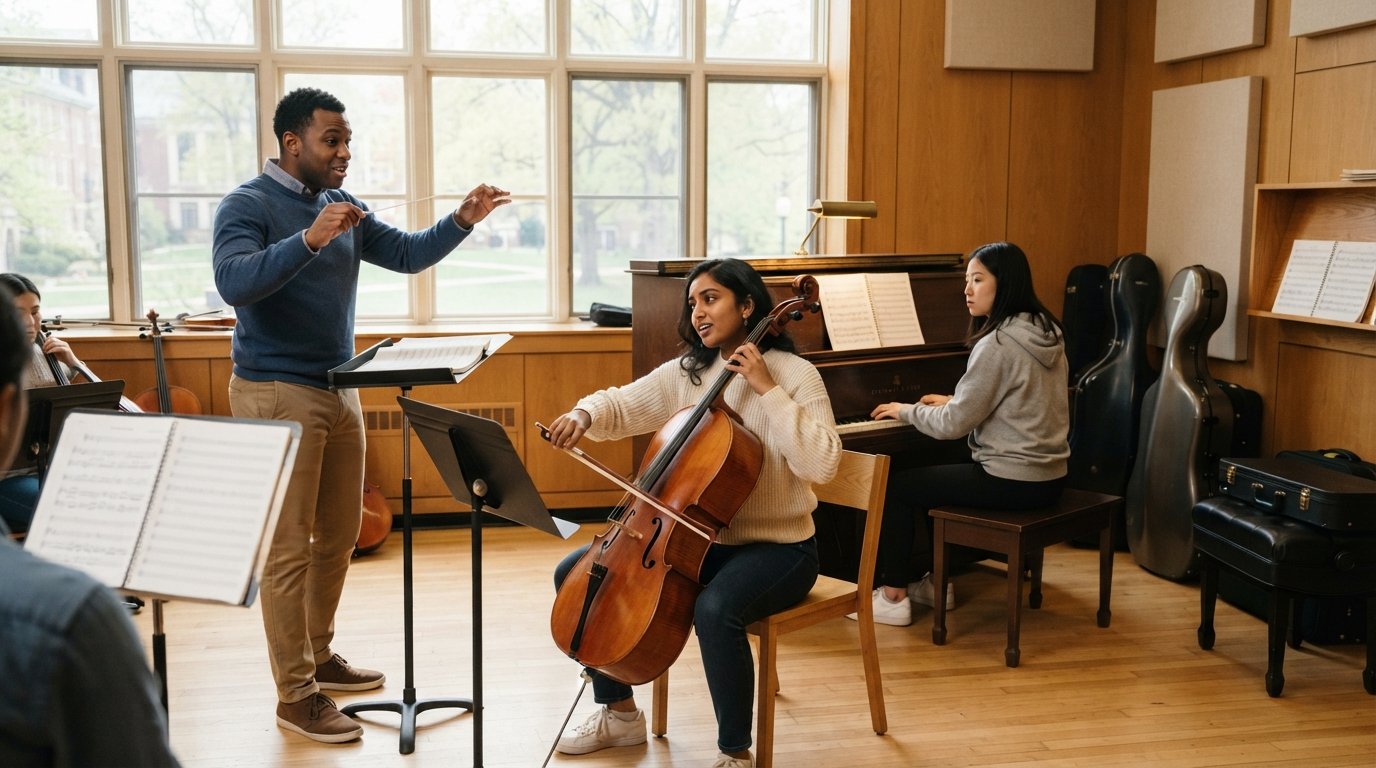
Music is a collaborative discipline. The in-person format at CUNY York College is not a bureaucratic detail; it shapes nearly everything about how you learn. Rehearsals, sectionals, studio lessons, and jam sessions depend on being in the same room, reading each other's cues, and responding in real time. Online music degrees exist, but they tend to emphasize production software and music business coursework rather than live performance and ensemble musicianship.
Studying on campus in Jamaica, Queens also plugs you into New York City's music ecosystem. York College sits within reach of venues, churches with active music ministries, community theaters, and school music programs that frequently need accompanists, section players, and teaching assistants. Faculty members who are active performers and educators can open doors that a remote program simply cannot. For students who thrive on structure and face-to-face mentorship, the in-person model is a strong fit.
The four-year timeline is standard for this degree, though the actual pace depends on your preparation. Students who enter with transfer credits, AP Music Theory, or strong placement exam scores may finish in three and a half years. Students who need developmental coursework in math or writing, or who switch majors late, may take longer. Planning your sequence with an advisor in your first semester is the single best way to stay on the four-year track.
Admission Requirements and Application Steps
CUNY York College admits students through the City University of New York's centralized application, and the music program generally expects applicants to demonstrate prior musical involvement. That does not mean you need to be a virtuoso. Many successful students arrive with high school band, choir, church music, or self-taught experience. What matters is evidence of genuine interest and readiness for college-level theory coursework.
Here is a practical sequence for applying to this Music, General Bachelor's degree, usually 4 years In-person at CUNY York College:
- Complete the CUNY application by the published deadline and list York College and the music major among your choices.
- Submit your high school transcript or equivalency, plus any college transcripts if you are a transfer student.
- Prepare for a placement evaluation or audition if the department requests one; ask the music office directly what is required for your entry term.
- File the FAFSA and any New York State aid applications early, since aid packages influence enrollment decisions.
- Attend an information session or meet with a music faculty advisor to map your first-year courses.
Transfer students should pay particular attention to how theory and ensemble credits will transfer. Music theory sequences are cumulative, and a partial transfer can leave gaps that slow your progress. Bring course descriptions and syllabi to your advising appointment so the department can evaluate equivalencies accurately. Applicants with international credentials should allow extra time for transcript evaluation.
Cost, Financial Aid, and Scholarship Strategy
CUNY senior colleges are among the most affordable four-year options in the country, particularly for New York State residents. Tuition for in-state undergraduates is a fraction of what private conservatories charge, and the in-person format means you can potentially live at home and commute, cutting housing costs dramatically. That combination makes the Music, General Bachelor's degree, usually 4 years In-person at CUNY York College, one of the better value propositions in music higher education.
Still, affordability is not automatic. Books, instrument maintenance, private lesson fees in some cases, recital expenses, and transportation add up. Students should pursue every aid source available:
- Federal Pell Grants and New York State TAP awards for eligible students
- Merit scholarships offered through the college and the music department
- External scholarships from community music organizations, churches, and arts councils
- Work-study positions in the music office, library, or ensemble programs
External scholarship databases can multiply your options quickly. Services such as Scholarship.Education help students discover and evaluate financial aid opportunities across the US, UK, Canada, Australia, and the EU, which is especially useful if you are considering summer study abroad or graduate funding later. Apply to several small awards rather than one large one; the odds are often better, and the essay prompts overlap.
Curriculum Highlights and Skills You Will Build
The general music curriculum is built around a theory core that typically spans four semesters, moving from fundamentals through chromatic harmony and analysis. Alongside theory, you will develop aural skills through sight-singing and dictation, which trains your ear to identify intervals, chords, and progressions by sound. These skills are the backbone of everything else, from arranging to teaching to producing.
History and literature courses place music in cultural context, covering Western art music, jazz, and global traditions. Applied study, usually individual lessons with a faculty specialist, develops technique on your instrument or voice. Ensembles, whether choir, band, or chamber groups, provide weekly collaborative performance experience. Many students also complete a senior project that combines research and performance, which becomes a portfolio piece for graduate school or job applications.
Beyond musicianship, the degree builds transferable skills employers consistently request: disciplined practice habits, critical listening, written communication, teamwork under pressure, and the ability to give and receive feedback. These competencies matter in classrooms, studios, arts nonprofits, and corporate training departments alike.
Career Outcomes and Earning Potential
Graduates with a general music bachelor's pursue a wider range of roles than most people expect. The degree is a common entry point for K-12 music teaching, though public school teaching in New York typically requires a master's degree within a set number of years and state certification. Other graduates move into private studio teaching, church music direction, arts administration, music retail and instrument sales, audio production support, and community arts programming.
Earnings vary widely by role and region. Music teachers in public schools generally earn salaries comparable to other teachers, with step increases and benefits. Private instructors set their own rates and can build substantial income with a full studio. Arts administrators and production staff earn salaries that depend heavily on the organization's size. Many musicians combine several income streams, which is why the broad foundation of a general degree is practical: it does not lock you into one lane.
Students planning to teach, perform at a high level, or move into music therapy should plan on graduate study. A master's in music education, performance, or a related field expands both credentials and salary ceilings. The four-year bachelor's is the launchpad, not the finish line.
Is This Program Right for You?
The Music, General Bachelor's degree, usually 4 years In-person at CUNY York College, fits students who want serious musical training without the singular focus of a conservatory, who value affordability and proximity to New York City's cultural life, and who learn best in hands-on, face-to-face settings. It is less ideal for students who need fully online flexibility or who already have elite performance credentials and want a conservatory-intensive track.
Before committing, visit campus, sit in on an ensemble rehearsal if possible, and speak with current students about workload and faculty accessibility. Ask about ensemble audition policies, lesson fees, practice room access, and recital requirements. Those practical details shape your day-to-day experience as much as the course catalog does. If you are comparing multiple majors, use a simple decision framework: list your top three career directions, identify which degree keeps the most doors open, and check the four-year cost at each school.
For students in Queens and the surrounding boroughs, this program offers a realistic, affordable route to a music career or to graduate study, with the energy of the city as a built-in laboratory. Take the application deadlines seriously, line up your financial aid early, and start the conversation with the music department as soon as you are admitted. A well-planned four years here can set you up for teaching, performance, or any number of music-adjacent professions.