
What Makes a Superior School of Nursing Curriculum
A superior school of nursing curriculum prepares graduates for real-world clinical challenges, blending rigorous science with hands-on practice and essential skills like leadership and informatics.

By Stacy Cignetti
Choosing the right nursing school is one of the most consequential decisions an aspiring healthcare professional will make. While factors like location, cost, and school reputation are important, the heart of any nursing program is its curriculum. A superior school of nursing curriculum is far more than a list of required courses. It is a meticulously designed educational blueprint that balances rigorous science with compassionate art, theoretical knowledge with hands-on skill, and foundational principles with innovative thinking. In today’s rapidly evolving healthcare landscape, where technology, patient demographics, and treatment modalities are constantly shifting, the curriculum is the engine that prepares nurses not just to pass the NCLEX, but to thrive in complex clinical environments, lead teams, and provide exceptional, holistic patient care from day one.
The Core Pillars of an Outstanding Nursing Curriculum
A truly effective nursing curriculum is built upon several foundational pillars that work in concert. The first and most visible is a robust and up-to-date science foundation. This goes beyond the standard anatomy, physiology, microbiology, and pharmacology. A superior curriculum integrates pathophysiology in a way that connects disease processes directly to nursing assessment and intervention. It incorporates genetics, nutrition, and advanced pharmacology to prepare nurses for personalized medicine. The sciences are not taught in isolation, but are immediately and consistently linked to nursing practice, answering the perennial student question, “Why do I need to know this?”
The second pillar is comprehensive clinical integration. Theory taught in the classroom must be seamlessly connected to practice in clinical settings. A superior curriculum structures this integration intentionally, often through a concept-based or competency-based approach. Students don’t just “do” pediatrics one semester and mental health the next, they learn core concepts, like gas exchange, perfusion, or coping, and apply them across the lifespan and across care settings. This method promotes deeper learning and clinical judgment, the ability to notice, interpret, and respond appropriately to patient cues. Clinical placements are diverse, moving beyond traditional hospital medical-surgical units to include community health centers, public health departments, schools, outpatient clinics, and simulation labs that replicate high-risk, low-frequency scenarios.
Third, a forward-thinking curriculum embeds essential threads throughout every course. These are the non-clinical competencies that define modern nursing excellence.
- Evidence-Based Practice (EBP): Students are taught not just to follow protocol, but to read, critique, and apply nursing research to improve patient outcomes.
- Health Informatics and Technology: Proficiency with Electronic Health Records (EHRs), telehealth platforms, and patient monitoring technology is no longer optional.
- Leadership and Systems Thinking: From bedside shift reports to quality improvement projects, nurses are prepared to see the bigger picture of healthcare delivery and their role within it.
- Cultural Humility and Social Determinants of Health: Curriculum content addresses implicit bias, health disparities, and the social, economic, and environmental factors that profoundly impact patient health.
- Communication and Interprofessional Collaboration: Students practice communicating with patients, families, and other healthcare professionals (doctors, therapists, social workers) to ensure safe, coordinated care.
Progressive Structure: From Novice to Advanced Beginner
The sequencing of a nursing curriculum is a science in itself. A superior design follows a logical, progressive scaffold that respects the cognitive and emotional development of the student nurse. The typical structure moves from simple to complex, from stable to unpredictable.
The first year, or pre-licensure core, often focuses on foundational health concepts, basic nursing skills, and care of the adult patient with common health alterations. This is where students learn essential psychomotor skills (assessment, medication administration, wound care) in lab settings before performing them on real patients. The emphasis is on safety, accuracy, and building confidence. Concurrently, students are introduced to the nursing process (assessment, diagnosis, planning, implementation, evaluation) as their fundamental critical thinking framework.
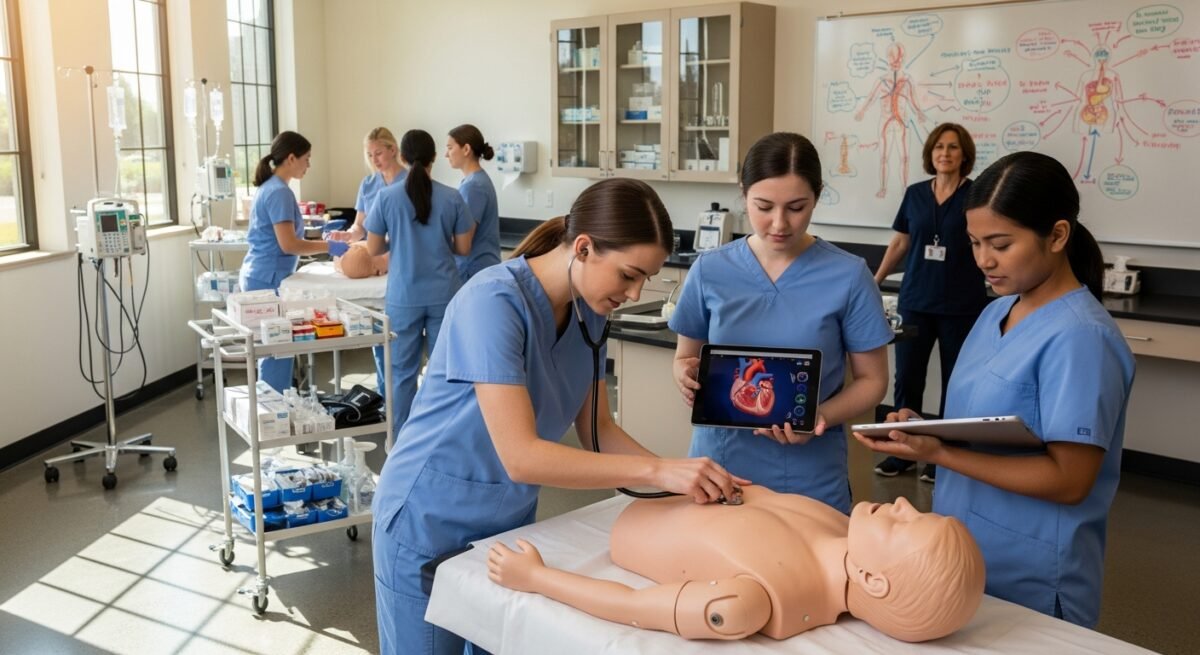
As the program progresses, the complexity ramps up significantly. Students advance to caring for specialized populations: children, childbearing families, psychiatric-mental health patients, and critically ill adults. The curriculum challenges them to manage multiple patients, prioritize care, delegate tasks appropriately (to nursing assistants, for example), and navigate ethical dilemmas. At this stage, simulation plays a crucial role. High-fidelity manikins that mimic physiological responses allow students to manage a deteriorating patient, run a “code,” or handle a difficult family conversation in a risk-free environment, receiving immediate feedback on their clinical judgment and teamwork.
The final sequence is a synthesis and transition to practice. This often involves an intensive preceptorship or capstone experience, where a student is paired one-on-one with an experienced RN in a specific unit, functioning at a near-graduate level of independence. The curriculum supports this transition with courses focused on NCLEX-RN preparation, professional role development, resume writing, and job interview skills. The goal is to bridge the infamous “practice gap,” ensuring the graduate feels prepared for the realities and responsibilities of a registered nurse.
Beyond the BSN: Curriculum Considerations for Advanced Paths
For many nurses, the initial pre-licensure curriculum is just the beginning. A superior school of nursing often houses graduate programs whose curricula are equally rigorous and specialized. A Master of Science in Nursing (MSN) curriculum for Advanced Practice Registered Nurses (APRNs), such as Nurse Practitioners or Nurse Anesthetists, delves deep into advanced pathophysiology, pharmacology, and physical assessment. It includes hundreds of required clinical hours focused on diagnosis and management. The curriculum is tightly aligned with national certification standards and scope of practice laws.
Doctor of Nursing Practice (DNP) curricula take this a step further, emphasizing leadership, healthcare policy, quality improvement science, and advanced evidence-based practice implementation. These programs are designed for nurses who will lead systemic change, whether as administrators, clinical directors, or policy advocates. Meanwhile, PhD in Nursing curricula focus intensely on research methodology, statistics, and theory development, preparing the next generation of nurse scientists to generate the knowledge that will inform future practice. The hallmark of a superior institution is a curriculum that creates clear, articulated pathways, allowing nurses to see how they can advance from an ADN to a BSN to a master’s or doctorate, often with streamlined admission and credit transfer.
Evaluating a Program: Key Questions to Ask
Prospective students must be proactive evaluators of any nursing curriculum. Looking beyond marketing brochures to the substance of the program is critical. Here are key areas to investigate.
First, examine the program’s outcomes. Ask for their NCLEX-RN first-time pass rates for the past several years. A consistently high pass rate (well above the national average) is a strong, objective indicator of a curriculum’s effectiveness in preparing students for the licensure exam. Also, inquire about graduation rates and job placement rates for recent cohorts. Second, scrutinize the faculty. Who is teaching the courses? A blend of seasoned PhD-prepared nurse educators and current clinical practitioners brings both academic depth and real-world relevance to the curriculum. Faculty engagement in research, clinical practice, or professional organizations is a positive sign.
Third, assess the learning resources and technology. Does the school have a modern simulation center? How extensive are their clinical partnership networks? Is the curriculum delivered using an up-to-date online learning management system that facilitates interaction and access to resources? Fourth, seek insights from current students and alumni. They can provide unfiltered perspectives on the curriculum’s workload, support systems, and its real-world preparation. Finally, ensure the program holds proper accreditation from either the Commission on Collegiate Nursing Education (CCNE) or the Accreditation Commission for Education in Nursing (ACEN). Accreditation is a non-negotiable seal of quality, affirming that the curriculum meets rigorous national standards for nursing education.
In essence, a superior school of nursing curriculum is a dynamic, responsive, and holistic educational journey. It is the defining factor that transforms a student into a safe, competent, compassionate, and resilient nurse. It provides not just the knowledge to treat illness, but the wisdom to care for human beings. By choosing a program with such a curriculum, aspiring nurses invest in a foundation that will support a lifetime of learning, leadership, and meaningful impact at the bedside and beyond.